
前列腺特异性抗原最低点作为放疗失败后全腺挽救性高强度聚焦超声治疗后生化无病生存期和总生存期的预测因素。
PSA nadir as a predictive factor for biochemical disease-free survival and overall survival following whole-gland salvage HIFU following radiotherapy failure.
作者信息
Shah T T, Peters M, Kanthabalan A, McCartan N, Fatola Y, van der Voort van Zyp J, van Vulpen M, Freeman A, Moore C M, Arya M, Emberton M, Ahmed H U
机构信息
Division of Surgery and Interventional Science, UCL, London, UK.
Department of Urology, Whittington Hospital NHS Trust, London, UK.
出版信息
Prostate Cancer Prostatic Dis. 2016 Sep;19(3):311-6. doi: 10.1038/pcan.2016.23. Epub 2016 Jul 19.
BACKGROUND
Treatment options for radio-recurrent prostate cancer are either androgen-deprivation therapy or salvage prostatectomy. Whole-gland high-intensity focussed ultrasound (HIFU) might have a role in this setting.
METHODS
An independent HIFU registry collated consecutive cases of HIFU. Between 2005 and 2012, we identified 50 men who underwent whole-gland HIFU following histological confirmation of localised disease following prior external beam radiotherapy (2005-2012). No upper threshold was applied for risk category, PSA or Gleason grade either at presentation or at the time of failure. Progression was defined as a composite with biochemical failure (Phoenix criteria (PSA>nadir+2 ng ml(-1))), start of systemic therapies or metastases.
RESULTS
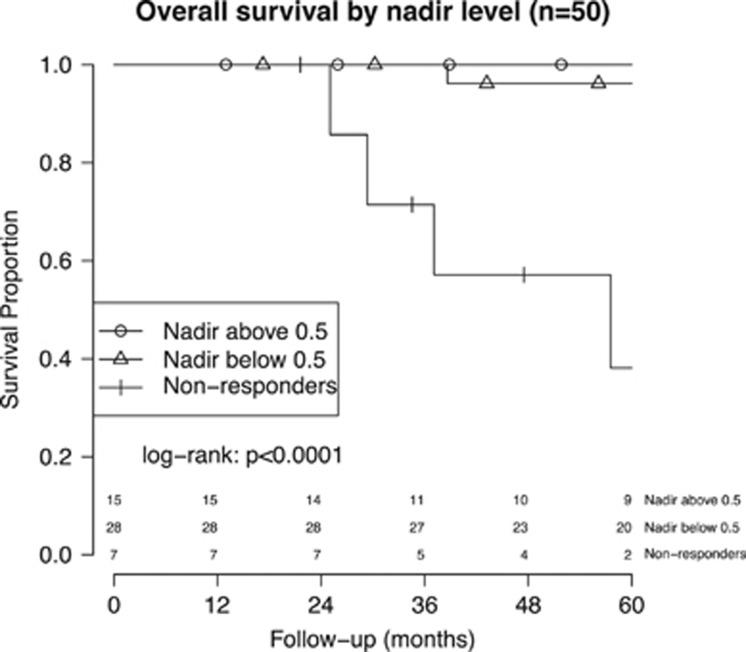
Median age (interquartile range (IQR)), pretreatment PSA (IQR) and Gleason score (range) were 68 years (64-72), 5.9 ng ml(-1) (2.2-11.3) and 7 (6-9), respectively. Median follow-up was 64 months (49-84). In all, 24/50 (48%) avoided androgen-deprivation therapies. Also, a total of 28/50 (56%) achieved a PSA nadir <0.5 ng ml(-1), 15/50 (30%) had a nadir ⩾0.5 ng ml(-1) and 7/50 (14%) did not nadir (PSA non-responders). Actuarial 1, 3 and 5-year progression-free survival (PFS) was 72, 40 and 31%, respectively. Actuarial 1, 3 and 5-year overall survival (OS) was 100, 94 and 87%, respectively. When comparing patients with PSA nadir <0.5 ng ml(-1), nadir ⩾0.5 and non-responders, a statistically significant difference in PFS was seen (P<0.0001). Three-year PFS in each group was 57, 20 and 0%, respectively. Five-year OS was 96, 100 and 38%, respectively. Early in the learning curve, between 2005 and 2007, 3/50 (6%) developed a fistula. Intervention for bladder outlet obstruction was needed in 27/50 (54%). Patient-reported outcome measure questionnaires showed incontinence (any pad-use) as 8/26 (31%).
CONCLUSIONS
In our series of high-risk patients, in whom 30-50% may have micro-metastases, disease control rates were promising in PSA responders, however, with significant morbidity. Additionally, post-HIFU PSA nadir appears to be an important predictor for both progression and survival. Further research on focal salvage ablation in order to reduce toxicity while retaining disease control rates is required.
背景
放射性复发前列腺癌的治疗选择包括雄激素剥夺疗法或挽救性前列腺切除术。全腺体高强度聚焦超声(HIFU)在这种情况下可能发挥作用。
方法
一个独立的HIFU登记处整理了连续的HIFU病例。在2005年至2012年期间,我们确定了50名男性,他们在先前的外照射放疗(2005 - 2012年)后经组织学证实为局限性疾病,随后接受了全腺体HIFU治疗。在就诊时或失败时,对风险类别、前列腺特异性抗原(PSA)或 Gleason分级均未设置上限。进展被定义为生化失败(凤凰标准(PSA>最低点 + 2 ng/ml(-1)))、开始全身治疗或转移的综合情况。
结果
中位年龄(四分位间距(IQR))、治疗前PSA(IQR)和Gleason评分(范围)分别为68岁(64 - 72岁)、5.9 ng/ml(-1)(2.2 - 11.3)和7(6 - 9)。中位随访时间为64个月(49 - 84个月)。总共24/50(48%)的患者避免了雄激素剥夺疗法。此外,共有28/50(56%)的患者PSA最低点<0.5 ng/ml(-1),15/50(30%)的患者最低点⩾0.5 ng/ml(-1),7/50(14%)的患者未出现最低点(PSA无反应者)。精算1年、3年和5年无进展生存率(PFS)分别为72%、40%和31%。精算1年、3年和5年总生存率(OS)分别为100%、94%和87%。当比较PSA最低点<0.5 ng/ml(-1)、最低点⩾0.5 ng/ml(-1)和无反应者的患者时,观察到PFS存在统计学显著差异(P<0.0001)。每组的3年PFS分别为57%、20%和0%。5年OS分别为96%、100%和38%。在学习曲线早期,即2005年至2007年期间,3/50(6%)的患者发生了瘘管。50名患者中有27名(54%)需要对膀胱出口梗阻进行干预。患者报告结局测量问卷显示尿失禁(任何垫使用情况)为8/26(31%)。
结论
在我们这组高危患者中,30 - 50%可能存在微转移,PSA反应者的疾病控制率很有前景,但存在明显的发病率。此外,HIFU治疗后的PSA最低点似乎是进展和生存的重要预测指标。需要进一步研究局部挽救性消融,以在保持疾病控制率的同时降低毒性。


 Zotero 插件