Brunner Andrew M, Li Shuli, Fathi Amir T, Wadleigh Martha, Ho Vincent T, Collier Kerry, Connolly Christine, Ballen Karen K, Cutler Corey S, Dey Bimalangshu R, El-Jawahri Areej, Nikiforow Sarah, McAfee Steven L, Koreth John, Deangelo Daniel J, Alyea Edwin P, Antin Joseph H, Spitzer Thomas R, Stone Richard M, Soiffer Robert J, Chen Yi-Bin
Massachusetts General Hospital, Boston, MA, USA.
Dana-Farber Cancer Institute, Boston, MA, USA.
Br J Haematol. 2016 Nov;175(3):496-504. doi: 10.1111/bjh.14260. Epub 2016 Jul 19.
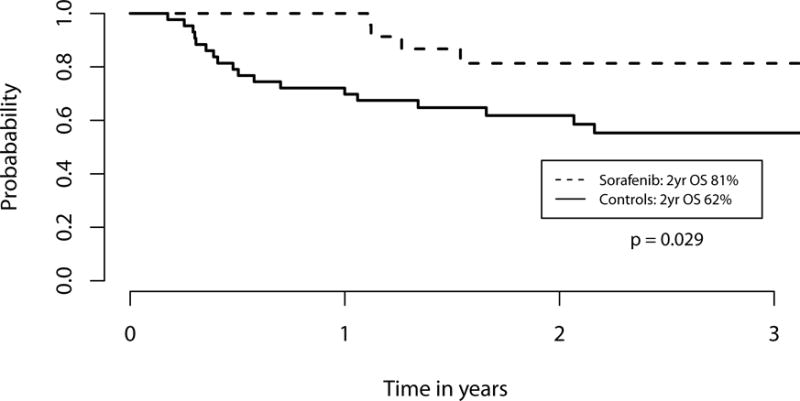
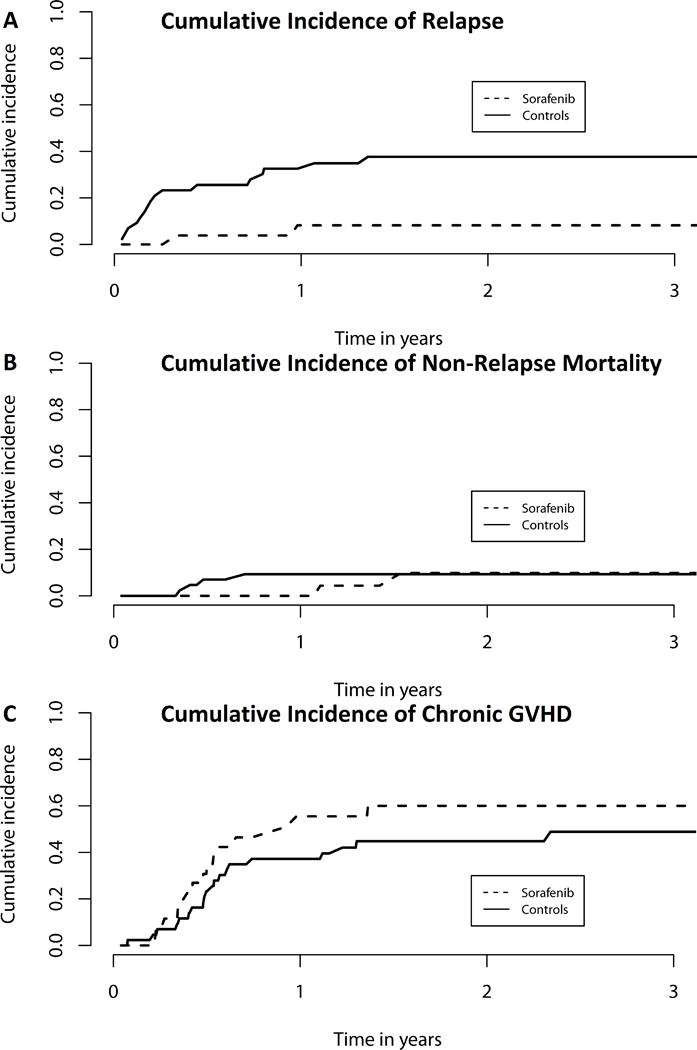
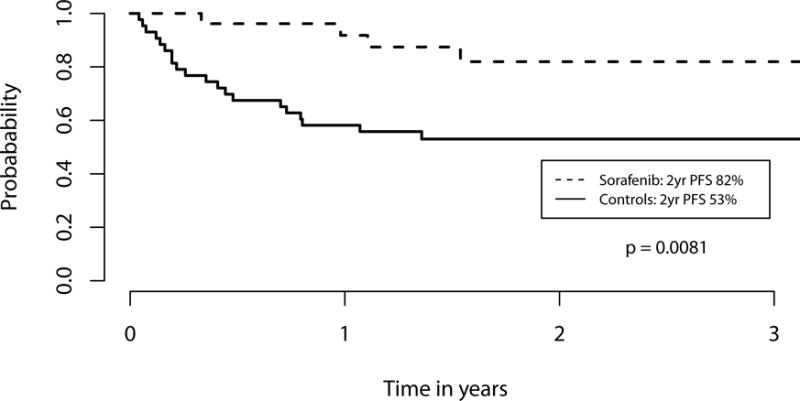
We performed a retrospective study analysing the effect of sorafenib, an oral fms-Like Tyrosine Kinase 3 (FLT3)/multikinase inhibitor, as post-transplant maintenance in adult patients with FLT3-internal tandem duplication (ITD) acute myeloid leukaemia (AML). We identified consecutive patients with FLT3-ITD AML diagnosed between 2008 and 2014 who received haematopoietic cell transplantation (HCT) in first complete remission (CR1). Post-HCT initiation of sorafenib (yes/no) was evaluated as a time-varying covariate in the overall survival/progression-free survival (OS/PFS) analysis and we performed a landmark analysis of controls alive without relapse at the median date of sorafenib initiation. We identified 26 sorafenib patients and 55 controls. Median follow-up was 27·2 months post-HCT for sorafenib survivors, and 38·4 months for controls (P = 0·021). The median time to initiating sorafenib was 68 days post-HCT; 43 controls were alive without relapse at this cut-off. Sorafenib patients had improved 2-year OS in the d+68 landmark analysis (81% vs. 62%, P = 0·029). Sorafenib was associated with improved 2-year PFS (82% vs. 53%, P = 0·0081) and lower 2-year cumulative incidence of relapse (8·2% vs. 37·7%, P = 0·0077). In multivariate analysis, sorafenib significantly improved OS [Hazard ratio (HR) 0·26, P = 0·021] and PFS (HR 0·25, P = 0·016). There was no difference in 2-year non-relapse mortality (9·8% vs. 9·3%, P = 0·82) or 1-year chronic graft-versus-host disease (55·5% vs. 37·2%, P = 0·28). These findings suggest potential benefit of post-HCT sorafenib in FLT3-ITD AML, and support further evaluation of post-HCT FLT3 inhibition.
我们进行了一项回顾性研究,分析口服fms样酪氨酸激酶3(FLT3)/多激酶抑制剂索拉非尼作为移植后维持治疗对伴有FLT3内部串联重复(ITD)的成年急性髓系白血病(AML)患者的疗效。我们纳入了2008年至2014年间确诊为FLT3-ITD AML且在首次完全缓解(CR1)时接受造血细胞移植(HCT)的连续患者。在总生存/无进展生存(OS/PFS)分析中,将移植后索拉非尼的起始情况(是/否)作为一个随时间变化的协变量进行评估,并且我们对在索拉非尼起始的中位日期时未复发存活的对照组进行了里程碑分析。我们确定了26例使用索拉非尼的患者和55例对照组。索拉非尼组患者移植后的中位随访时间为27.2个月,对照组为38.4个月(P = 0.021)。开始使用索拉非尼的中位时间为移植后68天;在这个时间点,43例对照组患者未复发存活。在d+68里程碑分析中,索拉非尼组患者的2年总生存率有所提高(81%对62%,P = 0.029)。索拉非尼与2年无进展生存率的提高(82%对53%,P = 0.0081)以及2年累积复发率的降低(8.2%对37.7%,P = 0.0077)相关。在多变量分析中,索拉非尼显著提高了总生存率[风险比(HR)0.26,P = 0.021]和无进展生存率(HR 0.25,P = 0.016)。2年非复发死亡率(9.8%对9.3%,P = 0.82)或1年慢性移植物抗宿主病(55.5%对37.2%,P = 0.28)没有差异。这些发现表明移植后使用索拉非尼对FLT3-ITD AML可能有益,并支持对移植后FLT3抑制进行进一步评估。