Poissonnier Amanda, Sanséau Doriane, Le Gallo Matthieu, Malleter Marine, Levoin Nicolas, Viel Roselyne, Morere Lucie, Penna Aubin, Blanco Patrick, Dupuy Alain, Poizeau Florence, Fautrel Alain, Seneschal Julien, Jouan Florence, Ritz Jerome, Forcade Edouard, Rioux Nathalie, Contin-Bordes Cécile, Ducret Thomas, Vacher Anne-Marie, Barrow Paul A, Flynn Robin J, Vacher Pierre, Legembre Patrick
Centre Eugène Marquis, Rue Bataille Flandres Dunkerque, 35042 Rennes, France; INSERM ERL440-OSS, Equipe Labellisée, Ligue Contre Le Cancer, 35042 Rennes, France; Université de Rennes 1, 2 Ave. du Prof. Léon Bernard, 35043 Rennes, France.
Centre Eugène Marquis, Rue Bataille Flandres Dunkerque, 35042 Rennes, France; INSERM ERL440-OSS, Equipe Labellisée, Ligue Contre Le Cancer, 35042 Rennes, France; Université de Rennes 1, 2 Ave. du Prof. Léon Bernard, 35043 Rennes, France; Biosit, Plateforme H2P2, Biogenouest, 2 Ave. du Prof. Léon Bernard, 35043 Rennes, France.
Immunity. 2016 Jul 19;45(1):209-23. doi: 10.1016/j.immuni.2016.06.028.
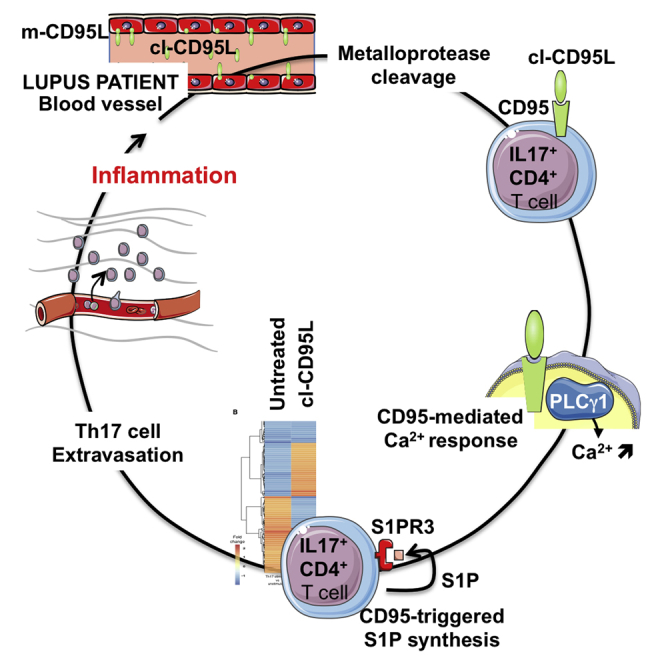
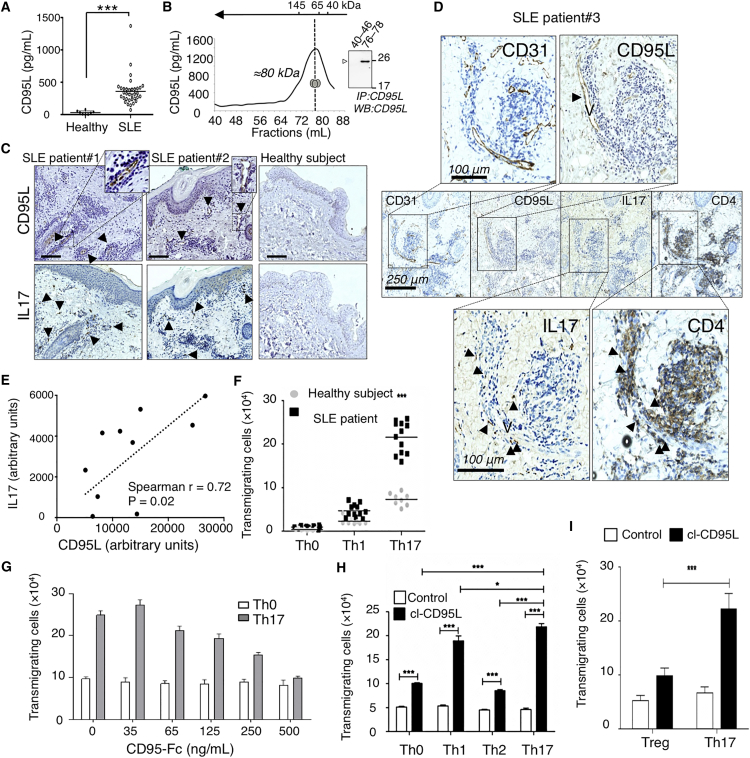
CD95 ligand (CD95L) is expressed by immune cells and triggers apoptotic death. Metalloprotease-cleaved CD95L (cl-CD95L) is released into the bloodstream but does not trigger apoptotic signaling. Hence, the pathophysiological role of cl-CD95L remains unclear. We observed that skin-derived endothelial cells from systemic lupus erythematosus (SLE) patients expressed CD95L and that after cleavage, cl-CD95L promoted T helper 17 (Th17) lymphocyte transmigration across the endothelial barrier at the expense of T regulatory cells. T cell migration relied on a direct interaction between the CD95 domain called calcium-inducing domain (CID) and the Src homology 3 domain of phospholipase Cγ1. Th17 cells stimulated with cl-CD95L produced sphingosine-1-phosphate (S1P), which promoted endothelial transmigration by activating the S1P receptor 3. We generated a cell-penetrating CID peptide that prevented Th17 cell transmigration and alleviated clinical symptoms in lupus mice. Therefore, neutralizing the CD95 non-apoptotic signaling pathway could be an attractive therapeutic approach for SLE treatment.
CD95配体(CD95L)由免疫细胞表达并引发凋亡性死亡。金属蛋白酶切割后的CD95L(cl-CD95L)释放到血液中,但不触发凋亡信号。因此,cl-CD95L的病理生理作用仍不清楚。我们观察到,系统性红斑狼疮(SLE)患者皮肤来源的内皮细胞表达CD95L,切割后,cl-CD95L以调节性T细胞为代价促进辅助性T细胞17(Th17)淋巴细胞穿过内皮屏障。T细胞迁移依赖于名为钙诱导结构域(CID)的CD95结构域与磷脂酶Cγ1的Src同源3结构域之间的直接相互作用。用cl-CD95L刺激的Th17细胞产生鞘氨醇-1-磷酸(S1P),其通过激活S1P受体3促进内皮迁移。我们生成了一种细胞穿透性CID肽,可阻止Th17细胞迁移并减轻狼疮小鼠的临床症状。因此,中和CD95非凋亡信号通路可能是一种有吸引力的SLE治疗方法。