Alsalem Mohammad, Millns Paul, Altarifi Ahmad, El-Salem Khalid, Chapman Victoria, Kendall David A
Department of Anatomy and Histology, Faculty of Medicine, The University of Jordan, Amman, 11942, Jordan.
School of Life Sciences, University of Nottingham, Queen's Medical Centre, Nottingham, NG7 2UH, UK.
BMC Pharmacol Toxicol. 2016 Jul 21;17(1):31. doi: 10.1186/s40360-016-0074-9.
Olvanil (NE 19550) is a non-pungent synthetic analogue of capsaicin, the natural pungent ingredient of capsicum which activates the transient receptor potential vanilloid type-1 (TRPV1) channel and was developed as a potential analgesic compound. Olvanil has potent anti-hyperalgesic effects in several experimental models of chronic pain. Here we report the inhibitory effects of olvanil on nociceptive processing using cultured dorsal root ganglion (DRG) neurons and compare the effects of capsaicin and olvanil on thermal nociceptive processing in vivo; potential contributions of the cannabinoid CB1 receptor to olvanil's anti-hyperalgesic effects were also investigated.
A hot plate analgesia meter was used to evaluate the anti-nociceptive effects of olvanil on capsaicin-induced thermal hyperalgesia and the role played by CB1 receptors in mediating these effects. Single cell calcium imaging studies of DRG neurons were employed to determine the desensitizing effects of olvanil on capsaicin-evoked calcium responses. Statistical analysis used Student's t test or one way ANOVA followed by Dunnett's post-hoc test as appropriate.
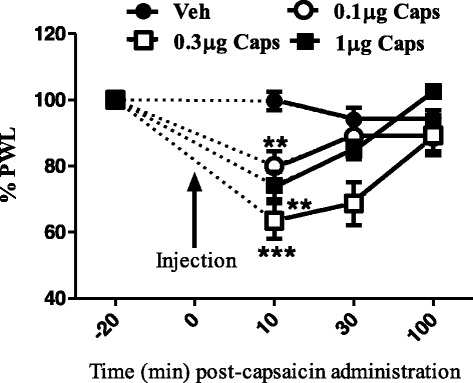
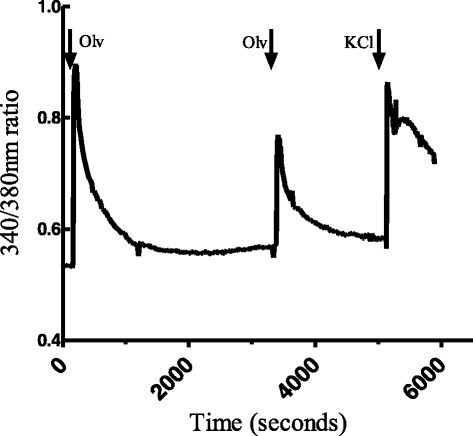
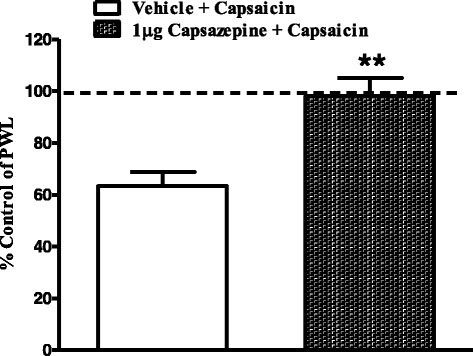
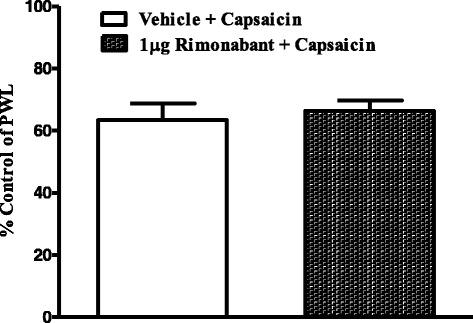
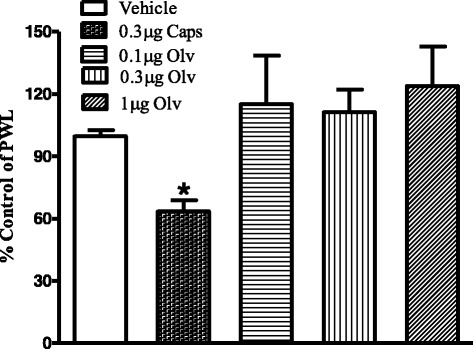
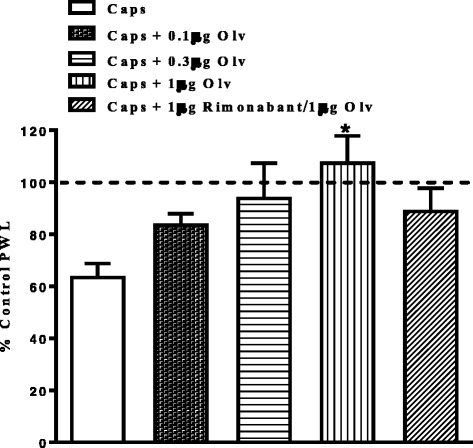
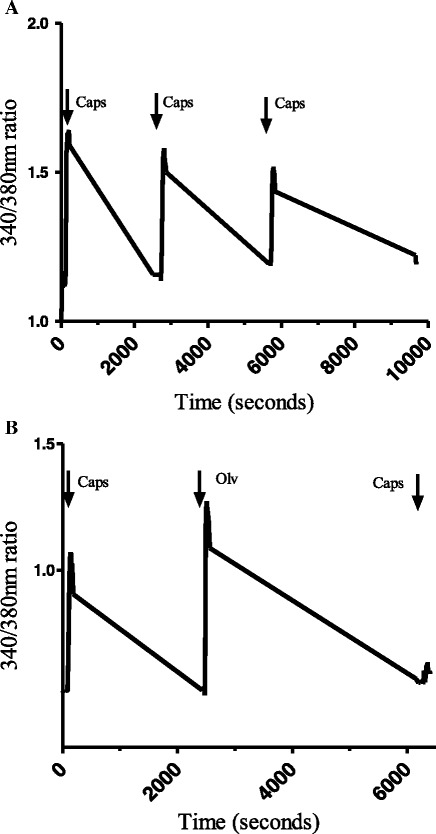
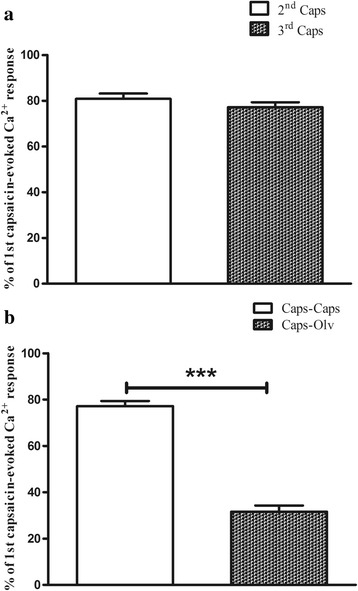
Both olvanil (100 nM) and capsaicin (100 nM) produced significant increases in intracellular calcium concentrations [Ca(2+)]i in cultured DRG neurons. Olvanil was able to desensitise TRPV1 responses to further capsaicin exposure more effectively than capsaicin. Intraplantar injection of capsaicin (0.1, 0.3 and 1 μg) produced a robust TRPV1-dependant thermal hyperalgesia in rats, whilst olvanil (0.1, 0.3 and 1 μg) produced no hyperalgesia, emphasizing its lack of pungency. The highest dose of olvanil significantly reduced the hyperalgesic effects of capsaicin in vivo. Intraplantar injection of the selective cannabinoid CB1 receptor antagonist rimonabant (1 μg) altered neither capsaicin-induced thermal hyperalgesia nor the desensitizing properties of olvanil, indicating a lack of involvement of CB1 receptors.
Olvanil is effective in reducing capsaicin-induced thermal hyperalgesia, probably via directly desensitizing TRPV1 channels in a CB1 receptor-independent fashion. The results presented clearly support the potential for olvanil in the development of new topical analgesic preparations for treating chronic pain conditions while avoiding the unwanted side effects of capsaicin treatments.
奥伐尼尔(NE 19550)是辣椒素的一种无刺激性合成类似物,辣椒素是辣椒中的天然刺激性成分,可激活瞬时受体电位香草酸亚型1(TRPV1)通道,它被开发为一种潜在的镇痛化合物。奥伐尼尔在几种慢性疼痛实验模型中具有强大的抗痛觉过敏作用。在此,我们报告奥伐尼尔对培养的背根神经节(DRG)神经元伤害性处理的抑制作用,并比较辣椒素和奥伐尼尔在体内对热伤害性处理的影响;还研究了大麻素CB1受体对奥伐尼尔抗痛觉过敏作用的潜在贡献。
使用热板镇痛仪评估奥伐尼尔对辣椒素诱导的热痛觉过敏的抗伤害性作用以及CB1受体在介导这些作用中所起的作用。采用DRG神经元的单细胞钙成像研究来确定奥伐尼尔对辣椒素诱发的钙反应的脱敏作用。统计分析采用学生t检验或单因素方差分析,随后根据情况进行Dunnett事后检验。
奥伐尼尔(100 nM)和辣椒素(100 nM)均使培养的DRG神经元细胞内钙浓度[Ca(2+)]i显著升高。与辣椒素相比,奥伐尼尔能更有效地使TRPV1对进一步暴露于辣椒素的反应脱敏。足底注射辣椒素(0.1、0.3和1μg)在大鼠中产生了强烈的TRPV1依赖性热痛觉过敏,而奥伐尼尔(0.1、0.3和1μg)未产生痛觉过敏,突出了其无刺激性。奥伐尼尔的最高剂量显著降低了辣椒素在体内的痛觉过敏作用。足底注射选择性大麻素CB1受体拮抗剂利莫那班(1μg)既未改变辣椒素诱导的热痛觉过敏,也未改变奥伐尼尔的脱敏特性,表明CB1受体未参与其中。
奥伐尼尔可有效减轻辣椒素诱导的热痛觉过敏,可能是通过以CB1受体非依赖性方式直接使TRPV1通道脱敏。所呈现的结果明确支持奥伐尼尔在开发用于治疗慢性疼痛疾病的新型局部镇痛制剂方面的潜力,同时避免辣椒素治疗的不良副作用。