Adedokun Omoniyi J, Xu Zhenhua, Marano Colleen W, Strauss Richard, Zhang Hongyan, Johanns Jewel, Zhou Honghui, Davis Hugh M, Reinisch Walter, Feagan Brian G, Rutgeerts Paul, Sandborn William J
Department of Global Clinical Pharmacology, Janssen Research & Development, LLC, Spring House, PA, USA
Department of Global Clinical Pharmacology, Janssen Research & Development, LLC, Spring House, PA, USA.
J Crohns Colitis. 2017 Jan;11(1):35-46. doi: 10.1093/ecco-jcc/jjw133. Epub 2016 Jul 20.
To assess golimumab pharmacokinetics [PK] and exposure-response [ER] in adults with moderate-to-severe ulcerative colitis [UC] from the Program of Ulcerative Colitis Research Studies Utilizing an Investigational Treatment [PURSUIT] studies.
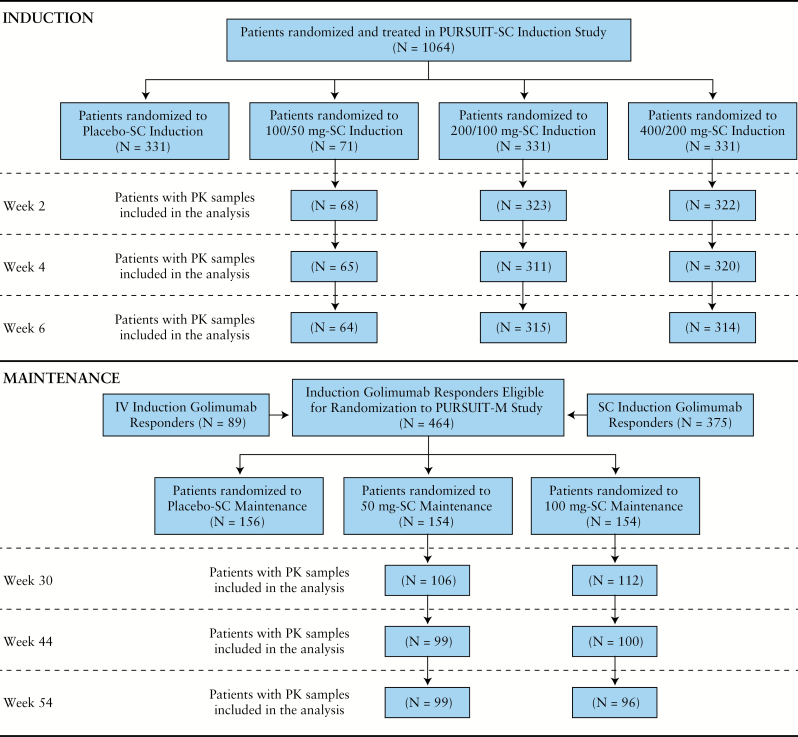
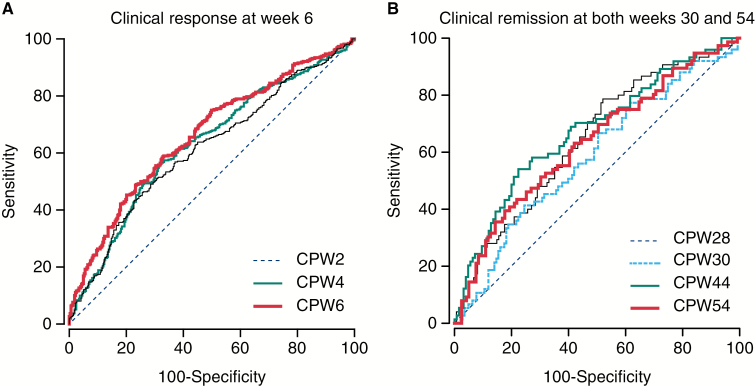
We analysed golimumab PK and ER data of patients with moderate-to-severe UC from the PURSUIT-subcutaneous induction [N = 1064] and maintenance [N = 464] studies. Induction analyses evaluated serum golimumab concentration [SGC] and efficacy data through Week [wk] 6 following subcutaneous doses at wk0 and wk2; maintenance analyses assessed data through wk54 following 4-weekly dosing. ER relationships were assessed using trend, logistic regression, and receiver-operating-characteristic curve analyses.
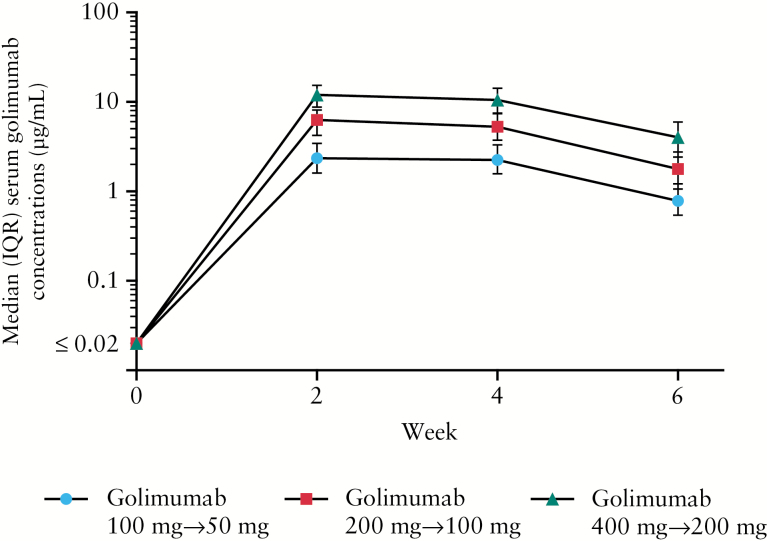
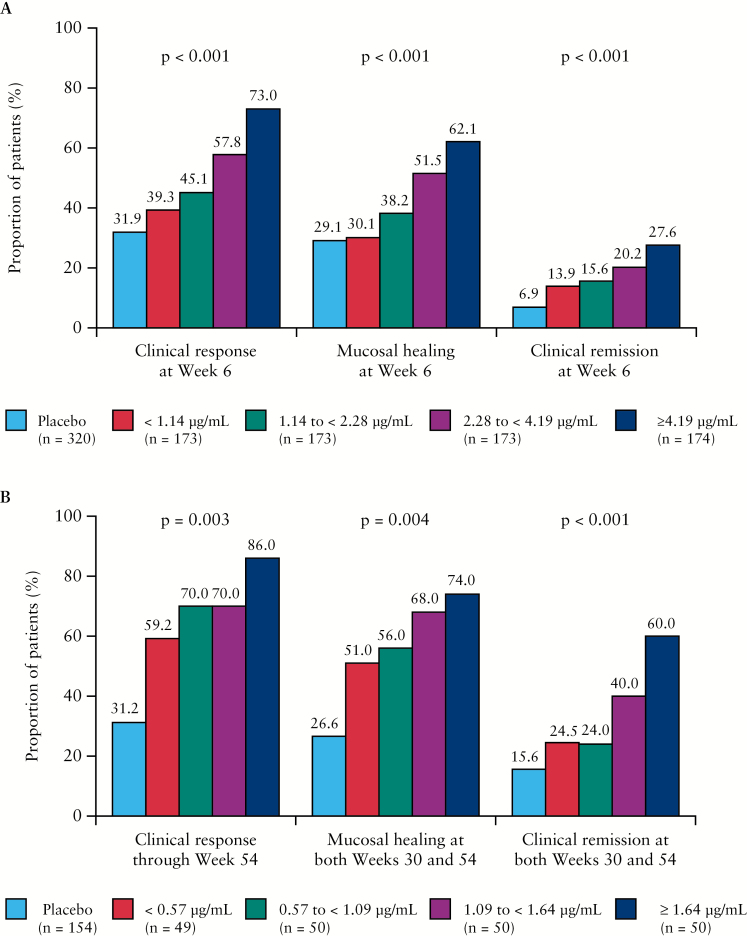
Median SGCs peaked at induction wk2 for golimumab 100/50mg, 200/100mg, and 400/200mg. Wk6 median SGCs were 0.78, 1.78, and 4.01 μg/ml, respectively. SGCs were sustained, reaching steady state approximately 8wks after golimumab maintenance commenced [wk14 of golimumab] regardless of induction dose. Median trough SGCs from maintenance wks8-44 ranged from 0.69 to 0.83 µg/ml [50 mg] and 1.33-1.58 µg/ml [100 mg]. SGCs were approximately dose proportional, and higher SGCs were associated with higher efficacy response rates during induction and maintenance. Factors associated with golimumab exposure were body weight, antibody-to-golimumab status, serum albumin, alkaline phosphatase, faecal markers, C-reactive protein, and pancolitis. SGCs of 2.5 µg/ml [induction wk6] and 1.4 µg/ml [maintenance steady-state trough] are potential target concentrations. Immunomodulators had no apparent impact on SGC with golimumab 100mg, whereas drug levels were slightly higher with golimumab 50mg with vs without immunomodulators.
SGCs are approximately dose proportional, and a positive SGC-efficacy relationship exists during induction/maintenance golimumab treatment of adult UC patients. Optimal SGC targets require validation in prospective studies.
通过溃疡性结肠炎研究治疗项目(PURSUIT)研究,评估中度至重度溃疡性结肠炎(UC)成人患者中戈利木单抗的药代动力学(PK)和暴露-反应(ER)关系。
我们分析了PURSUIT皮下诱导(N = 1064)和维持(N = 464)研究中中度至重度UC患者的戈利木单抗PK和ER数据。诱导分析评估了在第0周和第2周皮下给药后至第6周的血清戈利木单抗浓度(SGC)和疗效数据;维持分析评估了每4周给药后至第54周的数据。使用趋势分析、逻辑回归和受试者工作特征曲线分析评估ER关系。
戈利木单抗100/50mg、200/100mg和400/200mg的SGC中位数在诱导第2周达到峰值。第6周的SGC中位数分别为0.78、1.78和4.01μg/ml。SGC保持稳定,无论诱导剂量如何,在戈利木单抗维持治疗开始后约8周(戈利木单抗第14周)达到稳态。维持第8 - 44周的SGC中位数谷值范围为0.69至0.83μg/ml(50mg)和1.33 - 1.58μg/ml(100mg)。SGC大致与剂量成比例,并且在诱导和维持期间,较高的SGC与较高的疗效反应率相关。与戈利木单抗暴露相关的因素包括体重、抗戈利木单抗状态、血清白蛋白、碱性磷酸酶、粪便标志物、C反应蛋白和全结肠炎。2.5μg/ml(诱导第6周)和1.4μg/ml(维持稳态谷值)的SGC是潜在的目标浓度。免疫调节剂对100mg戈利木单抗的SGC没有明显影响,而50mg戈利木单抗使用免疫调节剂与未使用时相比,药物水平略高。
SGC大致与剂量成比例,并且在成人UC患者戈利木单抗诱导/维持治疗期间存在SGC - 疗效正相关关系。最佳SGC目标需要在前瞻性研究中进行验证。