Maeda Hideyuki, Kanzaki Masato, Sakamoto Kei, Isaka Tamami, Yamazaki Kenji, Onuki Takamasa
Department of Surgery I, Tokyo Women's Medical University, 8-1 Kawada-cho, Shinjuku-ku, Tokyo, 162-8666, Japan.
Department of Cardiovascular Surgery, Tokyo Women's Medical University, Tokyo, Japan.
Surg Today. 2017 Mar;47(3):284-292. doi: 10.1007/s00595-016-1386-5. Epub 2016 Jul 21.
To clarify if previous cardiovascular surgery (CVS) affects the postoperative outcome of surgery for non-small cell lung cancer (NSCLC).
We reviewed, retrospectively, the medical records of 36 patients with a history of CVS, who underwent lung cancer surgery at a single institution (study group; SG) and compared their characteristics and postoperative outcomes with those of patients without a history of CVS history (control group; CG), and also with those of patients with coexisting cardiovascular diseases in the CG (specified control group; SCG). Finally, we used a thoracic revised cardiac risk index (ThRCRI) to evaluate the risk of perioperative cardiovascular events.
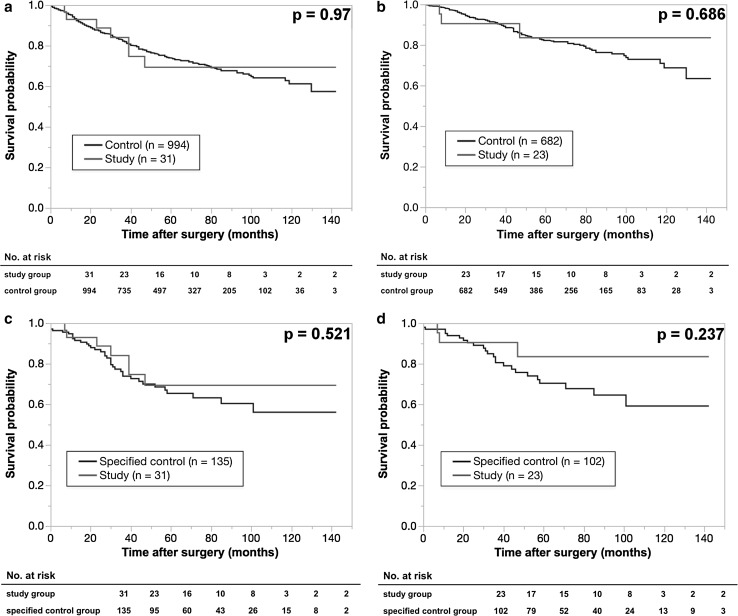
There was a significant difference in the ThRCRI classifications between the SG and the SCG (p < 0.0001). There were no significant differences in the incidence of intraoperative and postoperative complications between the SG and CG, or between the SG and SCG. The 5-year survival rates of the SG, CG, and SCG were 69.3, 73.9, and 65.4 % in all stages, and 83.5, 82.2, and 70.4 % in stage I, respectively.
Previous CVS did not increase the number of perioperative cardiovascular events in this study and had no significant influence on the prognosis of patients undergoing resection of NSCLC.
明确既往心血管手术(CVS)是否会影响非小细胞肺癌(NSCLC)手术的术后结局。
我们回顾性分析了36例有CVS病史且在单一机构接受肺癌手术的患者的病历(研究组;SG),并将其特征和术后结局与无CVS病史的患者(对照组;CG)以及CG中合并心血管疾病的患者(特定对照组;SCG)进行比较。最后,我们使用胸部修订心脏风险指数(ThRCRI)来评估围手术期心血管事件的风险。
SG和SCG之间的ThRCRI分类存在显著差异(p < 0.0001)。SG与CG之间以及SG与SCG之间在术中和术后并发症发生率方面无显著差异。SG、CG和SCG在所有分期的5年生存率分别为69.3%、73.9%和65.4%,在I期分别为83.5%、82.2%和70.4%。
在本研究中,既往CVS并未增加围手术期心血管事件的数量,且对接受NSCLC切除术的患者的预后没有显著影响。