Xiao X, Hao J, Wen Y, Wang W, Guo X, Zhang F
Key Laboratory of Trace Elements and Endemic Diseases of National Health and Family Planning Commission, School of Public Health, Health Science Center, Xi'an Jiaotong University, Yanta West Road 76, Xi'an, Shaanxi, China.
Key Laboratory of Trace Elements and Endemic Diseases of National Health and Family Planning Commission, School of Public Health, Health Science Center, Xi'an Jiaotong University, Yanta West Road 76, Xi'an, Shaanxi, China
Bone Joint Res. 2016 Jul;5(7):314-9. doi: 10.1302/2046-3758.57.2000502.
The molecular mechanism of rheumatoid arthritis (RA) remains elusive. We conducted a protein-protein interaction network-based integrative analysis of genome-wide association studies (GWAS) and gene expression profiles of RA.
We first performed a dense search of RA-associated gene modules by integrating a large GWAS meta-analysis dataset (containing 5539 RA patients and 20 169 healthy controls), protein interaction network and gene expression profiles of RA synovium and peripheral blood mononuclear cells (PBMCs). Gene ontology (GO) enrichment analysis was conducted by DAVID. The protein association networks of gene modules were generated by STRING.
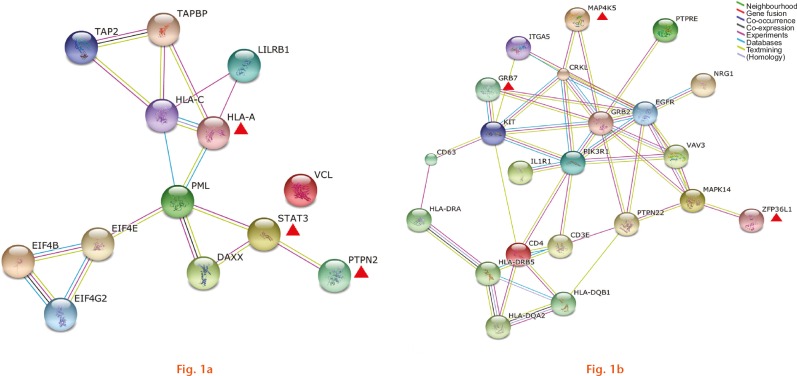
For RA synovium, the top-ranked gene module is HLA-A, containing TAP2, HLA-A, HLA-C, TAPBP and LILRB1 genes. For RA PBMCs, the top-ranked gene module is GRB7, consisting of HLA-DRB5, HLA-DRA, GRB7, CD63 and KIT genes. Functional enrichment analysis identified three significant GO terms for RA synovium, including antigen processing and presentation of peptide antigen via major histocompatibility complex class I (false discovery rate (FDR) = 4.86 × 10 - 4), antigen processing and presentation of peptide antigen (FDR = 2.33 × 10 - 3) and eukaryotic translation initiation factor 4F complex (FDR = 2.52 × 10 - 2).
This study reported several RA-associated gene modules and their functional association networks.Cite this article: X. Xiao, J. Hao, Y. Wen, W. Wang, X. Guo, F. Zhang. Genome-wide association studies and gene expression profiles of rheumatoid arthritis: an analysis. Bone Joint Res 2016;5:314-319. DOI: 10.1302/2046-3758.57.2000502.
类风湿关节炎(RA)的分子机制仍不清楚。我们基于蛋白质-蛋白质相互作用网络对RA的全基因组关联研究(GWAS)和基因表达谱进行了综合分析。
我们首先通过整合一个大型GWAS荟萃分析数据集(包含5539例RA患者和20169例健康对照)、蛋白质相互作用网络以及RA滑膜和外周血单个核细胞(PBMC)的基因表达谱,对与RA相关的基因模块进行了密集搜索。通过DAVID进行基因本体(GO)富集分析。基因模块的蛋白质关联网络由STRING生成。
对于RA滑膜,排名最靠前的基因模块是HLA - A,包含TAP2、HLA - A、HLA - C、TAPBP和LILRB1基因。对于RA PBMC,排名最靠前的基因模块是GRB7,由HLA - DRB5、HLA - DRA、GRB7、CD63和KIT基因组成。功能富集分析确定了RA滑膜的三个显著GO术语,包括通过主要组织相容性复合体I类进行肽抗原的抗原加工和呈递(错误发现率(FDR)= 4.86×10 - 4)、肽抗原的抗原加工和呈递(FDR = 2.33×10 - 3)以及真核翻译起始因子4F复合物(FDR = 2.52×10 - 2)。
本研究报告了几个与RA相关的基因模块及其功能关联网络。引用本文:肖X,郝J,文Y,王W,郭X,张F。类风湿关节炎的全基因组关联研究和基因表达谱:一项分析。骨关节研究2016;5:314 - 319。DOI:10.1302/2046 - 3758.57.2000502。