Xie Yangmei, Chen Yinghui
Department of Neurology, Jinshan Hospital, Fudan UniversityShanghai, China; Department of Neurology, Shanghai Medical College, Fudan UniversityShanghai, China.
Front Neurosci. 2016 Jun 28;10:298. doi: 10.3389/fnins.2016.00298. eCollection 2016.
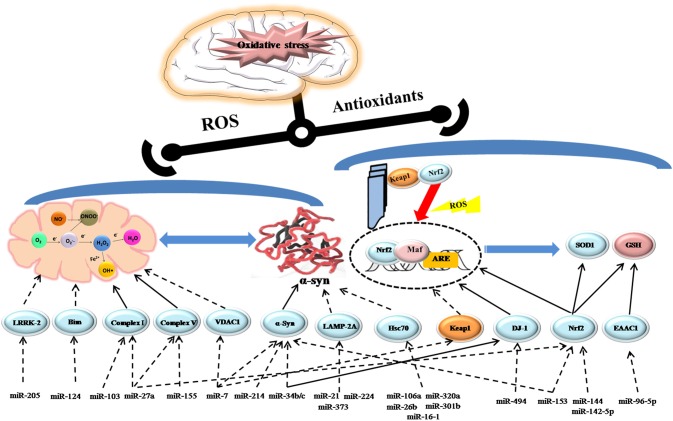
Parkinson's disease (PD) is the second most common neurodegenerative disorder. This chronic, progressive disease is characterized by loss of dopaminergic (DA) neurons in the substantia nigra pars compacta (SNpc) and the presence of cytoplasmic inclusions called Lewy bodies (LBs) in surviving neurons. PD is attributed to a combination of environment and genetic factors, but the precise underlying molecular mechanisms remain elusive. Oxidative stress is generally recognized as one of the main causes of PD, and excessive reactive oxygen species (ROS) can lead to DA neuron vulnerability and eventual death. Several studies have demonstrated that small non-coding RNAs termed microRNAs (miRNAs) can regulate oxidative stress in vitro and in vivo models of PD. Relevant miRNAs involved in oxidative stress can prevent ROS-mediated damage to DA neurons, suggesting that specific miRNAs may be putative targets for novel therapeutic targets in PD.
帕金森病(PD)是第二常见的神经退行性疾病。这种慢性进行性疾病的特征是黑质致密部(SNpc)中多巴胺能(DA)神经元的丧失以及存活神经元中存在称为路易小体(LBs)的细胞质内含物。PD归因于环境和遗传因素的共同作用,但其确切的潜在分子机制仍不清楚。氧化应激通常被认为是PD的主要原因之一,过量的活性氧(ROS)可导致DA神经元易损性并最终死亡。多项研究表明,称为微小RNA(miRNA)的小非编码RNA可在PD的体外和体内模型中调节氧化应激。参与氧化应激的相关miRNA可预防ROS介导的对DA神经元的损伤,这表明特定的miRNA可能是PD新型治疗靶点的推定靶点。