Arimany-Nardi Cristina, Minuesa Gerard, Keller Thorsten, Erkizia Itziar, Koepsell Hermann, Martinez-Picado Javier, Pastor-Anglada Marçal
Molecular Pharmacology and Experimental Therapeutics, Department of Biochemistry and Molecular Biology, Institute of Biomedicine, University of BarcelonaBarcelona, Spain; Oncology Program, National Biomedical Research Institute on Liver and Gastrointestinal Diseases (CIBER EHD), Instituto de Salud Carlos IIIMadrid, Spain.
AIDS Research Institute IrsiCaixa, Institut d'Investigació en Cièncias de la Salut Germans Trias i Pujol, Universitat Autònoma de Barcelona Badalona, Spain.
Front Pharmacol. 2016 Jun 24;7:175. doi: 10.3389/fphar.2016.00175. eCollection 2016.
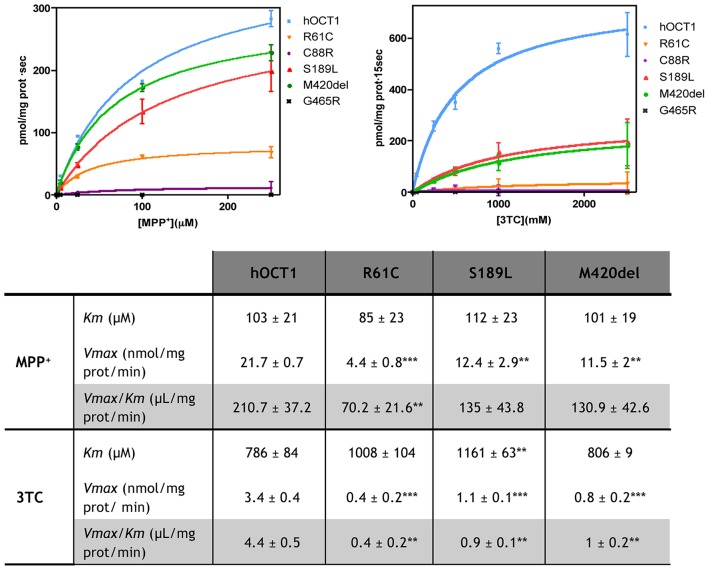
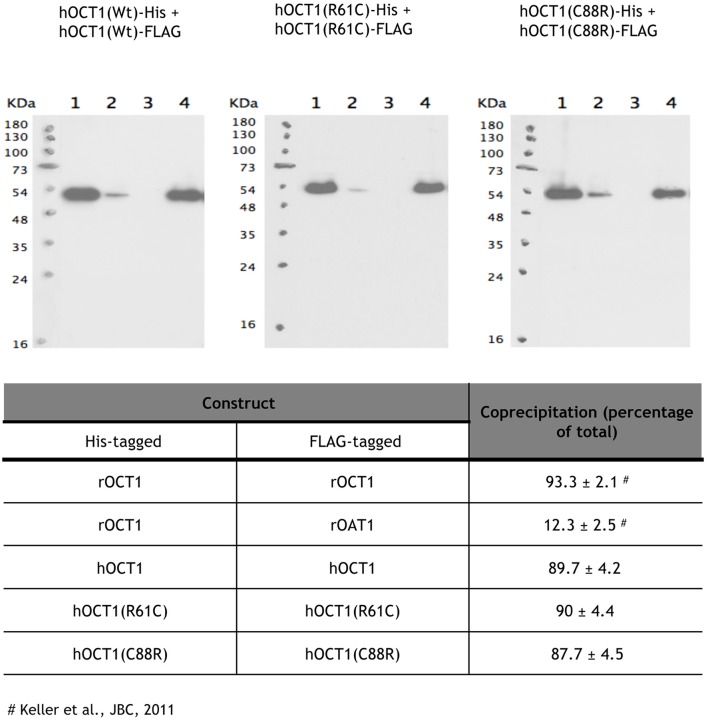
Lamivudine (3TC), a drug used in the treatment of HIV infection, needs to cross the plasma membrane to exert its therapeutic action. Human Organic cation transporter 1 (hOCT1), encoded by the SLC22A1 gene, is the transporter responsible for its uptake into target cells. As SLC22A1 is a highly polymorphic gene, the aim of this study was to determine how SNPs in the OCT1-encoding gene affected 3TC internalization and its interaction with other co-administered drugs. HEK293 cells stably transfected with either the wild type form or the polymorphic variants of hOCT1 were used to perform kinetic and drug-drug interaction studies. Protein co-immunoprecipitation was used to assess the impact of selected polymorphic cysteines on the oligomerization of the transporter. Results showed that 3TC transport efficiency was reduced in all polymorphic variants tested (R61C, C88R, S189L, M420del, and G465R). This was not caused by lack of oligomerization in case of variants located at the transporter extracellular loop (R61C and C88R). Drug-drug interaction measurements showed that co-administered drugs [abacavir (ABC), zidovudine (AZT), emtricitabine (FTC), tenofovir diproxil fumarate (TDF), efavirenz (EFV) and raltegravir (RAL)], differently inhibited 3TC uptake depending upon the polymorphic variant analyzed. These data highlight the need for accurate analysis of drug transporter polymorphic variants of clinical relevance, because polymorphisms can impact on substrate (3TC) translocation but even more importantly they can differentially affect drug-drug interactions at the transporter level.
拉米夫定(3TC)是一种用于治疗HIV感染的药物,需要穿过质膜才能发挥其治疗作用。由SLC22A1基因编码的人类有机阳离子转运体1(hOCT1)是负责将其摄取到靶细胞中的转运体。由于SLC22A1是一个高度多态性的基因,本研究的目的是确定OCT1编码基因中的单核苷酸多态性如何影响3TC的内化及其与其他联合用药的相互作用。使用稳定转染了hOCT1野生型或多态性变体的HEK293细胞进行动力学和药物-药物相互作用研究。蛋白质免疫共沉淀用于评估所选多态性半胱氨酸对转运体寡聚化的影响。结果表明,在所有测试的多态性变体(R61C、C88R、S189L、M420del和G465R)中,3TC的转运效率均降低。对于位于转运体细胞外环的变体(R61C和C88R),这不是由寡聚化缺失引起的。药物-药物相互作用测量表明,联合使用的药物[阿巴卡韦(ABC)、齐多夫定(AZT)、恩曲他滨(FTC)、替诺福韦酯(TDF)、依非韦伦(EFV)和拉替拉韦(RAL)],根据所分析的多态性变体不同程度地抑制3TC的摄取。这些数据突出了对具有临床相关性的药物转运体多态性变体进行准确分析的必要性,因为多态性会影响底物(3TC)的转运,但更重要的是,它们会在转运体水平上不同程度地影响药物-药物相互作用。