Geraghty Anna C, Muroy Sandra E, Kriegsfeld Lance J, Bentley George E, Kaufer Daniela
Department of Integrative Biology, University of California Berkeley , Berkeley, CA , USA.
Department of Psychology, University of California Berkeley, Berkeley, CA, USA; Helen Wills Neuroscience Institute, University of California Berkeley, Berkeley, CA, USA.
Front Endocrinol (Lausanne). 2016 Jun 21;7:71. doi: 10.3389/fendo.2016.00071. eCollection 2016.
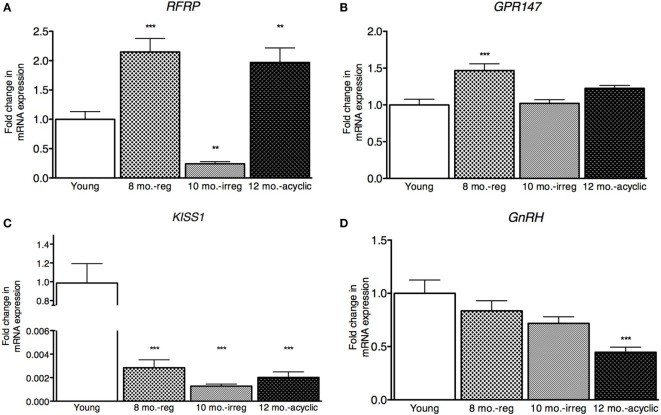
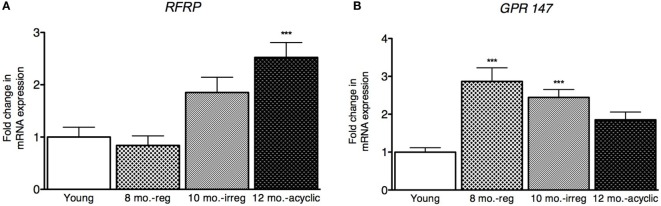
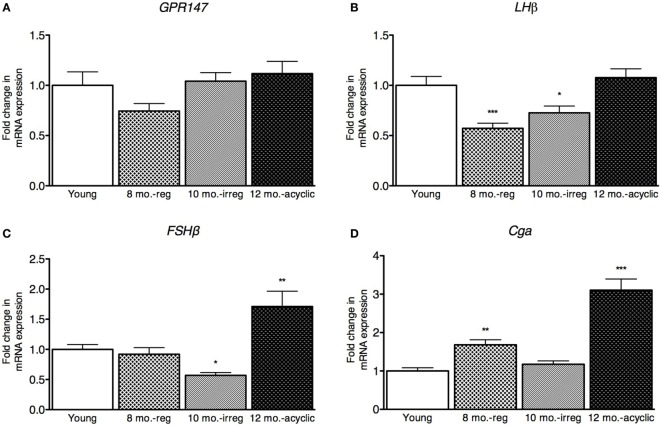
Reproductive senescence, the point in time when females cease to show estrous cyclicity, is associated with endocrine changes in the hypothalamus, pituitary, and gonads. However, the mechanisms triggering this transition are not well understood. To gain a better understanding of the top-down control of the transition from reproductive competence to a state of reproductive senescence, we investigated middle-aged female rats exhibiting varying degrees of reproductive decline, including individuals with normal cycles, irregular cycles, and complete cessation of cycles. We identified hormonal changes in the brain that manifest before ovarian cycles exhibit any deterioration. We found that females exhibit an increase in RFamide-related peptide-3 (RFRP3) mRNA expression in the hypothalamus in middle age prior to changes in estrous cycle length. This increase is transient and followed by subsequent decreases in kisspeptin (KiSS1) and gonadotropin-releasing hormone (GnRH) mRNA expression. Expression of RFRP3 and its receptor also increased locally in the ovaries with advancing age. While it is well known that aging is associated with decreased GnRH release and downstream disruption of the hypothalamic-pituitary-gonadal (HPG) axis, herein, we provide evidence that reproductive senescence is likely triggered by alterations in a network of regulatory neuropeptides upstream of the GnRH system.
生殖衰老,即雌性动物停止表现出发情周期的时间点,与下丘脑、垂体和性腺的内分泌变化有关。然而,引发这种转变的机制尚未完全明确。为了更好地理解从生殖能力到生殖衰老状态转变的自上而下的调控机制,我们研究了表现出不同程度生殖能力下降的中年雌性大鼠,包括具有正常周期、周期不规律以及完全停止周期的个体。我们确定了在卵巢周期出现任何恶化之前大脑中就已出现的激素变化。我们发现,在发情周期长度发生变化之前,中年雌性大鼠下丘脑内RF酰胺相关肽-3(RFRP3)的mRNA表达就有所增加。这种增加是短暂的,随后促性腺激素释放激素(GnRH)和亲吻素(KiSS1)的mRNA表达会随之下降。随着年龄的增长,RFRP3及其受体的表达在卵巢中也会局部增加。虽然众所周知衰老与GnRH释放减少以及下丘脑-垂体-性腺(HPG)轴的下游破坏有关,但在此我们提供证据表明,生殖衰老可能是由GnRH系统上游的调节性神经肽网络变化引发的。