Messineo Sebastiano, Laria Anna Elisa, Arcidiacono Biagio, Chiefari Eusebio, Luque Huertas Raúl M, Foti Daniela P, Brunetti Antonio
Department of Health Sciences, University "Magna Græcia" of Catanzaro , Catanzaro , Italy.
Department of Cell Biology, Physiology and Immunology, Instituto Maimónides de Investigación Biomédica de Córdoba (IMIBIC), Hospital Universitario Reina Sofía (HURS), CIBERobn and ceiA3, University of Córdoba , Córdoba , Spain.
Front Endocrinol (Lausanne). 2016 Jun 27;7:73. doi: 10.3389/fendo.2016.00073. eCollection 2016.
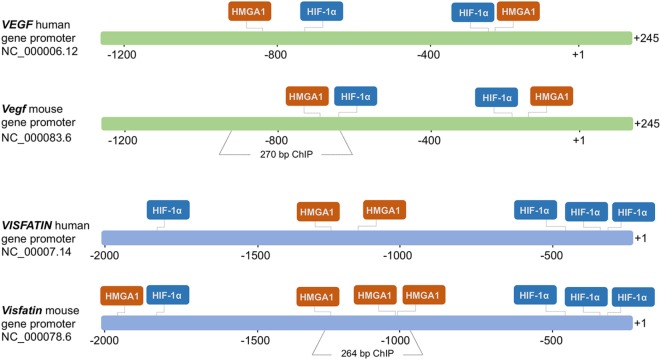
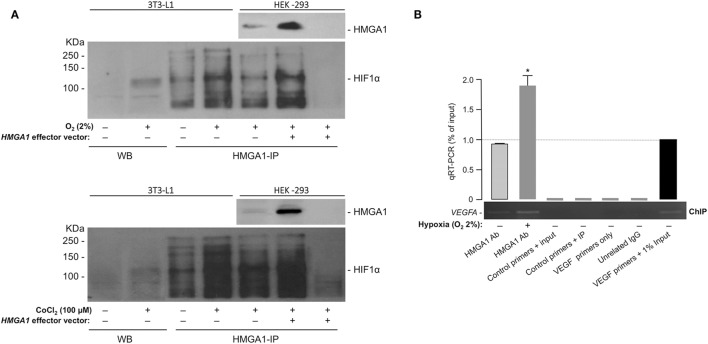
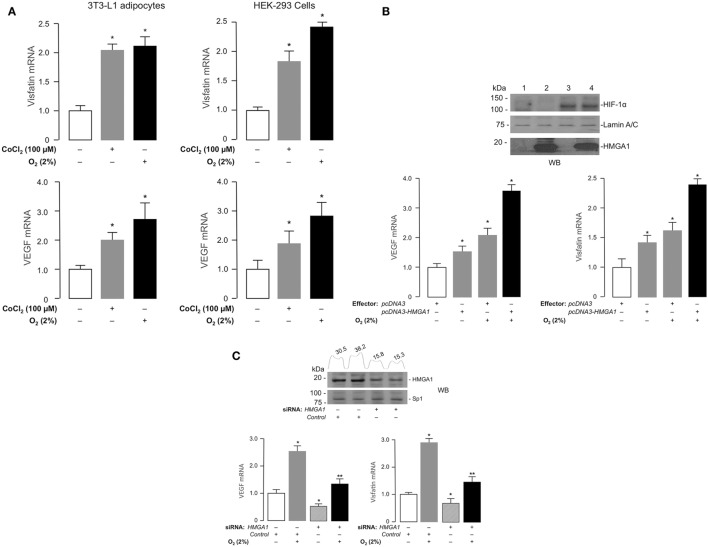
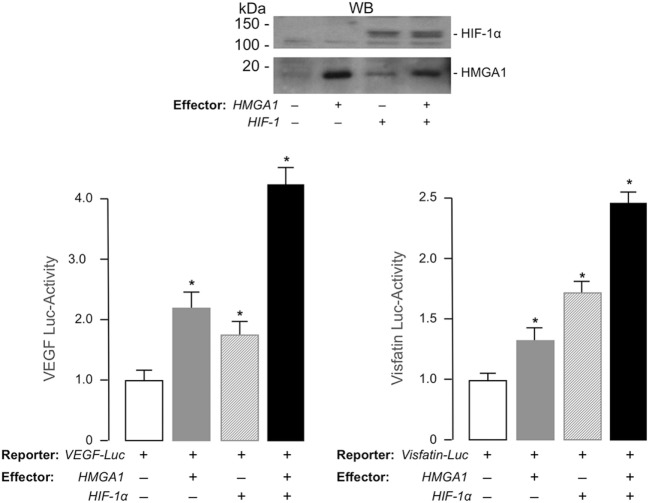
The architectural transcription factor high-mobility group AT-hook 1 (HMGA1) is a chromatin regulator with implications in several biological processes, including tumorigenesis, inflammation, and metabolism. Previous studies have indicated a role for this factor in promoting the early stages of adipogenesis, while inhibiting adipocyte terminal differentiation, and decreasing fat mass. It has been demonstrated that hypoxia - through the hypoxia-inducible factor 1 (HIF-1) - plays a major role in triggering changes in the adipose tissue of the obese, leading to inhibition of adipocyte differentiation, adipose cell dysfunction, inflammation, insulin resistance, and type 2 diabetes. To examine the possible cooperation between HMGA1 and HIF-1, herein, we investigated the role of HMGA1 in the regulation of Visfatin and VEGF, two genes normally expressed in adipose cells, which are both responsive to hypoxia. We demonstrated that HMGA1 enhanced Visfatin and VEGF gene expression in human embryonic kidney (HEK) 293 cells in hypoxic conditions, whereas HMGA1 knockdown in differentiated 3T3-L1 adipocytes reduced these effects. Reporter gene analysis showed that Visfatin and VEGF transcriptional activity was increased by the addition of either HMGA1 or HIF-1 and even further by the combination of both factors. As demonstrated by chromatin immunoprecipitation in intact cells, HMGA1 directly interacted with the VEGF gene, and this interaction was enhanced in hypoxic conditions. Furthermore, as indicated by co-immunoprecipitation studies, HMGA1 and HIF-1 physically interacted with each other, supporting the notion that this association may corroborate a functional link between these factors. Therefore, our findings provide evidence for molecular cross-talk between HMGA1 and HIF-1, and this may be important for elucidating protein and gene networks relevant to obesity.
高迁移率族AT钩蛋白1(HMGA1)是一种参与多种生物学过程(包括肿瘤发生、炎症和代谢)的染色质调节因子。先前的研究表明,该因子在促进脂肪生成早期阶段发挥作用,同时抑制脂肪细胞终末分化并减少脂肪量。已证明,缺氧通过缺氧诱导因子1(HIF-1)在引发肥胖者脂肪组织变化中起主要作用,导致脂肪细胞分化受抑制、脂肪细胞功能障碍、炎症、胰岛素抵抗和2型糖尿病。为了研究HMGA1与HIF-1之间可能的协同作用,在此我们研究了HMGA1在调节内脂素(Visfatin)和血管内皮生长因子(VEGF)中的作用,这两个基因在脂肪细胞中正常表达,且均对缺氧有反应。我们证明,在缺氧条件下,HMGA1增强了人胚肾(HEK)293细胞中内脂素和VEGF基因的表达,而在分化的3T3-L1脂肪细胞中敲低HMGA1则降低了这些作用。报告基因分析表明,添加HMGA1或HIF-1均可增加内脂素和VEGF的转录活性,二者联合作用时增强效果更明显。完整细胞中的染色质免疫沉淀实验表明,HMGA1直接与VEGF基因相互作用,且这种相互作用在缺氧条件下增强。此外,免疫共沉淀研究表明,HMGA1和HIF-1相互之间存在物理性相互作用,支持了这种关联可能证实这些因子之间功能联系的观点。因此,我们的研究结果为HMGA1与HIF-1之间的分子相互作用提供了证据,这对于阐明与肥胖相关的蛋白质和基因网络可能具有重要意义。