Esra Rachel T, Olivier Abraham J, Passmore Jo-Ann S, Jaspan Heather B, Harryparsad Rushil, Gray Clive M
Department of Pathology, Division of Immunology, Faculty of Health Sciences, Institute of Infectious Disease and Molecular Medicine, University of Cape Town , Cape Town , South Africa.
Department of Pathology, Division of Virology, Faculty of Health Sciences, Institute of Infectious Disease and Molecular Medicine, University of Cape Town, Cape Town, South Africa; National Health Laboratory Services, Cape Town, South Africa.
Front Immunol. 2016 Jun 24;7:245. doi: 10.3389/fimmu.2016.00245. eCollection 2016.
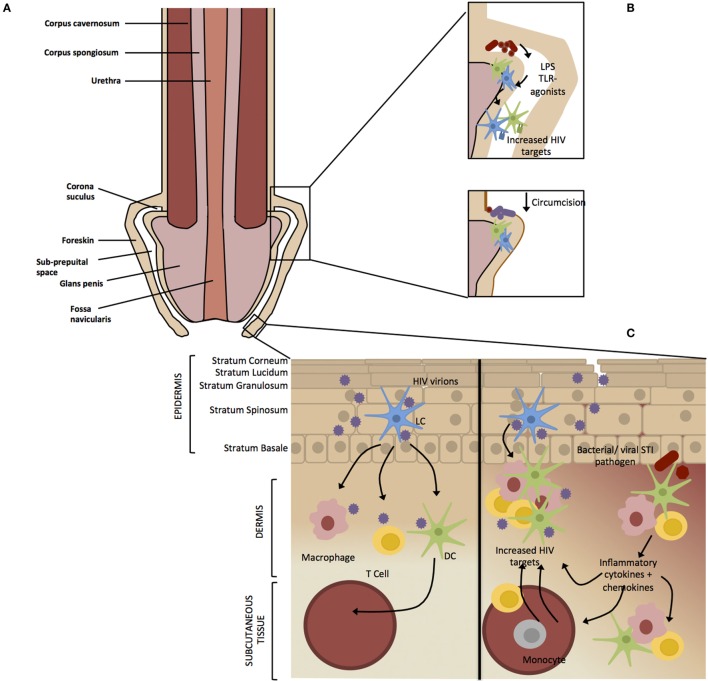
In many parts of the World, medical male circumcision (MMC) is used as standard prevention of care against HIV infection. This is based on seminal reports made over 10 years ago that removal of the foreskin provides up to 60% protection against HIV infection in males and seems currently the best antiretroviral-free prevention strategy yet against the global epidemic. We explore the potential mechanisms by which MMC protects against HIV-1 acquisition and that one of the oldest, albeit re-invented, rituals of removing a foreskin underscores the exploitative nature of HIV on the anatomy and tissue of the uncircumcised penis. Furthermore, foreskin removal also reveals how males acquire HIV, and in reality, the underlying mechanisms of MMC are not known. We argue that the normal sequelae of inflammation in the male genital tract (MGT) for protection from sexually transmitted infections (STI)-induced pathology represents a perfect immune and microbial ecosystem for HIV acquisition. The accumulation of HIV-1 target cells in foreskin tissue and within the urethra in response to STIs, both during and after resolution of infection, suggests that acquisition of HIV-1, through sexual contact, makes use of the natural immune milieu of the MGT. Understanding immunity in the MGT, the movement of HIV-1 target cells to the urethra and foreskin tissue upon encounter with microbial signals would provide more insight into viral acquisition and lay the foundation for further prevention strategies in males that would be critical to curb the epidemic in all sexual partners at risk of infection. The global female-centric focus of HIV-1 transmission and acquisition research has tended to leave gaps in our knowledge of what determines HIV-1 acquisition in men and such understanding would provide a more balanced and complete view of viral acquisition.
在世界许多地区,医学男性包皮环切术(MMC)被用作预防HIV感染的标准医疗手段。这是基于10多年前的一些重要报告,即切除包皮可为男性提供高达60%的HIV感染防护,而且目前似乎是对抗全球疫情的最佳无抗逆转录病毒预防策略。我们探讨了MMC预防HIV-1感染的潜在机制,以及这种最古老(尽管是重新采用)的包皮切除仪式如何凸显了HIV对未割包皮阴茎的解剖结构和组织的利用本质。此外,包皮切除还揭示了男性感染HIV的方式,而实际上,MMC的潜在机制尚不清楚。我们认为,男性生殖道(MGT)中炎症的正常后遗症可预防性传播感染(STI)诱发的病理状况,这代表了一个完美的HIV感染免疫和微生物生态系统。在感染期间及感染消退后,包皮组织和尿道内HIV-1靶细胞因STI而积聚,这表明通过性接触感染HIV-1利用了MGT的自然免疫环境。了解MGT中的免疫情况,以及HIV-1靶细胞在遇到微生物信号时向尿道和包皮组织的移动,将为病毒感染提供更多见解,并为男性进一步的预防策略奠定基础,这对于遏制所有有感染风险的性伴侣中的疫情至关重要。以全球女性为中心的HIV-1传播和感染研究往往在我们对男性HIV-1感染决定因素的认识上留下空白,而这样的认识将提供一个更平衡和完整的病毒感染观点。