Gan Lu, Feng Cong, Liu Chunlei, Tian Shuping, Song Xiang, Yang Li
Department of Radiology, General Hospital of the PLA, Beijing 100853, P.R. China.
Department of Emergency, General Hospital of the PLA, Beijing 100853, P.R. China.
Exp Ther Med. 2016 Aug;12(2):667-675. doi: 10.3892/etm.2016.3371. Epub 2016 May 19.
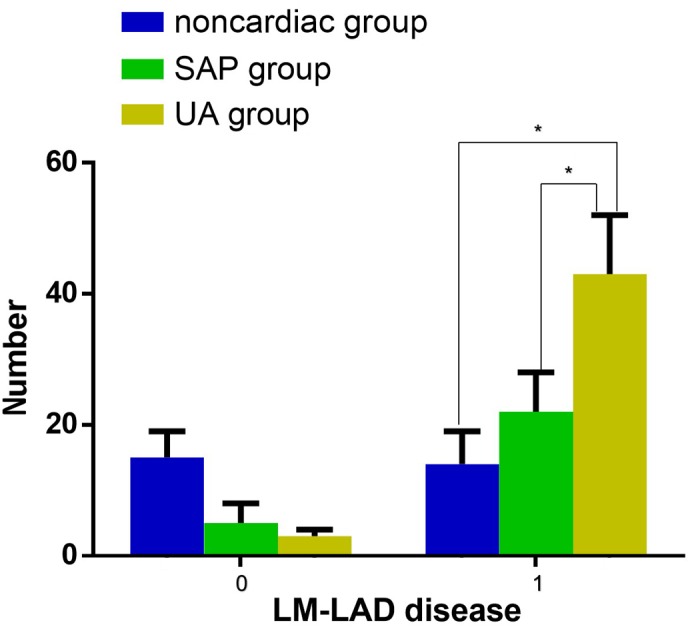
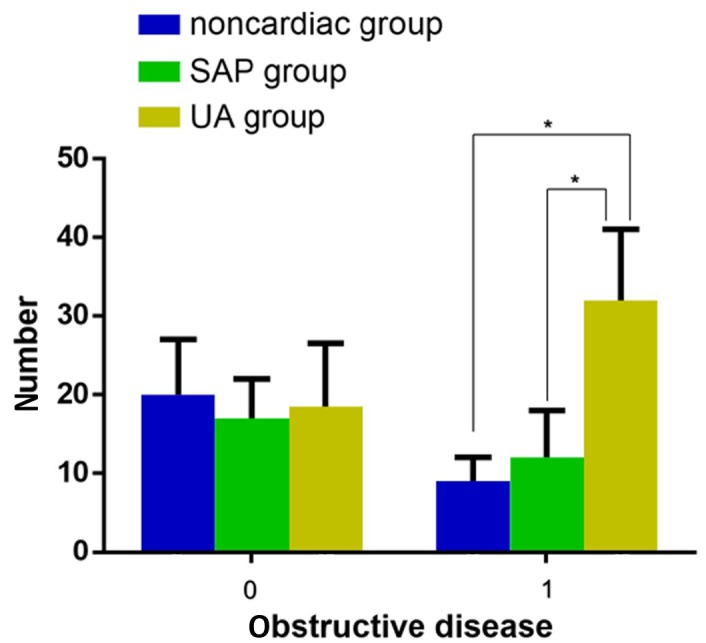
The aim of the present study was to explore the association between the levels of serum N-terminal pro-B-type natriuretic peptide (NT-pro BNP) and the characteristics of coronary atherosclerotic plaque detected by coronary computed tomography angiography (CCTA), in patients with unstable angina (UA). A total of 202 patients (age range, 47-82 years) were divided into the following three groups: Non-cardiac disease group (57 patients); stable angina pectoris (SAP) group (62 patients); and UA group (83 patients). There were significant differences between the serum NT-pro BNP levels among the three groups (P=0.007). However, in multivariant diagnoses, NT-pro BNP level was not an independent risk factor for UA. The levels of serum NT-pro BNP were observed to be positively correlated with the number of vessels involved (r=0.462; P<0.001), SIS (r=0.475; P<0.001), segment-stenosis score (r=0.453; P<0.001), coronary calcification score (r=0.412; P=0.001), number of obstructive diseases (r=0.346; P<0.001), and the number of segments with non-calcified plaque (r=0.235; P=0.017), mixed plaque (r=0.234; P=0.017) and calcified plaque (r=0.431; P<0.001). The levels of serum NT-pro BNP were significantly higher in patients with UA and left main-left anterior descending (LM-LAD) disease, compared with UA patients without LM-LAD disease (P<0.001). In addition, serum NT-pro BNP was significantly higher in patients with obstructive disease and UA than in those without obstructive disease (P<0.001). The area under the curve of log(NT-pro BNP) was 0.656 (P=0.006; optimal cut-off value, 1.74; sensitivity, 77.6%; specificity, 51.9%). In conclusion, the levels of serum NT-pro BNP are associated with the burden and severity of coronary artery atherosclerotic disease in patients with UA, and may be helpful in risk stratification of patients with UA.
本研究旨在探讨不稳定型心绞痛(UA)患者血清N末端B型脑钠肽原(NT-pro BNP)水平与冠状动脉计算机断层扫描血管造影(CCTA)检测到的冠状动脉粥样硬化斑块特征之间的关联。共纳入202例患者(年龄范围47 - 82岁),分为以下三组:非心脏疾病组(57例);稳定型心绞痛(SAP)组(62例);UA组(83例)。三组间血清NT-pro BNP水平存在显著差异(P = 0.007)。然而,在多变量诊断中,NT-pro BNP水平并非UA的独立危险因素。观察到血清NT-pro BNP水平与受累血管数量(r = 0.462;P < 0.001)、狭窄指数(SIS,r = 0.475;P < 0.001)、节段狭窄评分(r = 0.453;P < 0.001)、冠状动脉钙化评分(r = 0.412;P = 0.001)、阻塞性疾病数量(r = 0.346;P < 0.001)以及非钙化斑块节段数量(r = 0.235;P = 0.017)、混合斑块节段数量(r = 0.234;P = 0.017)和钙化斑块节段数量(r = 0.431;P < 0.001)呈正相关。与无左主干 - 左前降支(LM - LAD)病变的UA患者相比,合并LM - LAD病变的UA患者血清NT-pro BNP水平显著更高(P < 0.001)。此外,合并阻塞性疾病的UA患者血清NT-pro BNP水平显著高于无阻塞性疾病的患者(P < 0.001)。log(NT-pro BNP)的曲线下面积为0.656(P = 0.006;最佳截断值为1.74;灵敏度为77.6%;特异性为51.9%)。总之,UA患者血清NT-pro BNP水平与冠状动脉粥样硬化疾病的负担和严重程度相关,可能有助于UA患者的危险分层。