Stoykow Christian, Erbes Thalia, Maecke Helmut R, Bulla Stefan, Bartholomä Mark, Mayer Sebastian, Drendel Vanessa, Bronsert Peter, Werner Martin, Gitsch Gerald, Weber Wolfgang A, Stickeler Elmar, Meyer Philipp T
1. Department of Nuclear Medicine, Medical Center - University of Freiburg, Faculty of Medicine, University of Freiburg, Germany;; 4. German Cancer Research Center (DKFZ), Heidelberg, Germany;; 5. German Cancer Consortium (DKTK), Freiburg, Germany;
2. Department of Obstetrics and Gynecology, University Medical Center Freiburg, Germany;
Theranostics. 2016 Jun 19;6(10):1641-50. doi: 10.7150/thno.14958. eCollection 2016.
The gastrin-releasing peptide receptor (GRPR) is overexpressed in breast cancer. The present study evaluates GRPR imaging as a novel imaging modality in breast cancer by employing positron emission tomography (PET) and the GRPR antagonist (68)Ga-RM2.
Fifteen female patients with biopsy confirmed primary breast carcinoma (3 bilateral tumors; median clinical stage IIB) underwent (68)Ga-RM2-PET/CT for pretreatment staging. In vivo tumor uptake of (68)Ga-RM2 was correlated with estrogen (ER) and progesterone (PR) receptor expression, HER2/neu status and MIB-1 proliferation index in breast core biopsy specimens.
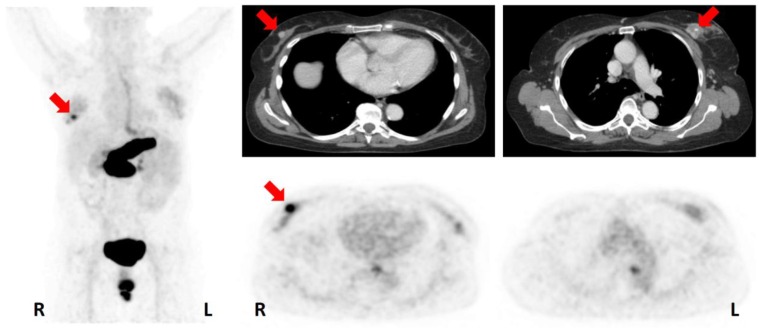
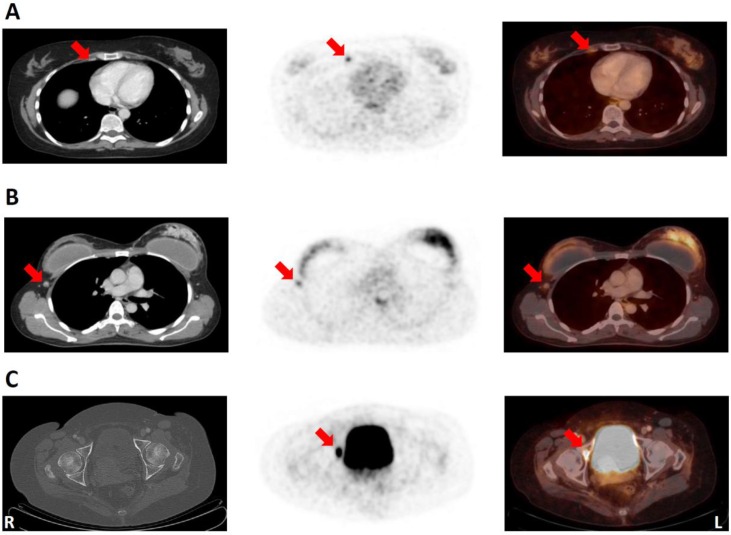
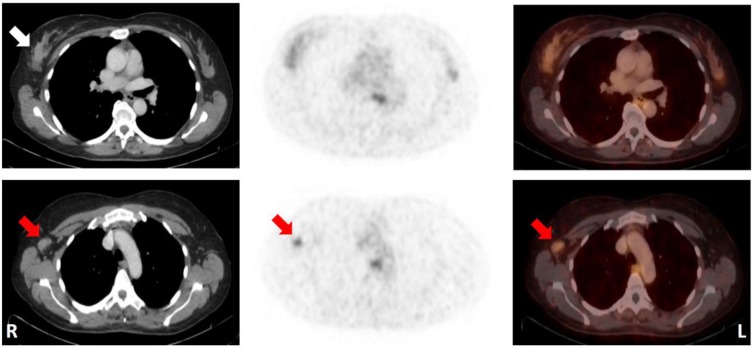
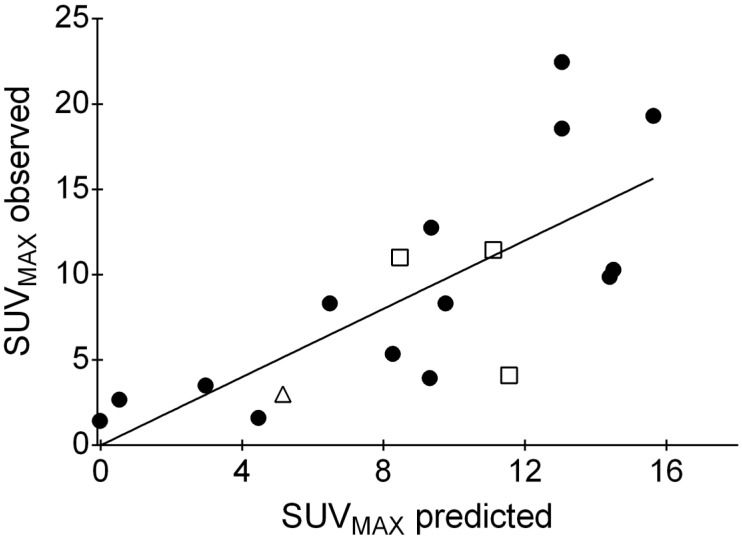
13/18 tumors demonstrated strongly increased (68)Ga-RM2 uptake compared to normal breast tissue (defined as PET-positive). All PET-positive primary tumors were ER- and PR-positive (13/13) in contrast to only 1/5 PET-negative tumors. Mean SUVMAX of ER-positive tumors was 10.6±6.0 compared to 2.3±1.0 in ER-negative tumors (p=0.016). In a multivariate analysis including ER, PR, HER2/neu and MIB-1, only ER expression predicted (68)Ga-RM2 uptake (model: r(2) =0.55, p=0.025). Normal breast tissue showed inter- and intraindividually variable, moderate GRPR binding (SUVMAX 2.3±1.0), while physiological uptake of other organs was considerably less except pancreas. Of note, (68)Ga-RM2-PET/CT detected internal mammary lymph nodes with high (68)Ga-RM2 uptake (n=8), a contralateral axillary lymph node metastasis (verified by biopsy) and bone metastases (n=1; not detected by bone scan and CT).
Our study demonstrates that (68)Ga-RM2-PET/CT is a promising imaging method in ER-positive breast cancer. In vivo GRPR binding assessed by (68)Ga-RM2-PET/CT correlated with ER expression in primary tumors of untreated patients.
胃泌素释放肽受体(GRPR)在乳腺癌中过表达。本研究通过正电子发射断层扫描(PET)和GRPR拮抗剂(68)Ga-RM2评估GRPR成像作为一种新型的乳腺癌成像方式。
15例经活检证实为原发性乳腺癌的女性患者(3例双侧肿瘤;临床分期中位数为IIB期)接受(68)Ga-RM2-PET/CT进行预处理分期。(68)Ga-RM2在体内的肿瘤摄取与乳腺粗针活检标本中的雌激素(ER)和孕激素(PR)受体表达、HER2/neu状态及MIB-1增殖指数相关。
与正常乳腺组织相比(定义为PET阳性),13/18个肿瘤显示(68)Ga-RM2摄取显著增加。所有PET阳性的原发性肿瘤均为ER和PR阳性(13/),而PET阴性肿瘤仅1/5为ER和PR阳性。ER阳性肿瘤的平均SUVMAX为10.6±6.0,而ER阴性肿瘤为2.3±1.0(p=0.016)。在包括ER、PR、HER2/neu和MIB-1的多变量分析中,只有ER表达可预测(68)Ga-RM2摄取(模型:r(2)=0.55,p=0.025)。正常乳腺组织显示个体间和个体内GRPR结合存在差异,呈中度结合(SUVMAX 2.3±1.0),而除胰腺外其他器官的生理性摄取明显较少。值得注意的是,(68)Ga-RM2-PET/CT检测到内乳淋巴结有高(68)Ga-RM2摄取(n=8)、1例对侧腋窝淋巴结转移(经活检证实)及骨转移(n=1;骨扫描和CT未检测到)。
我们的研究表明,(68)Ga-RM2-PET/CT是ER阳性乳腺癌一种有前景的成像方法。通过(68)Ga-RM2-PET/CT评估的体内GRPR结合与未治疗患者原发性肿瘤中的ER表达相关。