Bryant Andrew J, Scott Edward W
Department of Medicine, Division of Pulmonary, Critical Care and Sleep Medicine, University of Florida College of Medicine, Gainesville, FL 32610-0225, USA.
Department of Molecular Genetics & Microbiology, University of Florida College of Medicine, Gainesville, FL 32610-0225, USA.
Receptors Clin Investig. 2016;3(1). doi: 10.14800/rci.1213. Epub 2016 Mar 14.
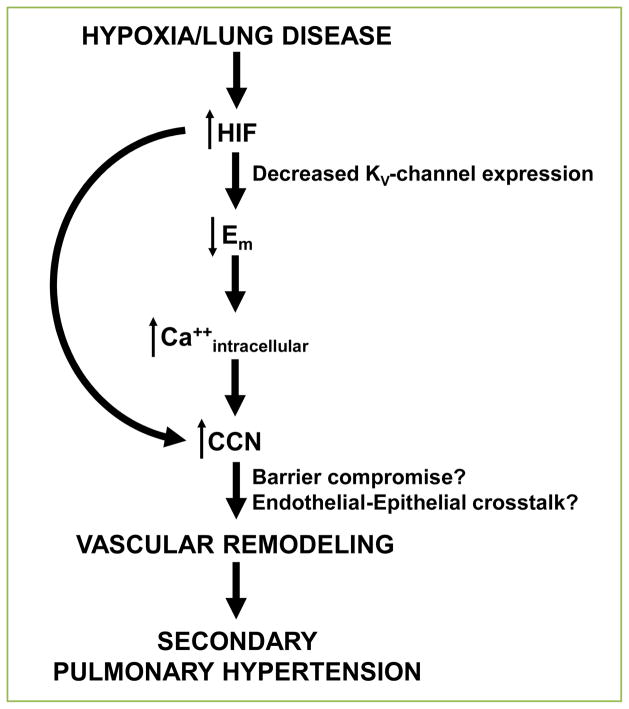
Pulmonary hypertension complicating idiopathic pulmonary fibrosis, also known as secondary pulmonary hypertension, represents a major source of morbidity and mortality in affected patients. While the study of primary pulmonary arterial hypertension has yielded several therapies, the same is not true for the treatment of pulmonary hypertension secondary to pulmonary fibrosis. Recent studies have indicated an important role of hypoxia-inducible factor (HIF) - a regulatory protein that is vital in adaptation to hypoxic conditions - in the development of secondary pulmonary hypertension. HIF influences development of hypoxia-induced pulmonary hypertension through alteration in voltage-gated potassium channels and homeostatic calcium regulation, resulting in disruption of endothelial cell-cell communication, and eventual vascular remodeling. This article summarizes salient literature related to HIF and secondary pulmonary hypertension, in addition to proposing a final common pathway in known mechanistic pathways that result in endothelial barrier integrity loss - vascular "leak" - primarily through a shared endothelial-epithelial signaling protein family, CCN.
肺动脉高压并发特发性肺纤维化,也称为继发性肺动脉高压,是受影响患者发病和死亡的主要原因。虽然对原发性肺动脉高压的研究已经产生了几种治疗方法,但对于继发于肺纤维化的肺动脉高压的治疗却并非如此。最近的研究表明,缺氧诱导因子(HIF)——一种在适应缺氧条件中至关重要的调节蛋白——在继发性肺动脉高压的发展中起重要作用。HIF通过电压门控钾通道的改变和稳态钙调节影响缺氧诱导的肺动脉高压的发展,导致内皮细胞间通讯中断,最终导致血管重塑。本文总结了与HIF和继发性肺动脉高压相关的重要文献,此外还提出了已知机制途径中的最终共同途径,该途径导致内皮屏障完整性丧失——血管“渗漏”——主要通过一个共享的内皮-上皮信号蛋白家族CCN。