Área de Biotecnología Industrial, CIATEJ Centro de Investigación y Asistencia en Tecnología y Diseño del Estado de Jalisco, Av. Normalistas 800, Col. Colinas de la Normal, 44270, Guadalajara, JAL, Mexico.
Systems and Synthetic Biology Group, Department of Biology and Biological Engineering, Chalmers University of Technology, Kemivägen 10, SE-412 96, Göteborg, Sweden.
AMB Express. 2016 Dec;6(1):47. doi: 10.1186/s13568-016-0218-8. Epub 2016 Jul 22.
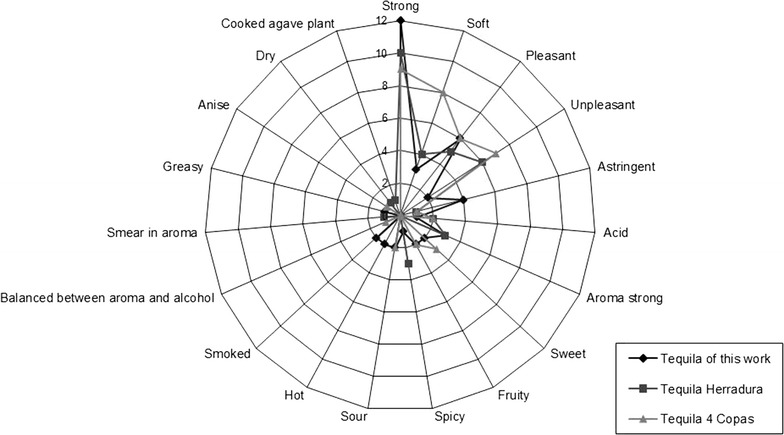
Agave (Agave tequilana Weber var. azul) fermentations are traditionally carried out employing batch systems in the process of tequila manufacturing; nevertheless, continuous cultures could be an attractive technological alternative to increase productivity and efficiency of sugar to ethanol conversion. However, agave juice (used as a culture medium) has nutritional deficiencies that limit the implementation of yeast continuous fermentations, resulting in high residual sugars and low fermentative rates. In this work, fermentations of agave juice using Saccharomyces cerevisiae were put into operation to prove the necessity of supplementing yeast extract, in order to alleviate nutritional deficiencies of agave juice. Furthermore, continuous fermentations were performed at two different aeration flow rates, and feeding sterilized and non-sterilized media. The obtained fermented musts were subsequently distilled to obtain tequila and the preference level was compared against two commercial tequilas, according to a sensorial analysis. The supplementation of agave juice with air and yeast extract augmented the fermentative capacity of S. cerevisiae S1 and the ethanol productivities, compared to those continuous fermentations non supplemented. In fact, aeration improved ethanol production from 37 to 40 g L(-1), reducing sugars consumption from 73 to 88 g L(-1) and ethanol productivity from 3.0 to 3.2 g (Lh)(-1), for non-aerated and aerated (at 0.02 vvm) cultures, respectively. Supplementation of yeast extract allowed an increase in specific growth rate and dilution rates (0.12 h(-1), compared to 0.08 h(-1) of non-supplemented cultures), ethanol production (47 g L(-1)), reducing sugars consumption (93 g L(-1)) and ethanol productivity [5.6 g (Lh)(-1)] were reached. Additionally, the effect of feeding sterilized or non-sterilized medium to the continuous cultures was compared, finding no significant differences between both types of cultures. The overall effect of adding yeast extract and air to the continuous fermentations resulted in 88 % increase in ethanol productivity. For all cultures, pH was not controlled, reaching low pH values (from 2.6 to 3). This feature suggested a reduced probability of contamination for prolonged continuous cultures and explained why no significant differences were found between continuous cultures fed with sterilized or non-sterilized media. Concentrations of volatile compounds quantified in the distillates (tequila) were in the allowed ranges established by the Mexican regulation of tequila (NOM-006-SCFI-2012, Norma Oficial Mexicana: Bebidas alcohólicas-Tequila-specificaciones, 2012). The preference level of the distillates was similar to that of two well-known commercial tequilas. The results suggested the possibility of implementing this innovative technology on an industrial scale, attaining high productivities and using non-sterilized agave juice.
龙舌兰(Agave tequilana Weber var. azul)发酵传统上采用分批系统进行,在龙舌兰酒的生产过程中;然而,连续培养可能是一种有吸引力的技术替代方案,可以提高糖到乙醇转化的生产力和效率。然而,龙舌兰汁(用作培养基)存在营养缺陷,限制了酵母连续发酵的实施,导致高残留糖和低发酵率。在这项工作中,使用酿酒酵母对龙舌兰汁进行了发酵,以证明添加酵母提取物的必要性,以缓解龙舌兰汁的营养缺陷。此外,在两种不同的通气流量下进行了连续发酵,并对灭菌和非灭菌培养基进行了进料。随后将获得的发酵醪进行蒸馏,以获得龙舌兰酒,并根据感官分析比较了与两种商业龙舌兰酒的偏好水平。与未补充的连续发酵相比,用空气和酵母提取物补充龙舌兰汁增强了 S. cerevisiae S1 的发酵能力和乙醇生产率。实际上,通气将乙醇产量从 37 提高到 40 g L(-1),将还原糖消耗从 73 减少到 88 g L(-1),将乙醇生产率从 3.0 提高到 3.2 g (Lh)(-1)对于非充气和充气(在 0.02 vvm 下)培养物,分别。添加酵母提取物可提高比生长速率和稀释速率(0.12 h(-1),而未补充培养物为 0.08 h(-1))、乙醇产量(47 g L(-1))、还原糖消耗(93 g L(-1))和乙醇生产率[5.6 g (Lh)(-1)]。此外,还比较了连续培养物中灭菌或非灭菌培养基的进料效果,发现两种类型的培养物之间没有显着差异。向连续发酵中添加酵母提取物和空气的综合效果导致乙醇生产率提高了 88%。对于所有培养物,均未控制 pH 值,达到低 pH 值(从 2.6 到 3)。这一特征表明,连续培养物的污染概率降低,这也解释了为什么在使用灭菌或非灭菌培养基进料的连续培养物之间没有发现显着差异。在馏出物(龙舌兰酒)中定量的挥发性化合物浓度在墨西哥龙舌兰酒法规(NOM-006-SCFI-2012,墨西哥官方标准:酒精饮料-龙舌兰酒的规格,2012 年)规定的允许范围内。馏出物的偏好水平与两种知名商业龙舌兰酒相似。结果表明,在工业规模上实施这项创新技术的可能性很高,可以实现高生产率,并使用非灭菌的龙舌兰汁。