Hai Yang, Christianson David W
Roy and Diana Vagelos Laboratories, Department of Chemistry, University of Pennsylvania, Philadelphia, Pennsylvania, USA.
Radcliffe Institute for Advanced Study and Department of Chemistry and Chemical Biology, Harvard University, Cambridge, Massachusetts, USA.
Nat Chem Biol. 2016 Sep;12(9):741-7. doi: 10.1038/nchembio.2134. Epub 2016 Jul 25.
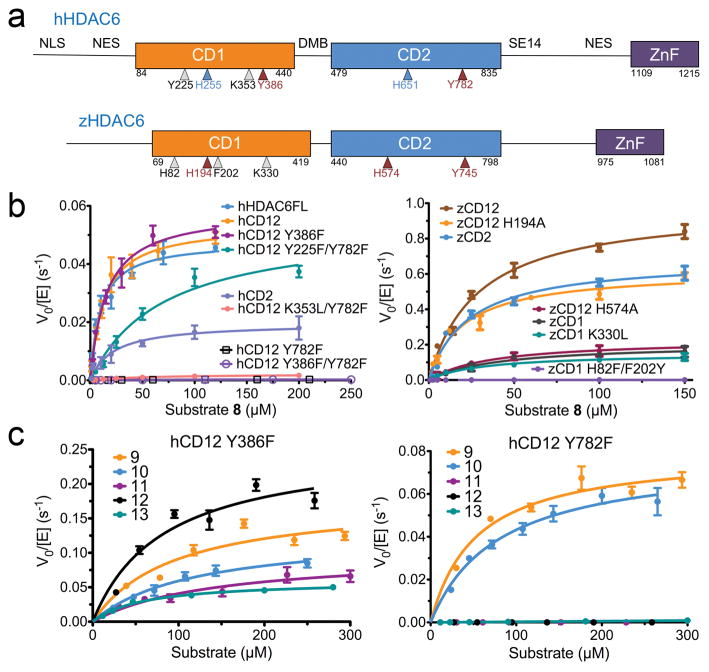
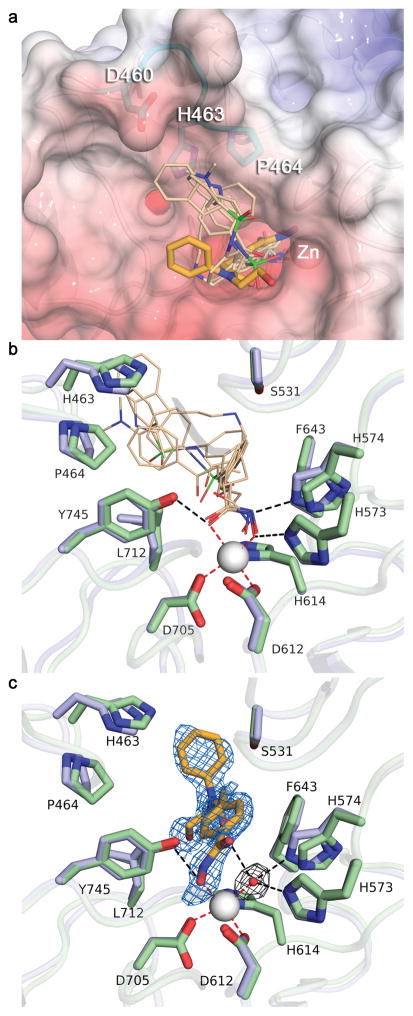
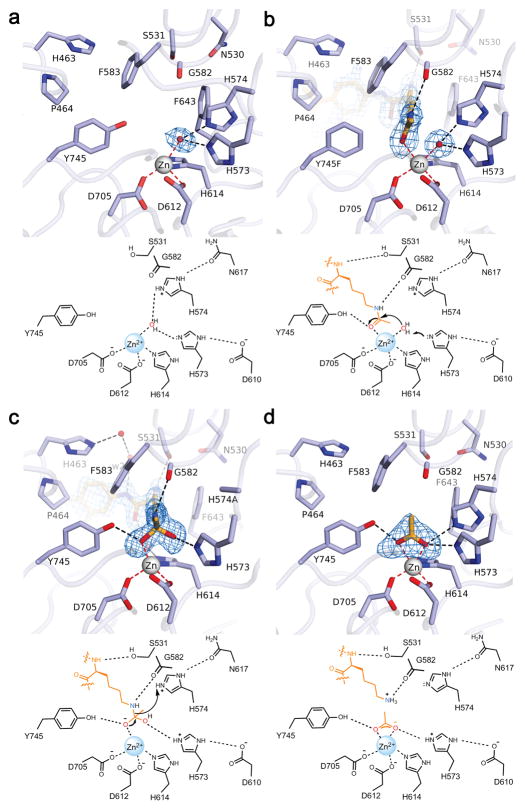
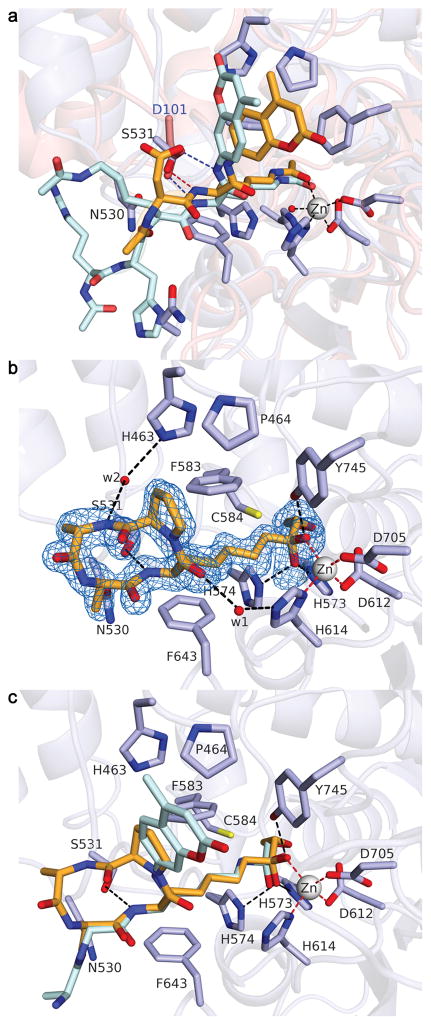
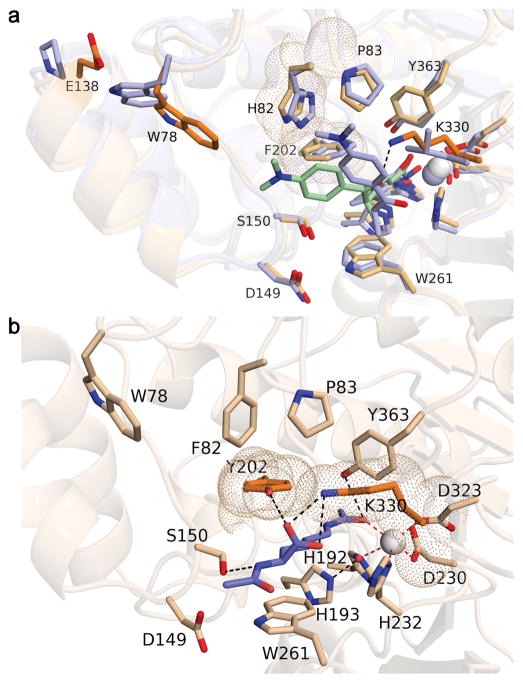
Histone deacetylase 6 (HDAC6) is a critical target for drug design because of its role in oncogenic transformation and cancer metastasis, and is unique among all histone deacetylases in that it contains tandem catalytic domains designated CD1 and CD2. We now report the crystal structures of CD2 from Homo sapiens HDAC6 and of CD1 and CD2 from Danio rerio HDAC6. We correlated these structures with activity measurements using 13 different substrates. The catalytic activity of CD2 from both species exhibited broad substrate specificity, whereas that of CD1 was highly specific for substrates bearing C-terminal acetyllysine residues. Crystal structures of substrate complexes yielded unprecedented snapshots of the catalytic mechanism. Additionally, crystal structures of complexes with eight different inhibitors, including belinostat and panobinostat (currently used in cancer chemotherapy), the macrocyclic tetrapeptide HC toxin, and the HDAC6-specific inhibitor N-hydroxy-4-(2-((2-hydroxyethyl)(phenyl)amino)-2-oxoethyl)benzamide, revealed surprising new insight regarding changes in Zn(2+) coordination and isozyme-specific inhibition.
组蛋白去乙酰化酶6(HDAC6)因其在致癌转化和癌症转移中的作用而成为药物设计的关键靶点,并且在所有组蛋白去乙酰化酶中独一无二,因为它含有称为CD1和CD2的串联催化结构域。我们现在报道了来自智人HDAC6的CD2以及来自斑马鱼HDAC6的CD1和CD2的晶体结构。我们将这些结构与使用13种不同底物的活性测量结果相关联。两种物种的CD2的催化活性表现出广泛的底物特异性,而CD1对带有C端乙酰赖氨酸残基的底物具有高度特异性。底物复合物的晶体结构产生了催化机制前所未有的快照。此外,与八种不同抑制剂形成的复合物的晶体结构,包括贝利司他和帕比司他(目前用于癌症化疗)、大环四肽HC毒素以及HDAC6特异性抑制剂N-羟基-4-(2-((2-羟乙基)(苯基)氨基)-2-氧代乙基)苯甲酰胺,揭示了关于Zn(2+)配位变化和同工酶特异性抑制的惊人新见解。