Li Bin, Hao Pan-Pan, Zhang Yong, Yin Rui-Hong, Kong Qing-Zan, Cai Xiao-Jun, Zhao Zhuo, Qi Jian-Ni, Li Ying, Xiao Jie, Wang Fu, Yi Wei, Ji Xiao-Ping, Su Guo-Hai
Department of Cardiology, Jinan Central Hospital affiliated to Shandong University, Jinan, Shandong, China.
Key Laboratory of Cardiovascular Remodeling and Function Research, Chinese Ministry of Education and Chinese Ministry of Health, Department of Cardiology, Shandong University Qilu Hospital, Jinan, Shandong, China.
Oncotarget. 2017 May 2;8(18):30455-30463. doi: 10.18632/oncotarget.10762.
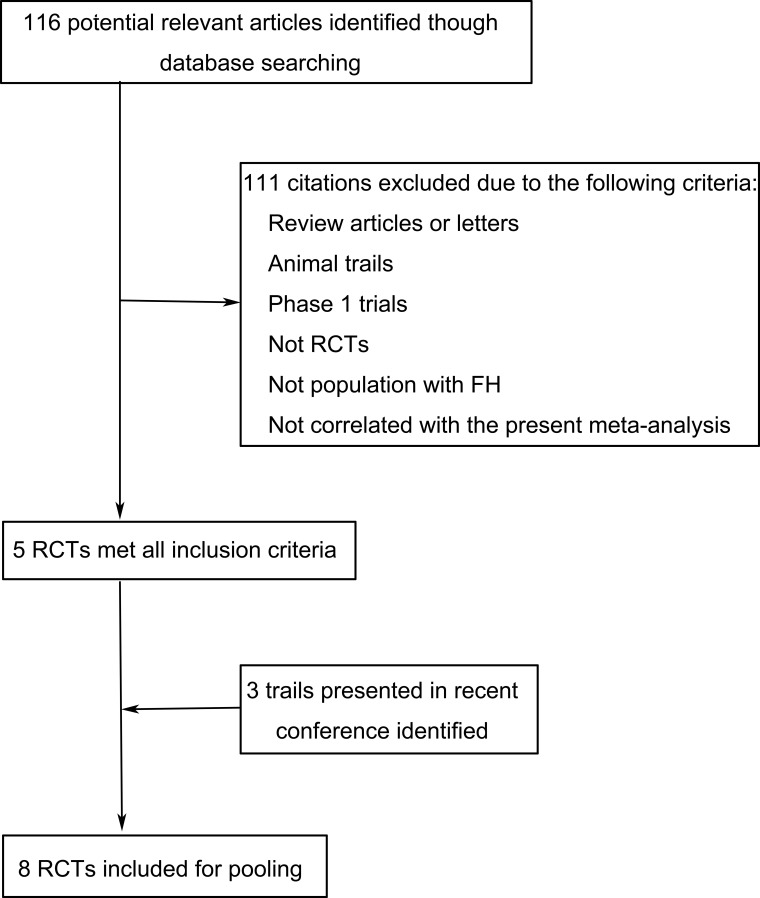
Proprotein convertase-subtilisin/kexin type 9 (PCSK9) monoclonal antibody is a new therapy to reduce low-density lipoprotein cholesterol (LDL-C) level in patients with familial hypercholesterolemia (FH). This pooled analysis aimed to estimate the efficacy and safety of PCSK9 antibody therapy in FH. Reports of randomized controlled trials (RCTs) comparing PCSK9 antibody to placebo were retrieved by a search of MEDLINE via PubMed, EMBASE, the Cochrane Library databases, ClinicalTrials.gov and Clinical Trial Results (up to November 30, 2015) with no language restriction. Data were abstracted by a standardized protocol. We found eight RCTs (1,879 patients with FH) for the pooled analysis. As compared with placebo, PCSK9 antibody therapy remarkably reduced LDL-C level (mean reduction: -48.54 %, 95 % CI: -53.19 to -43.88), total cholesterol (mean reduction: -31.08%, 95 % CI: -35.20 to -26.95), lipoprotein (a) (mean reduction: -20.44%, 95 % CI: -25.21 to -15.66), and apolipoprotein B (mean reduction: -36.32%, 95 % CI: -40.75 to -31.90) and elevated the level of high-density lipoprotein cholesterol (mean change: 6.29 %, 95 % CI: 5.12 to 7.46) and apolipoprotein A1(mean change: 4.86%, 95 % CI: 3.77 to 5.95). Therapy with and without PCSK9 antibodies did not differ in rate of adverse events (pooled rate: 50.86 % vs. 48.63%; RR: 1.03; 95 % CI: 0.92 to 1.15; P = 0.64; heterogeneity P = 0.13; I2= 40%) or serious adverse events (pooled rate: 7.14% vs. 6.74%; RR: 1.05; 95 % CI: 0.70 to 1.58; P = 0.80; heterogeneity P = 0.69; I2= 0%). PCSK9 antibody may be an effective and safe treatment for FH.
前蛋白转化酶枯草溶菌素/kexin 9型(PCSK9)单克隆抗体是一种用于降低家族性高胆固醇血症(FH)患者低密度脂蛋白胆固醇(LDL-C)水平的新疗法。这项汇总分析旨在评估PCSK9抗体疗法在FH中的疗效和安全性。通过PubMed检索MEDLINE、EMBASE、Cochrane图书馆数据库、ClinicalTrials.gov和临床试验结果(截至2015年11月30日),检索比较PCSK9抗体与安慰剂的随机对照试验(RCT)报告,无语言限制。数据通过标准化方案提取。我们纳入八项RCT(1879例FH患者)进行汇总分析。与安慰剂相比,PCSK9抗体疗法显著降低LDL-C水平(平均降低:-48.54%,95%CI:-53.19至-43.88)、总胆固醇(平均降低:-31.08%,95%CI:-35.20至-26.95)、脂蛋白(a)(平均降低:-20.44%,95%CI:-25.21至-15.66)和载脂蛋白B(平均降低:-36.32%,95%CI:-40.75至-31.90),并提高高密度脂蛋白胆固醇水平(平均变化:6.29%,95%CI:5.12至7.46)和载脂蛋白A1(平均变化:4.86%,95%CI:3.77至5.95)。使用和未使用PCSK9抗体治疗的不良事件发生率无差异(汇总发生率:50.86%对48.63%;RR:1.03;95%CI:0.92至1.15;P = 0.64;异质性P = 0.13;I2 = 40%)或严重不良事件发生率(汇总发生率:7.14%对6.74%;RR:1.05;95%CI:0.70至1.58;P = 0.80;异质性P = 0.69;I2 = 0%)。PCSK9抗体可能是一种治疗FH的有效且安全的疗法。