Center for Disability Research, Liberty Mutual Research Institute for Safety, 71 Frankland Road, Hopkinton, MA, 01748, USA.
J Occup Rehabil. 2017 Jun;27(2):284-295. doi: 10.1007/s10926-016-9656-z.
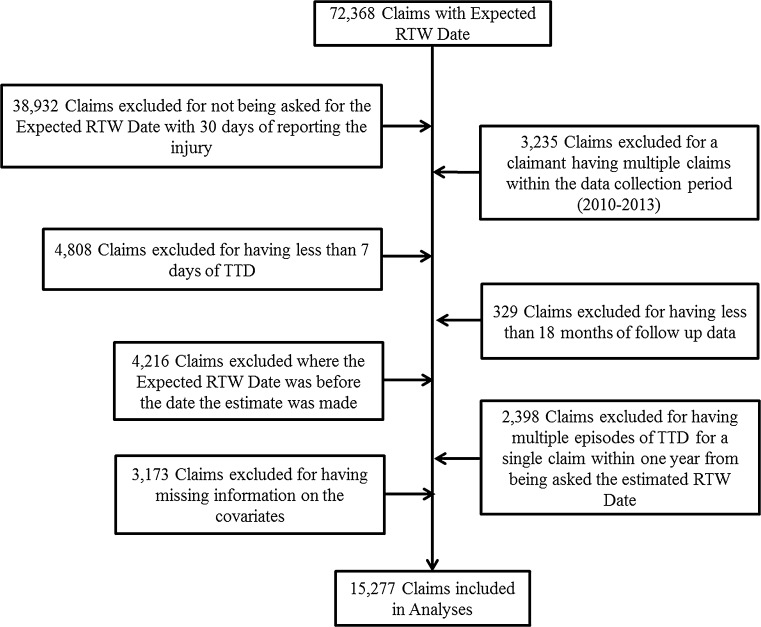
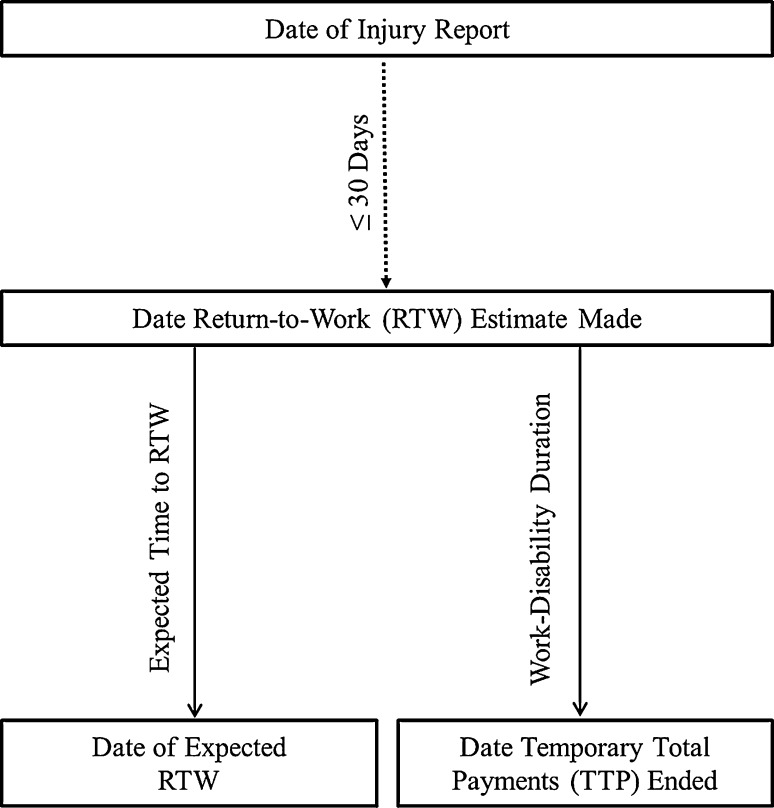
Purpose This research sought to determine whether there is a relationship between claimants' expected time to return to work (RTW) as recorded by claims managers and compensated days of work disability. Methods We utilized workers' compensation data from a large, United States-based insurance company. RTW expectations were collected within 30 days of the claim being reported and these were compared with the termination of total temporary indemnity payments. Bivariate and hierarchical regression analyses were conducted. Results A significant relationship between expected time to RTW and compensated disability duration was observed. The unadjusted correlation between work-disability duration and expected time to RTW was .25 (p < .001). Our multivariate model explained 29.8 % of the variance, with expected time to RTW explaining an additional 9.5 % of the variance in work-disability duration beyond what was explained by the covariates. Conclusion The current study's findings support the hypothesis that claimant RTW estimates as recorded by claims managers are significantly related to compensated-disability duration, and the relationship is maintained after controlling for variance that can be explained by other variables available within workers' compensation databases.
目的 本研究旨在确定索赔管理人记录的索赔人预计重返工作岗位(RTW)时间与工作残疾补偿天数之间是否存在关系。
方法 我们使用了一家大型美国保险公司的工人赔偿数据。在报告索赔后的 30 天内收集 RTW 预期,并将其与总临时赔偿金的终止进行比较。进行了双变量和分层回归分析。
结果 观察到预期 RTW 时间与补偿性残疾持续时间之间存在显著关系。工作残疾持续时间与预期 RTW 时间之间的未经调整的相关性为.25(p<.001)。我们的多变量模型解释了 29.8%的方差,预期 RTW 时间解释了工作残疾持续时间方差的额外 9.5%,超出了协变量可以解释的范围。
结论 本研究的结果支持了这样一种假设,即索赔管理人记录的索赔人 RTW 估计值与补偿性残疾持续时间显著相关,并且在控制工人赔偿数据库中其他可用变量可以解释的方差后,这种关系仍然存在。