Zylberberg Maxine, Van Hemert Caroline, Dumbacher John P, Handel Colleen M, Tihan Tarik, DeRisi Joseph L
Department of Biochemistry and Biophysics, University of California, San Francisco, San Francisco, California, USA California Academy of Sciences, San Francisco, California, USA
U.S. Geological Survey, Alaska Science Center, Anchorage, Alaska, USA.
mBio. 2016 Jul 26;7(4):e00874-16. doi: 10.1128/mBio.00874-16.
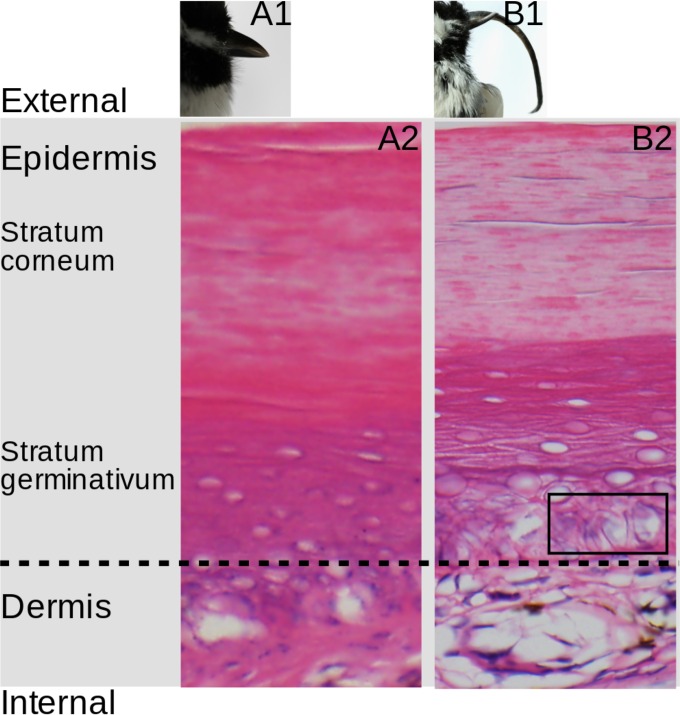
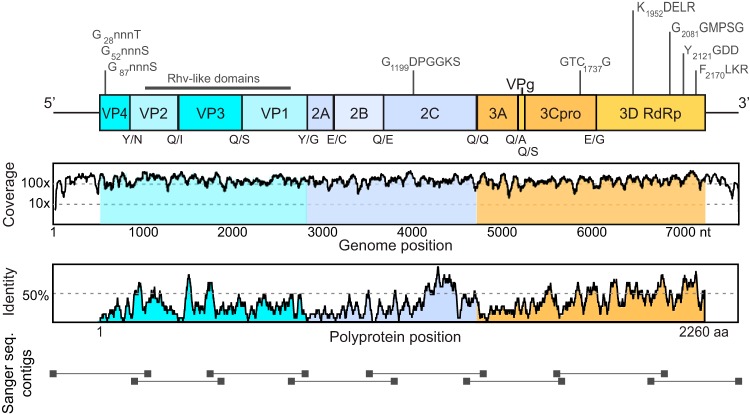
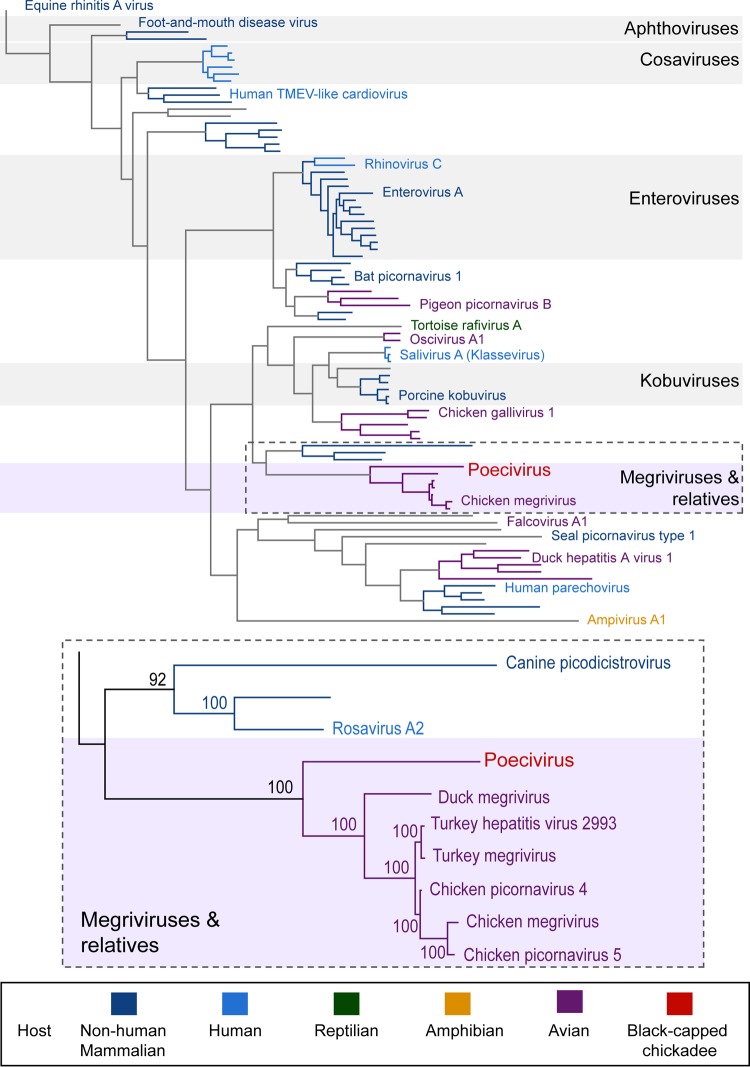
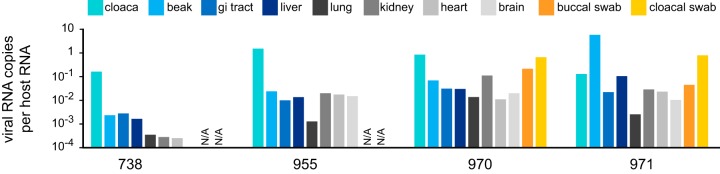
Avian keratin disorder (AKD), characterized by debilitating overgrowth of the avian beak, was first documented in black-capped chickadees (Poecile atricapillus) in Alaska. Subsequently, similar deformities have appeared in numerous species across continents. Despite the widespread distribution of this emerging pathology, the cause of AKD remains elusive. As a result, it is unknown whether suspected cases of AKD in the afflicted species are causally linked, and the impacts of this pathology at the population and community levels are difficult to evaluate. We applied unbiased, metagenomic next-generation sequencing to search for candidate pathogens in birds affected with AKD. We identified and sequenced the complete coding region of a novel picornavirus, which we are calling poecivirus. Subsequent screening of 19 AKD-affected black-capped chickadees and 9 control individuals for the presence of poecivirus revealed that 19/19 (100%) AKD-affected individuals were positive, while only 2/9 (22%) control individuals were infected with poecivirus. Two northwestern crows (Corvus caurinus) and two red-breasted nuthatches (Sitta canadensis) with AKD-consistent pathology also tested positive for poecivirus. We suggest that poecivirus is a candidate etiological agent of AKD.
Avian keratin disorder (AKD) is an increasingly common disease of wild birds. This disease, characterized by beak overgrowth, was first described in the late 1990s and has been spreading rapidly both geographically and in terms of host species affected. AKD decreases host fitness and can be fatal. However, the cause of the disease has remained elusive, and its impact on host populations is poorly understood. We found a novel and divergent picornavirus in 19/19 AKD-affected black-capped chickadees that we examined but in only 2/9 control cases. We also found this virus in 4 individuals of 2 other passerine species that exhibited symptoms consistent with AKD. Our data suggest that this novel picornavirus warrants further investigation as the causative agent of AKD.
禽角蛋白紊乱症(AKD),其特征为禽类喙部过度生长导致衰弱,最早在阿拉斯加的黑顶山雀(Poecile atricapillus)中被记录下来。随后,类似的畸形在各大洲的众多物种中出现。尽管这种新出现的病理学现象分布广泛,但AKD的病因仍然不明。因此,受影响物种中疑似AKD病例是否存在因果关联尚不清楚,而且这种病理学现象在种群和群落层面的影响也难以评估。我们应用无偏见的宏基因组新一代测序技术,在受AKD影响的鸟类中寻找候选病原体。我们鉴定并测序了一种新型小RNA病毒的完整编码区,我们将其命名为雀病毒。随后对19只受AKD影响的黑顶山雀和9只对照个体进行雀病毒检测,结果显示,19/19(100%)受AKD影响的个体呈阳性,而只有2/9(22%)的对照个体感染了雀病毒。两只患有与AKD一致病理学症状的西北乌鸦(Corvus caurinus)和两只棕腹坚果雀(Sitta canadensis)的雀病毒检测也呈阳性。我们认为雀病毒是AKD的候选病原体。
禽角蛋白紊乱症(AKD)是野生鸟类中越来越常见的疾病。这种以喙部过度生长为特征的疾病最早在20世纪90年代末被描述,并且在地理范围和受影响的宿主物种方面都在迅速蔓延。AKD会降低宿主的适应性,甚至可能致命。然而,该病的病因仍然不明,其对宿主种群的影响也知之甚少。我们在19只接受检查的受AKD影响的黑顶山雀中发现了一种新型且不同的小RNA病毒,但在仅9只对照个体中的2只发现了该病毒。我们还在另外2种雀形目物种的4只个体中发现了这种病毒,这些个体表现出与AKD一致的症状。我们的数据表明,这种新型小RNA病毒作为AKD的病原体值得进一步研究。