Baumann Jan, Wong Jason, Sun Yan, Conklin Douglas S
Department of Biomedical Sciences, Cancer Research Center, State University of New York, University at Albany, Rensselaer, NY, 12144, USA.
BMC Cancer. 2016 Jul 27;16:551. doi: 10.1186/s12885-016-2611-8.
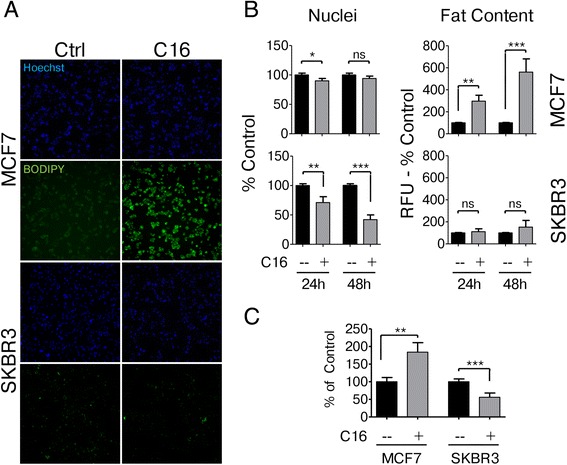
HER2/neu-positive breast cancer cells have recently been shown to use a unique Warburg-like metabolism for survival and aggressive behavior. These cells exhibit increased fatty acid synthesis and storage compared to normal breast cells or other tumor cells. Disruption of this synthetic process results in apoptosis. Since the addition of physiological doses of exogenous palmitate induces cell death in HER2/neu-positive breast cancer cells, the pathway is likely operating at its limits in these cells. We have studied the response of HER2/neu-positive breast cancer cells to physiological concentrations of exogenous palmitate to identify lipotoxicity-associated consequences of this physiology. Since epidemiological data show that a diet rich in saturated fatty acids is negatively associated with the development of HER2/neu-positive cancer, this cellular physiology may be relevant to the etiology and treatment of the disease. We sought to identify signaling pathways that are regulated by physiological concentrations of exogenous palmitate specifically in HER2/neu-positive breast cancer cells and gain insights into the molecular mechanism and its relevance to disease prevention and treatment.
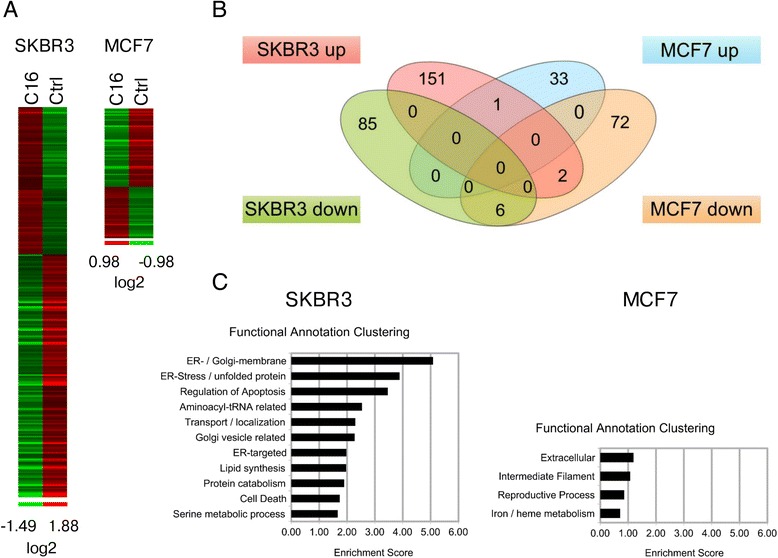
Transcriptional profiling was performed to assess programs that are regulated in HER2-normal MCF7 and HER2/neu-positive SKBR3 breast cancer cells in response to exogenous palmitate. Computational analyses were used to define and predict functional relationships and identify networks that are differentially regulated in the two cell lines. These predictions were tested using reporter assays, fluorescence-based high content microscopy, flow cytometry and immunoblotting. Physiological effects were confirmed in HER2/neu-positive BT474 and HCC1569 breast cancer cell lines.
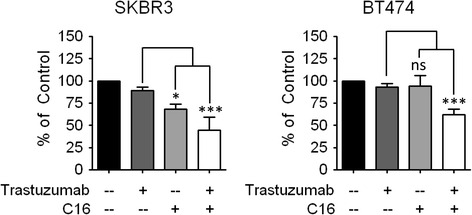
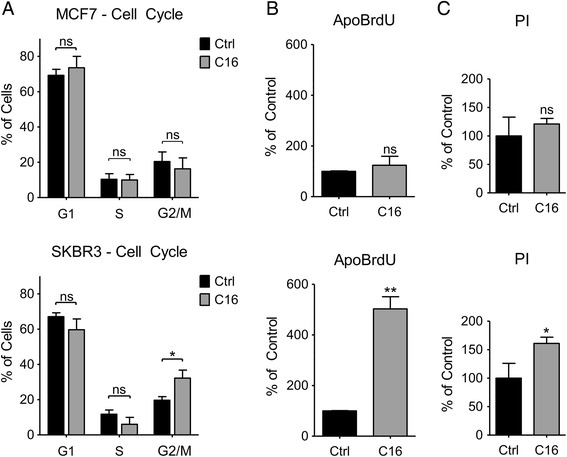
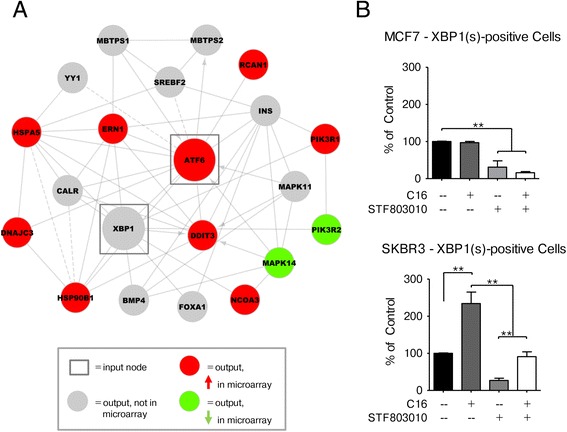
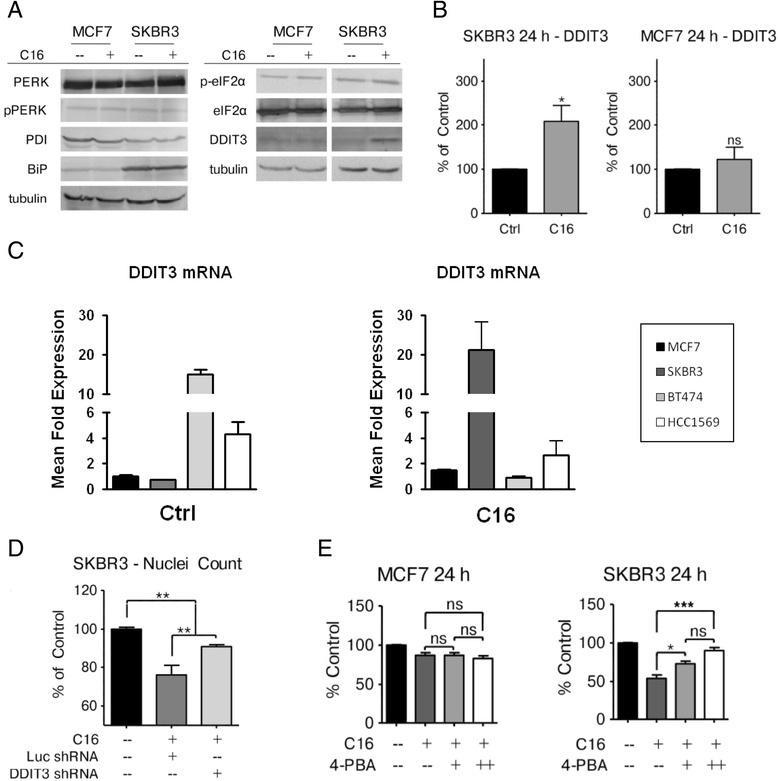
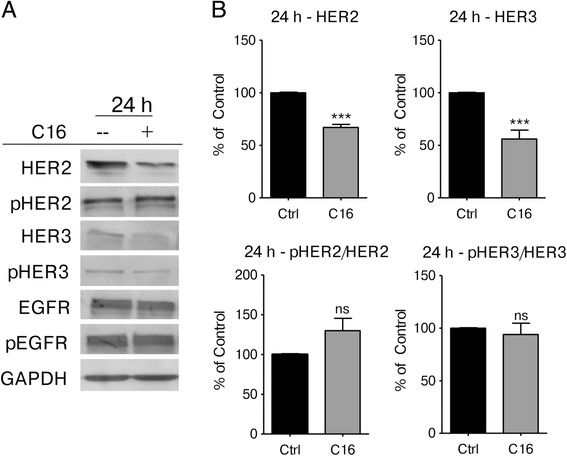
Exogenous palmitate induces functionally distinct transcriptional programs in HER2/neu-positive breast cancer cells. In the lipogenic HER2/neu-positive SKBR3 cell line, palmitate induces a G2 phase cell cycle delay and CHOP-dependent apoptosis as well as a partial activation of the ER stress response network via XBP1 and ATF6. This response appears to be a general feature of HER2/neu-positive breast cancer cells but not cells that overexpress only HER2/neu. Exogenous palmitate reduces HER2 and HER3 protein levels without changes in phosphorylation and sensitizes HER2/neu-positive breast cancer cells to treatment with the HER2-targeted therapy trastuzumab.
Several studies have shown that HER2, FASN and fatty acid synthesis are functionally linked. Exogenous palmitate exerts its toxic effects in part through inducing ER stress, reducing HER2 expression and thereby sensitizing cells to trastuzumab. These data provide further evidence that HER2 signaling and fatty acid metabolism are highly integrated processes that may be important for disease development and progression.
最近研究表明,HER2/neu阳性乳腺癌细胞利用一种独特的类瓦伯格代谢方式来实现存活和侵袭性行为。与正常乳腺细胞或其他肿瘤细胞相比,这些细胞的脂肪酸合成和储存增加。这种合成过程的中断会导致细胞凋亡。由于添加生理剂量的外源性棕榈酸会诱导HER2/neu阳性乳腺癌细胞死亡,因此该途径在这些细胞中可能处于极限运作状态。我们研究了HER2/neu阳性乳腺癌细胞对生理浓度外源性棕榈酸的反应,以确定这种生理状态下与脂毒性相关的后果。由于流行病学数据表明,富含饱和脂肪酸的饮食与HER2/neu阳性癌症的发生呈负相关,这种细胞生理状态可能与该疾病的病因和治疗相关。我们试图确定在外源性棕榈酸生理浓度作用下,特别是在HER2/neu阳性乳腺癌细胞中受到调控的信号通路,并深入了解其分子机制及其与疾病预防和治疗的相关性。
进行转录谱分析,以评估HER2正常的MCF7和HER2/neu阳性的SKBR3乳腺癌细胞对外源性棕榈酸的反应中所调控的程序。利用计算分析来定义和预测功能关系,并识别在这两种细胞系中差异调控的网络。使用报告基因检测、基于荧光的高内涵显微镜、流式细胞术和免疫印迹对这些预测进行验证。在HER2/neu阳性的BT474和HCC1569乳腺癌细胞系中证实了生理效应。
外源性棕榈酸在HER2/neu阳性乳腺癌细胞中诱导功能不同的转录程序。在具有脂肪生成能力的HER2/neu阳性SKBR3细胞系中,棕榈酸诱导G2期细胞周期延迟和CHOP依赖的细胞凋亡,以及通过XBP1和ATF6对内质网应激反应网络的部分激活。这种反应似乎是HER2/neu阳性乳腺癌细胞的一个普遍特征,而不仅仅是仅过表达HER2/neu的细胞所具有的特征。外源性棕榈酸降低HER2和HER3蛋白水平,但不改变其磷酸化状态,并使HER2/neu阳性乳腺癌细胞对HER2靶向治疗曲妥珠单抗治疗敏感。
多项研究表明,HER2、脂肪酸合酶(FASN)和脂肪酸合成在功能上相互关联。外源性棕榈酸部分通过诱导内质网应激、降低HER2表达从而使细胞对曲妥珠单抗敏感来发挥其毒性作用。这些数据进一步证明,HER2信号传导和脂肪酸代谢是高度整合的过程,可能对疾病的发生和发展很重要。