Shell Global Solutions International, Kessler Park 1, 2288 GS Rijswijk, The Netherlands.
Department of Earth Sciences, University of Cambridge, Downing Street, Cambridge CB2 3EQ, UK.
Nat Commun. 2016 Jul 28;7:12268. doi: 10.1038/ncomms12268.
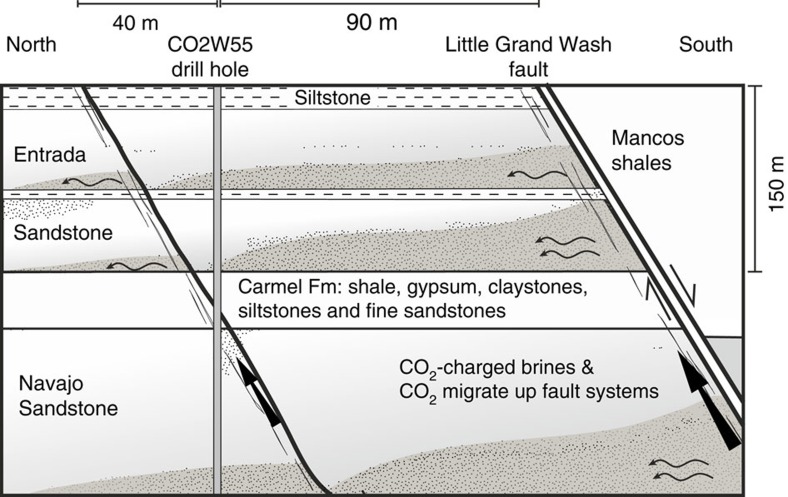
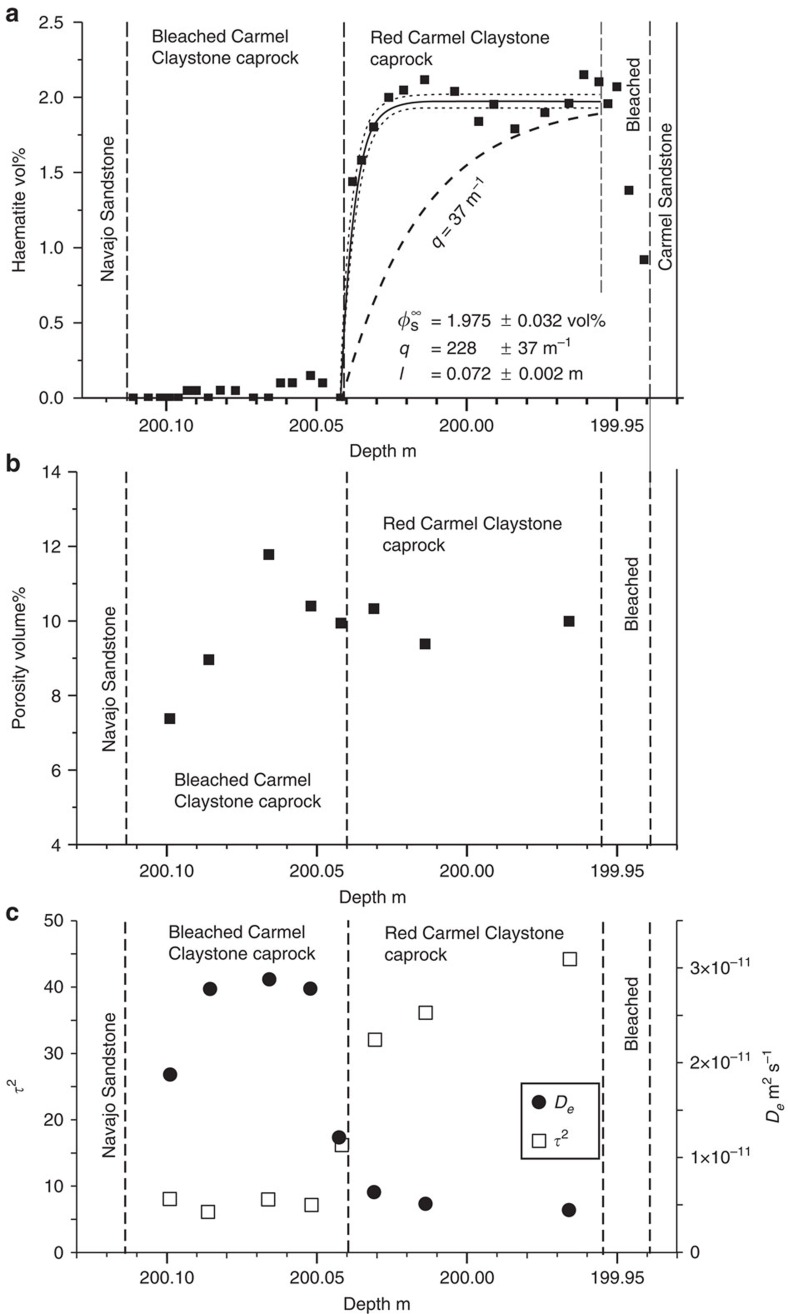
Storage of anthropogenic CO2 in geological formations relies on a caprock as the primary seal preventing buoyant super-critical CO2 escaping. Although natural CO2 reservoirs demonstrate that CO2 may be stored safely for millions of years, uncertainty remains in predicting how caprocks will react with CO2-bearing brines. This uncertainty poses a significant challenge to the risk assessment of geological carbon storage. Here we describe mineral reaction fronts in a CO2 reservoir-caprock system exposed to CO2 over a timescale comparable with that needed for geological carbon storage. The propagation of the reaction front is retarded by redox-sensitive mineral dissolution reactions and carbonate precipitation, which reduces its penetration into the caprock to ∼7 cm in ∼10(5) years. This distance is an order-of-magnitude smaller than previous predictions. The results attest to the significance of transport-limited reactions to the long-term integrity of sealing behaviour in caprocks exposed to CO2.
在地质构造中储存人为产生的二氧化碳(CO2)依赖于一个盖帽岩作为主要的密封层,以防止浮力超临界 CO2 逸出。尽管天然 CO2 储层表明 CO2 可以安全储存数百万年,但仍不确定盖帽岩将如何与含 CO2 的卤水发生反应。这种不确定性对地质碳储存的风险评估构成了重大挑战。在这里,我们描述了暴露于 CO2 中超过地质碳储存所需时间尺度的 CO2 储层-盖帽岩系统中的矿物反应前缘。反应前缘的传播受到氧化还原敏感矿物溶解反应和碳酸盐沉淀的阻碍,这将其穿透盖帽岩的深度减少到约 10(5)年内的 7 厘米左右。这个距离比以前的预测小一个数量级。研究结果证明了在暴露于 CO2 的盖帽岩中,运输限制反应对密封性能的长期完整性具有重要意义。