
CD90(THY-1)表达的降低导致间充质基质细胞分化增加。
A reduction in CD90 (THY-1) expression results in increased differentiation of mesenchymal stromal cells.
作者信息
Moraes Daniela A, Sibov Tatiana T, Pavon Lorena F, Alvim Paula Q, Bonadio Raphael S, Da Silva Jaqueline R, Pic-Taylor Aline, Toledo Orlando A, Marti Luciana C, Azevedo Ricardo B, Oliveira Daniela M
机构信息
Departamento de Genética e Morfologia, Universidade de Brasília, Brasília, DF, Brazil.
Centro Universitario do Distrito Federal UDF, Brasília, DF, Brazil.
出版信息
Stem Cell Res Ther. 2016 Jul 28;7(1):97. doi: 10.1186/s13287-016-0359-3.
BACKGROUND
Mesenchymal stromal cells (MSCs) are multipotent progenitor cells used in several cell therapies. MSCs are characterized by the expression of CD73, CD90, and CD105 cell markers, and the absence of CD34, CD45, CD11a, CD19, and HLA-DR cell markers. CD90 is a glycoprotein present in the MSC membranes and also in adult cells and cancer stem cells. The role of CD90 in MSCs remains unknown. Here, we sought to analyse the role that CD90 plays in the characteristic properties of in vitro expanded human MSCs.
METHODS
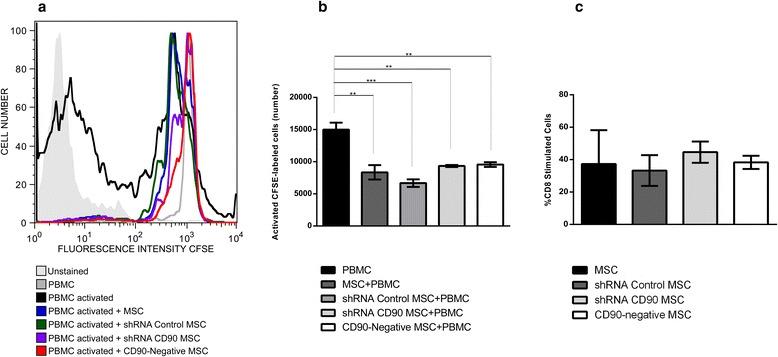
We investigated the function of CD90 with regard to morphology, proliferation rate, suppression of T-cell proliferation, and osteogenic/adipogenic differentiation of MSCs by reducing the expression of this marker using CD90-target small hairpin RNA lentiviral vectors.
RESULTS
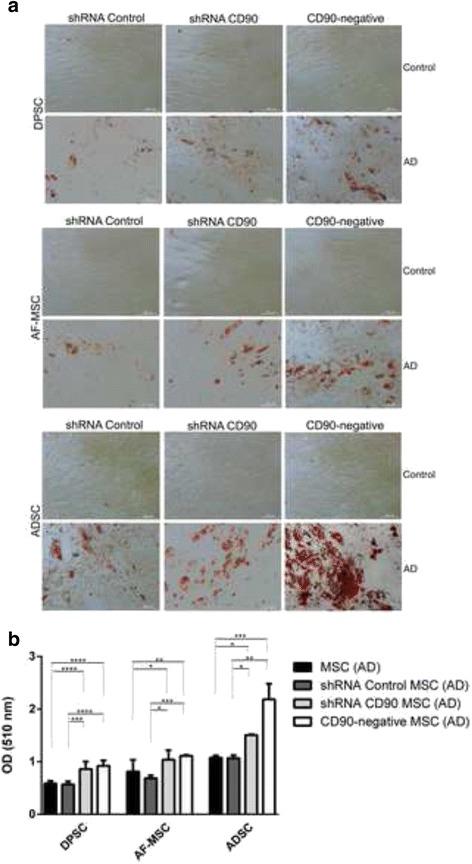
The present study shows that a reduction in CD90 expression enhances the osteogenic and adipogenic differentiation of MSCs in vitro and, unexpectedly, causes a decrease in CD44 and CD166 expression.
CONCLUSION
Our study suggests that CD90 controls the differentiation of MSCs by acting as an obstacle in the pathway of differentiation commitment. This may be overcome in the presence of the correct differentiation stimuli, supporting the idea that CD90 level manipulation may lead to more efficient differentiation rates in vitro.
背景
间充质基质细胞(MSCs)是用于多种细胞治疗的多能祖细胞。MSCs的特征是表达CD73、CD90和CD105细胞标志物,且不表达CD34、CD45、CD11a、CD19和HLA-DR细胞标志物。CD90是一种存在于MSC膜中以及成体细胞和癌症干细胞中的糖蛋白。CD90在MSCs中的作用尚不清楚。在此,我们试图分析CD90在体外扩增的人MSCs特性中所起的作用。
方法
我们通过使用靶向CD90的小发夹RNA慢病毒载体降低该标志物的表达,研究了CD90在MSCs的形态、增殖率、抑制T细胞增殖以及成骨/成脂分化方面的功能。
结果
本研究表明,CD90表达的降低增强了MSCs在体外的成骨和成脂分化,并且出乎意料的是,导致CD44和CD166表达下降。
结论
我们的研究表明,CD90通过在分化承诺途径中充当障碍来控制MSCs的分化。在存在正确的分化刺激时,这一点可能会被克服,这支持了操纵CD90水平可能导致体外更高效分化率的观点。




 Zotero 插件