Saman Yougan, Mclellan Lucie, Mckenna Laurence, Dutia Mayank B, Obholzer Rupert, Libby Gerald, Gleeson Michael, Bamiou Doris-Eva
Institute of Neurology, National Hospital for Neurology and Neurosurgery, UCL, London, UK; Nelson R. Mandela School of Medicine, UKZN, Durban, South Africa.
Neuro-otology Department, National Hospital for Neurology and Neurosurgery , London , England.
Front Neurol. 2016 Jul 13;7:101. doi: 10.3389/fneur.2016.00101. eCollection 2016.
Evidence is emerging for a significant clinical and neuroanatomical relationship between balance and anxiety. Research has suggested a potentially priming effect with anxiety symptoms predicting a worsening of balance function in patients with underlying balance dysfunction. We propose to show that a vestibular stimulus is responsible for an increase in state anxiety, and there is a relationship between increased state anxiety and worsening balance function.
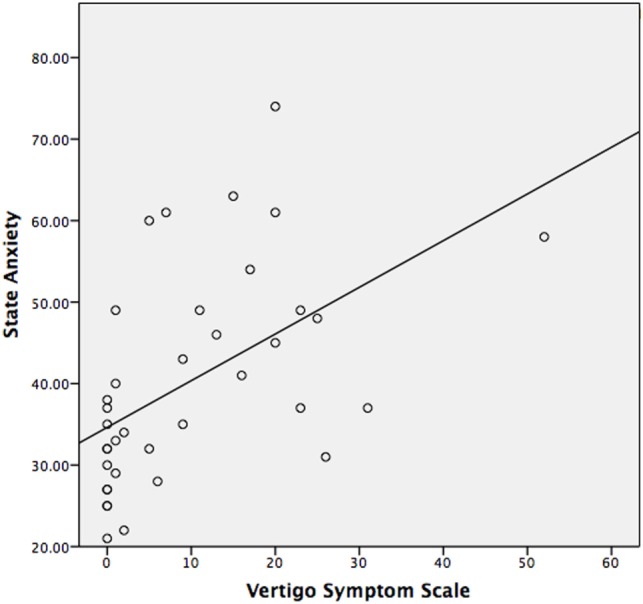
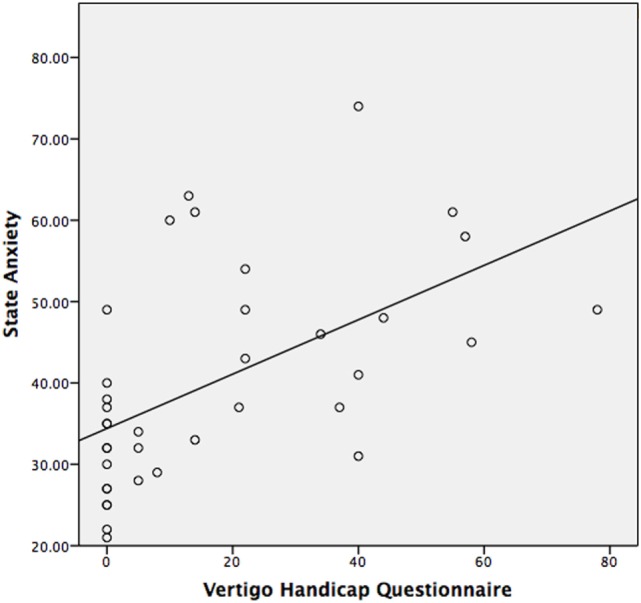
(1) To quantify state anxiety following a vestibular stimulus in patients with a chronic vestibular deficit. (2) To determine if state anxiety during a vestibular stimulus would correlate with the severity of chronic balance symptoms and handicap.
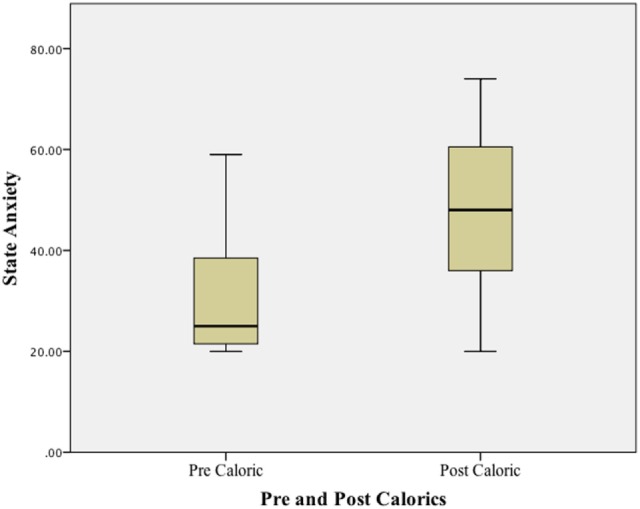
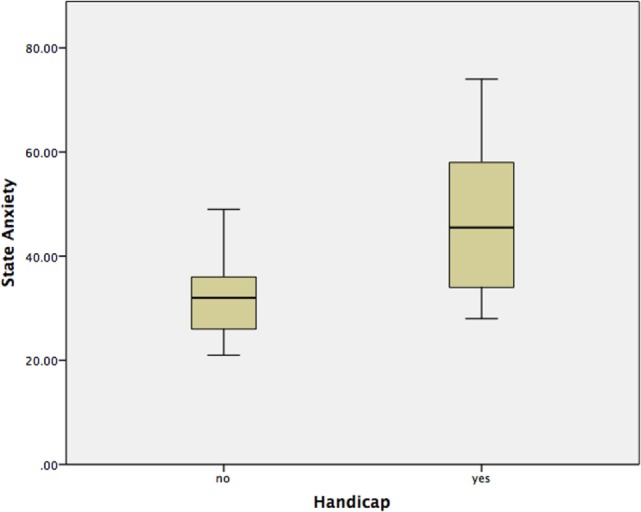
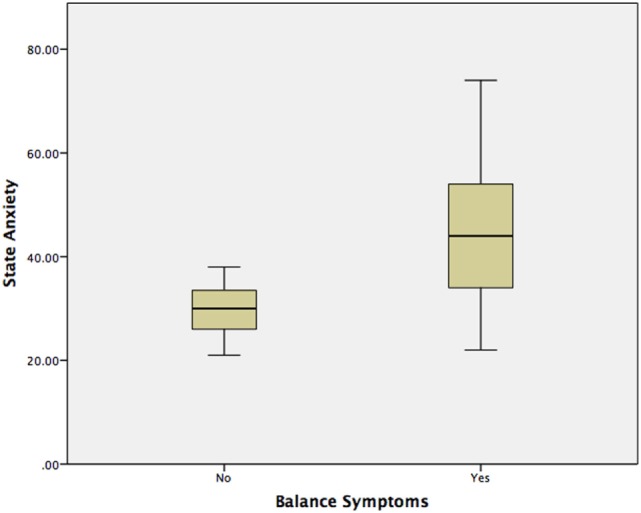
Two separate cohorts of vestibular schwannoma (VS) patients underwent vestibular tests (electronystagmography, cervical and ocular vestibular evoked myogenic potentials, and caloric responses) and questionnaire assessments [vertigo handicap questionnaire (VHQ), vertigo symptom scale (VSS), and state-trait anxiety inventory (STAIY)]. Fifteen post-resection VS patients, with complete unilateral vestibular deafferentation, were assessed at a minimum of 6 months after surgery in Experiment 1 (Aim 1). Forty-five patients with VS in situ formed the cohort for Experiment 2 (Aim 2). Experiment 1: VS subjects (N = 15) with a complete post-resection unilateral vestibular deafferentation completed a state anxiety questionnaire before caloric assessment and again afterward with the point of maximal vertigo as the reference (Aim 1). Experiment 2: state anxiety measured at the point of maximal vertigo following a caloric assessment was compared between two groups of patients with VS in situ presenting with balance symptoms (Group 1, N = 26) and without balance symptoms (Group 2, N = 11) (Aim 2). The presence of balance symptoms was defined as having a positive score on the VSS-VER.
In Experiment 1, a significant difference (p < 0.01) was found when comparing STAIY at baseline and at the peak of the subjective vertiginous response in post-resection patients with a unilateral vestibular deafferentation. In Experiment 2, VS in situ patients with balance symptoms had significantly worse state anxiety at the peak vertiginous response than patients without balance symptoms (p < 0.001), as did patients with a balance-related handicap (p < 0.001).
Anxiety symptoms during a vestibular stimulus may contribute to a priming effect that could explain worsening balance function.
越来越多的证据表明平衡与焦虑之间存在显著的临床和神经解剖学关系。研究表明,焦虑症状可能具有潜在的启动效应,可预测存在潜在平衡功能障碍的患者平衡功能恶化。我们提出,前庭刺激会导致状态焦虑增加,且状态焦虑增加与平衡功能恶化之间存在关联。
(1)量化慢性前庭功能缺损患者在前庭刺激后的状态焦虑。(2)确定前庭刺激期间的状态焦虑是否与慢性平衡症状的严重程度和功能障碍相关。
两组不同的前庭神经鞘瘤(VS)患者接受了前庭测试(眼震电图、颈肌和眼肌前庭诱发肌源性电位以及冷热试验反应)和问卷调查评估[眩晕功能障碍问卷(VHQ)、眩晕症状量表(VSS)以及状态-特质焦虑量表(STAIY)]。在实验1(目的1)中,对15例单侧前庭完全失传入的VS切除术后患者,在术后至少6个月进行评估。45例原位VS患者组成实验2(目的2)的队列。实验1:单侧前庭完全失传入的VS切除术后患者(N = 15)在冷热试验评估前及评估后以最大眩晕点为参照完成状态焦虑问卷(目的1)。实验2:比较两组原位VS患者在冷热试验评估后最大眩晕点时测量的状态焦虑,一组有平衡症状(第1组,N = 26),另一组无平衡症状(第2组,N = 11)(目的2)。平衡症状的存在定义为VSS-VER得分呈阳性。
在实验1中,比较单侧前庭失传入的切除术后患者基线时和主观眩晕反应峰值时的STAIY,发现存在显著差异(p < 0.01)。在实验2中,原位VS有平衡症状的患者在眩晕反应峰值时的状态焦虑显著高于无平衡症状的患者(p < 0.001),有平衡相关功能障碍的患者也是如此(p < 0.001)。
前庭刺激期间的焦虑症状可能导致一种启动效应,这可以解释平衡功能的恶化。