Nunn Charles L, Samson David R, Krystal Andrew D
Department of Evolutionary Anthropology, Duke University, Durham, North Carolina 27708, USA Duke Global Health Institute, Durham, North Carolina 27710, USA Triangle Center for Evolutionary Medicine, Durham, NC 27708, USA
Department of Evolutionary Anthropology, Duke University, Durham, North Carolina 27708, USA.
Evol Med Public Health. 2016 Aug 3;2016(1):227-43. doi: 10.1093/emph/eow018. Print 2016.
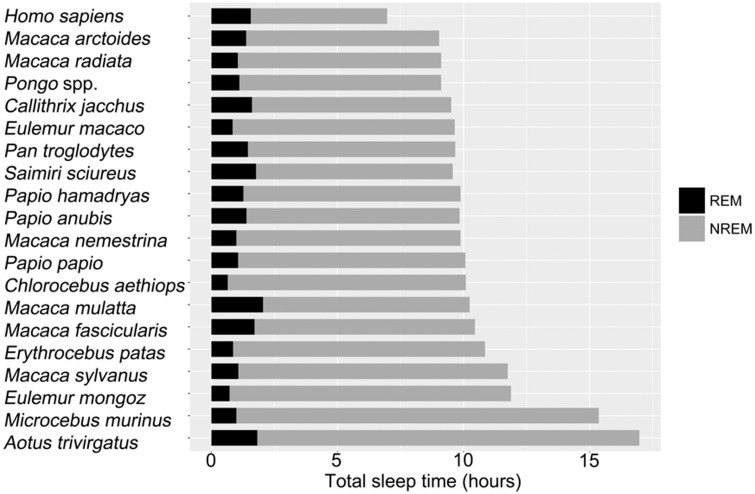
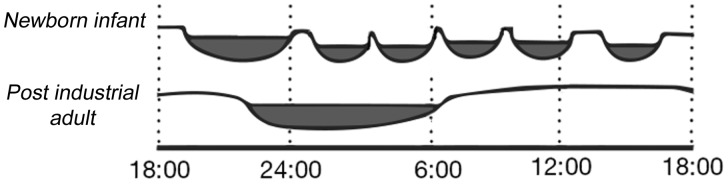
Sleep is essential to cognitive function and health in humans, yet the ultimate reasons for sleep-i.e. 'why' sleep evolved-remain mysterious. We integrate findings from human sleep studies, the ethnographic record, and the ecology and evolution of mammalian sleep to better understand sleep along the human lineage and in the modern world. Compared to other primates, sleep in great apes has undergone substantial evolutionary change, with all great apes building a sleeping platform or 'nest'. Further evolutionary change characterizes human sleep, with humans having the shortest sleep duration, yet the highest proportion of rapid eye movement sleep among primates. These changes likely reflect that our ancestors experienced fitness benefits from being active for a greater portion of the 24-h cycle than other primates, potentially related to advantages arising from learning, socializing and defending against predators and hostile conspecifics. Perspectives from evolutionary medicine have implications for understanding sleep disorders; we consider these perspectives in the context of insomnia, narcolepsy, seasonal affective disorder, circadian rhythm disorders and sleep apnea. We also identify how human sleep today differs from sleep through most of human evolution, and the implications of these changes for global health and health disparities. More generally, our review highlights the importance of phylogenetic comparisons in understanding human health, including well-known links between sleep, cognitive performance and health in humans.
睡眠对人类的认知功能和健康至关重要,然而睡眠的根本原因——即睡眠为何会进化——仍然是个谜。我们整合了人类睡眠研究、人种志记录以及哺乳动物睡眠的生态学和进化方面的研究结果,以便更好地理解人类谱系及现代世界中的睡眠情况。与其他灵长类动物相比,大型猿类的睡眠经历了重大的进化变化,所有大型猿类都会搭建睡眠平台或“巢穴”。人类睡眠有进一步的进化变化,人类的睡眠时间最短,但在灵长类动物中快速眼动睡眠的比例最高。这些变化可能反映出,我们的祖先比其他灵长类动物在24小时周期中的更大比例时间内保持活跃从而获得了适应性优势,这可能与学习、社交以及抵御捕食者和敌对同类所带来的优势有关。进化医学的观点对于理解睡眠障碍具有启示意义;我们在失眠、发作性睡病、季节性情感障碍、昼夜节律障碍和睡眠呼吸暂停的背景下考虑这些观点。我们还确定了当今人类睡眠与人类大部分进化过程中的睡眠有何不同,以及这些变化对全球健康和健康差距的影响。更广泛地说,我们的综述强调了系统发育比较在理解人类健康方面的重要性,包括睡眠、认知表现和人类健康之间的知名联系。