
亨廷顿舞蹈症会加速人类大脑的表观遗传衰老,并扰乱DNA甲基化水平。
Huntington's disease accelerates epigenetic aging of human brain and disrupts DNA methylation levels.
作者信息
Horvath Steve, Langfelder Peter, Kwak Seung, Aaronson Jeff, Rosinski Jim, Vogt Thomas F, Eszes Marika, Faull Richard L M, Curtis Maurice A, Waldvogel Henry J, Choi Oi-Wa, Tung Spencer, Vinters Harry V, Coppola Giovanni, Yang X William
机构信息
Human Genetics, David Geffen School of Medicine, University of California Los Angeles, Los Angeles, CA 90095, USA.
Biostatistics, Fielding School of Public Health, University of California Los Angeles, Los Angeles, CA 90095, USA.
出版信息
Aging (Albany NY). 2016 Jul;8(7):1485-512. doi: 10.18632/aging.101005.
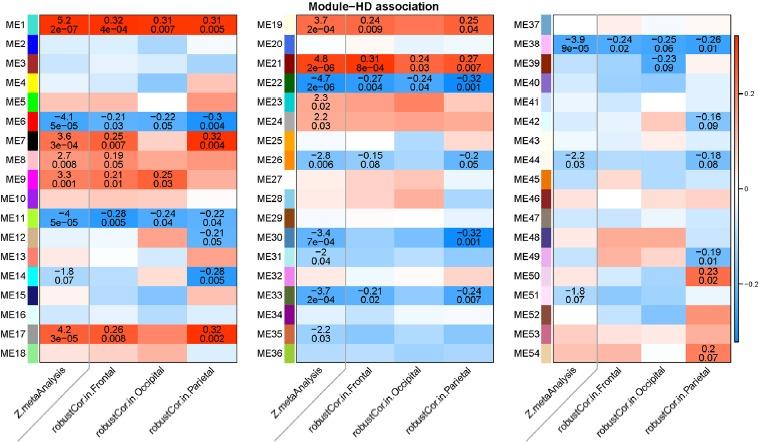
Age of Huntington's disease (HD) motoric onset is strongly related to the number of CAG trinucleotide repeats in the huntingtin gene, suggesting that biological tissue age plays an important role in disease etiology. Recently, a DNA methylation based biomarker of tissue age has been advanced as an epigenetic aging clock. We sought to inquire if HD is associated with an accelerated epigenetic age. DNA methylation data was generated for 475 brain samples from various brain regions of 26 HD cases and 39 controls. Overall, brain regions from HD cases exhibit a significant epigenetic age acceleration effect (p=0.0012). A multivariate model analysis suggests that HD status increases biological age by 3.2 years. Accelerated epigenetic age can be observed in specific brain regions (frontal lobe, parietal lobe, and cingulate gyrus). After excluding controls, we observe a negative correlation (r=-0.41, p=5.5×10⁻⁸) between HD gene CAG repeat length and the epigenetic age of HD brain samples. Using correlation network analysis, we identify 11 co-methylation modules with a significant association with HD status across 3 broad cortical regions. In conclusion, HD is associated with an accelerated epigenetic age of specific brain regions and more broadly with substantial changes in brain methylation levels.
亨廷顿舞蹈症(HD)运动症状出现的年龄与亨廷顿基因中CAG三核苷酸重复序列的数量密切相关,这表明生物组织年龄在疾病病因学中起着重要作用。最近,一种基于DNA甲基化的组织年龄生物标志物已被提出作为一种表观遗传衰老时钟。我们试图探究HD是否与表观遗传年龄加速有关。我们为来自26例HD患者和39名对照的不同脑区的475个脑样本生成了DNA甲基化数据。总体而言,HD患者的脑区表现出显著的表观遗传年龄加速效应(p = 0.0012)。多变量模型分析表明,HD状态使生物年龄增加3.2岁。在特定脑区(额叶、顶叶和扣带回)可观察到表观遗传年龄加速。排除对照后,我们观察到HD基因CAG重复长度与HD脑样本的表观遗传年龄之间存在负相关(r = -0.41,p = 5.5×10⁻⁸)。使用相关网络分析,我们在3个广泛的皮质区域中识别出11个与HD状态显著相关的共甲基化模块。总之,HD与特定脑区的表观遗传年龄加速有关,更广泛地说,与脑甲基化水平的实质性变化有关。


 Zotero 插件