Saito Ikuo, Kario Kazuomi, Kushiro Toshio, Teramukai Satoshi, Yaginuma Mai, Mori Yoshihiro, Okuda Yasuyuki, Shimada Kazuyuki
Keio University Health Center, Yokohama, Japan.
Division of Cardiovascular Medicine, Department of Medicine, Jichi Medical University School of Medicine, Shimotsuke, Japan.
Hypertens Res. 2016 Dec;39(12):857-862. doi: 10.1038/hr.2016.99. Epub 2016 Aug 4.
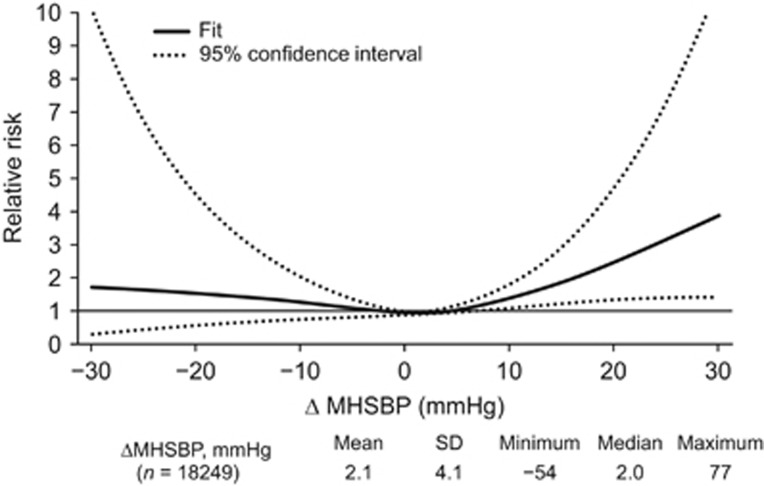
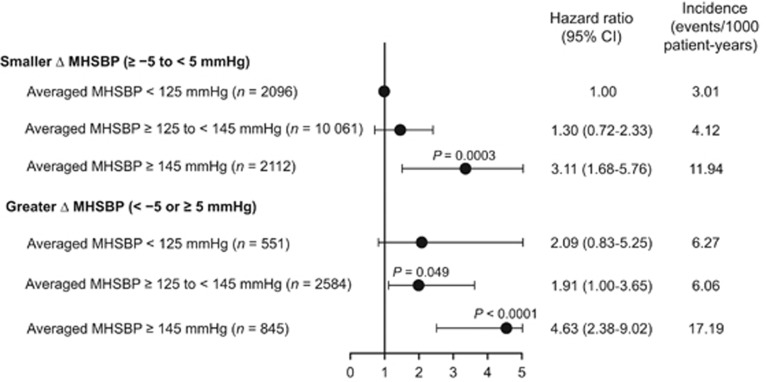
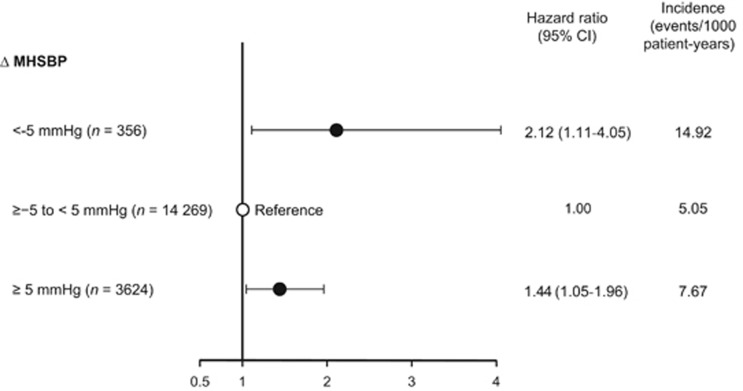
Hypertension guidelines recommend using the average of two home blood pressure (HBP) measurements obtained on one occasion to monitor blood pressure. We studied the prognostic value of the first and second measurements or their average value during the follow-up period, as well as the relationships among the difference between the first and second HBP measurements and the prognosis using data from the HONEST (HBP measurement with Olmesartan-Naive patients to Establish Standard Target blood pressure) study. During the mean 2.02 years follow-up, 280 patients had cardiovascular events. Hazard ratios (HRs) for cardiovascular events for each 1 mm Hg increase in the first, second and averaged morning home systolic blood pressure (MHSBP) were similar. Hazards were significantly higher in patients with a large difference between the first and second MHSBP (ΔMHSBP) of <-5 mm Hg (HR: 2.12) or ⩾5 mm Hg (HR: 1.44) compared with those with a small ΔMHSBP of ⩾-5 to <5 mm Hg using the Cox proportional hazards model adjusted for the averaged MHSBP during the follow-up and other risk factors. Hazards in patients with an averaged MHSBP ⩾145 mmHg and a small ΔMHSBP (HR: 3.11), those with an averaged MHSBP ⩾125 to <145 mm Hg and a large ΔMHSBP (HR: 1.91) and those with an averaged MHSBP ⩾145 mm Hg and a large ΔMHSBP (HR: 4.63) were higher compared with those with an averaged MHSBP <125 mm Hg and a small ΔMHSBP. In conclusion, the first, second and averaged MHSBP measurements have similar prognostic values. Prognosis is worse for patients with a large ΔMHSBP. In clinical practice, it would be prudent to measure the HBP two times and use the average HBP of two measurements obtained on one occasion with particular attention to patients with a large ΔMHSBP.
高血压指南建议使用一次测量所得的两次家庭血压(HBP)平均值来监测血压。我们利用HONEST(奥美沙坦初治患者的HBP测量以建立标准目标血压)研究的数据,研究了随访期间首次和第二次测量值或其平均值的预后价值,以及首次和第二次HBP测量值之间的差异与预后的关系。在平均2.02年的随访期间,280例患者发生了心血管事件。首次、第二次和平均早晨家庭收缩压(MHSBP)每升高1 mmHg,心血管事件的风险比(HR)相似。使用Cox比例风险模型对随访期间的平均MHSBP和其他风险因素进行校正后,首次和第二次MHSBP差值(ΔMHSBP)<-5 mmHg(HR:2.12)或⩾5 mmHg(HR:1.44)的患者与ΔMHSBP⩾-5至<5 mmHg的患者相比,风险显著更高。与平均MHSBP<125 mmHg且ΔMHSBP较小的患者相比,平均MHSBP⩾145 mmHg且ΔMHSBP较小(HR:3.11)、平均MHSBP⩾125至<145 mmHg且ΔMHSBP较大(HR:1.91)以及平均MHSBP⩾145 mmHg且ΔMHSBP较大(HR:4.63)的患者风险更高。总之,首次、第二次和平均MHSBP测量具有相似的预后价值。ΔMHSBP较大的患者预后较差。在临床实践中,谨慎的做法是测量两次HBP,并使用一次测量所得的两次测量值的平均HBP,尤其要关注ΔMHSBP较大的患者。