• 文献检索
  • 文档翻译
  • 深度研究
  • 学术资讯
  • Suppr Zotero 插件Zotero 插件
  • 邀请有礼
  • 套餐&价格
  • 历史记录
应用&插件
Suppr Zotero 插件Zotero 插件浏览器插件Mac 客户端Windows 客户端微信小程序
定价
高级版会员购买积分包购买API积分包
服务
文献检索文档翻译深度研究API 文档MCP 服务
关于我们
关于 Suppr公司介绍联系我们用户协议隐私条款
关注我们

Suppr 超能文献

核心技术专利:CN118964589B侵权必究
粤ICP备2023148730 号-1Suppr @ 2026

文献检索

告别复杂PubMed语法,用中文像聊天一样搜索,搜遍4000万医学文献。AI智能推荐,让科研检索更轻松。

立即免费搜索

文件翻译

保留排版,准确专业,支持PDF/Word/PPT等文件格式,支持 12+语言互译。

免费翻译文档

深度研究

AI帮你快速写综述,25分钟生成高质量综述,智能提取关键信息,辅助科研写作。

立即免费体验

基于网络的认知行为疗法对伴有抑郁症状的心力衰竭患者的影响:一项初步随机对照试验。

The Effect of Guided Web-Based Cognitive Behavioral Therapy on Patients With Depressive Symptoms and Heart Failure: A Pilot Randomized Controlled Trial.

作者信息

Lundgren Johan Gustav, Dahlström Örjan, Andersson Gerhard, Jaarsma Tiny, Kärner Köhler Anita, Johansson Peter

机构信息

Division of Nursing Science, Department of Social and Welfare Studies, Linköping University, Norrköping, Sweden.

出版信息

J Med Internet Res. 2016 Aug 3;18(8):e194. doi: 10.2196/jmir.5556.

DOI:10.2196/jmir.5556
PMID:27489077
原文链接:https://pmc.ncbi.nlm.nih.gov/articles/PMC5070581/
Abstract

BACKGROUND

Depressive symptoms, and the associated coexistence of symptoms of anxiety and decreased quality of life (QoL), are common in patients with heart failure (HF). However, treatment strategies for depressive symptoms in patients with HF still remain to be established. Internet-based cognitive behavioral therapy (ICBT), as guided self-help CBT programs, has shown good effects in the treatment of depression. Until now, ICBT has not been evaluated in patients with HF with depressive symptoms.

OBJECTIVE

The aims of this study were to (1) evaluate the effect of a 9-week guided ICBT program on depressive symptoms in patients with HF; (2) investigate the effect of the ICBT program on cardiac anxiety and QoL; and (3) assess factors associated with the change in depressive symptoms.

METHODS

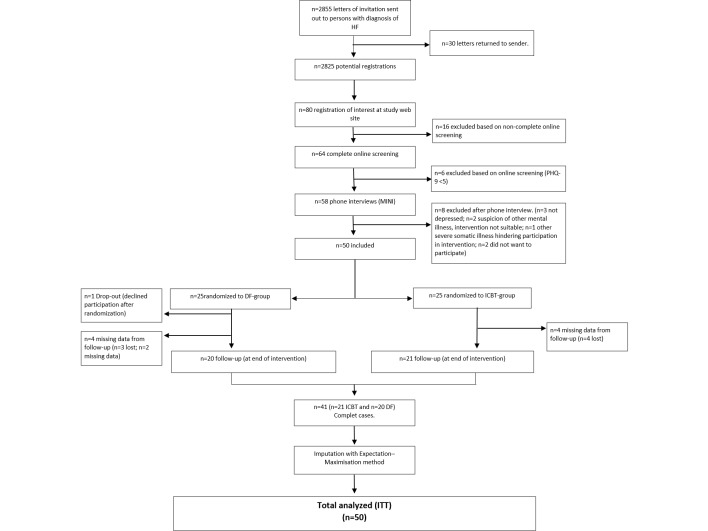
Fifty participants were randomized into 2 treatment arms: ICBT or a Web-based moderated discussion forum (DF). The Patient Health Questionnaire-9 was used to measure depressive symptoms, the Cardiac Anxiety Questionnaire (CAQ) was used to measure cardiac-related anxiety, and the Minnesota Living with Heart Failure questionnaire was used to measure QoL. Data were collected at baseline and at follow-up at the end of the 9-week intervention. Intention-to-treat analysis was used, and missing data were imputed by the Expectation-Maximization method. Between-group differences were determined by analysis of covariance with control for baseline score and regression to the mean.

RESULTS

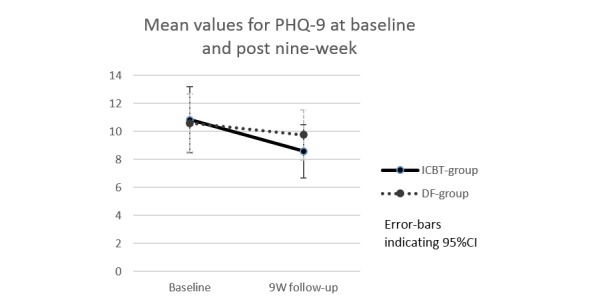
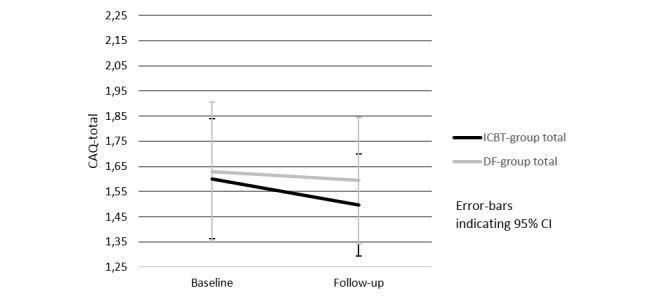
No significant difference in depressive symptoms between the ICBT and the DF group at the follow-up was found, [F(1,47)=1.63, P=.21] and Cohen´s d=0.26. Secondary within-group analysis of depressive symptoms showed that such symptoms decreased significantly in the ICBT group from baseline to the follow-up (baseline M=10.8, standard deviation [SD]=5.7 vs follow-up M=8.6, SD=4.6, t(24)=2.6, P=.02, Cohen´s d=0.43), whereas in the DF group, there was no significant change (baseline M=10.6, SD=5.0, vs follow-up M=9.8, SD=4.3, t(24)=0.93, P=.36. Cohen´s d=0.18). With regard to CAQ and QoL no significant differences were found between the groups (CAQ [d(1,47)=0.5, P=.48] and QoL [F(1,47)=2.87, P=.09]). In the ICBT group in the CAQ subscale of fear, a significant within-group decrease was shown (baseline M=1.55 vs follow-up M=1.35, P=.04). In the ICBT group, the number of logins to the Web portal correlated significantly with improvement in depressive symptoms (P=.02), whereas higher age (P=.01) and male sex (P=.048) were associated with less change in depressive symptoms. This study is underpowered because of difficulties in the recruitment of patients.

CONCLUSIONS

Guided ICBT adapted for persons with HF and depressive symptoms was not statistically superior to participation in a Web-based DF. However, within the ICBT group, a statically significant improvement of depressive symptoms was detected.

CLINICALTRIAL

Clinicaltrials.gov NCT01681771; https://clinicaltrials.gov/ct2/show/NCT01681771 (Archived by WebCite at http://www.webcitation.org/6ikzbcuLN).
https://cdn.ncbi.nlm.nih.gov/pmc/blobs/6e8a/5070581/7f0c7f900cf0/jmir_v18i8e194_fig3.jpg
https://cdn.ncbi.nlm.nih.gov/pmc/blobs/6e8a/5070581/5633f1a747ce/jmir_v18i8e194_fig1.jpg
https://cdn.ncbi.nlm.nih.gov/pmc/blobs/6e8a/5070581/e632c0afb1a8/jmir_v18i8e194_fig2.jpg
https://cdn.ncbi.nlm.nih.gov/pmc/blobs/6e8a/5070581/7f0c7f900cf0/jmir_v18i8e194_fig3.jpg
https://cdn.ncbi.nlm.nih.gov/pmc/blobs/6e8a/5070581/5633f1a747ce/jmir_v18i8e194_fig1.jpg
https://cdn.ncbi.nlm.nih.gov/pmc/blobs/6e8a/5070581/e632c0afb1a8/jmir_v18i8e194_fig2.jpg
https://cdn.ncbi.nlm.nih.gov/pmc/blobs/6e8a/5070581/7f0c7f900cf0/jmir_v18i8e194_fig3.jpg
摘要

背景

抑郁症状以及焦虑症状和生活质量(QoL)下降的相关共存情况在心力衰竭(HF)患者中很常见。然而,HF患者抑郁症状的治疗策略仍有待确立。基于互联网的认知行为疗法(ICBT)作为指导性自助认知行为疗法项目,已在抑郁症治疗中显示出良好效果。到目前为止,ICBT尚未在有抑郁症状的HF患者中进行评估。

目的

本研究的目的是:(1)评估为期9周的指导性ICBT项目对HF患者抑郁症状的影响;(2)调查ICBT项目对心脏焦虑和生活质量的影响;(3)评估与抑郁症状变化相关的因素。

方法

50名参与者被随机分为2个治疗组:ICBT组或基于网络的适度讨论论坛(DF)组。使用患者健康问卷-9来测量抑郁症状,使用心脏焦虑问卷(CAQ)来测量与心脏相关的焦虑,使用明尼苏达心力衰竭生活问卷来测量生活质量。在基线和9周干预结束时的随访中收集数据。采用意向性分析,缺失数据用期望最大化方法进行估算。通过协方差分析并控制基线分数和均值回归来确定组间差异。

结果

随访时ICBT组和DF组在抑郁症状方面未发现显著差异,[F(1,47)=1.63,P=.21],Cohen's d=0.26。抑郁症状的组内二次分析表明,ICBT组从基线到随访抑郁症状显著减少(基线M=10.8,标准差[SD]=5.7,随访M=8.6,SD=4.6,t(24)=2.6,P=.02,Cohen's d=0.43),而DF组没有显著变化(基线M=10.6,SD=5.0,随访M=9.8,SD=4.3,t(24)=0.93,P=.36,Cohen's d=0.18)。关于CAQ和生活质量,两组之间未发现显著差异(CAQ [d(1,47)=0.5,P=.48],生活质量[F(1,47)=2.87,P=.09])。在ICBT组的恐惧CAQ子量表中,组内有显著下降(基线M=1.55,随访M=1.35,P=.04)。在ICBT组中,登录网络门户的次数与抑郁症状的改善显著相关(P=.02),而年龄较大(P=.01)和男性(P=.048)与抑郁症状变化较小有关。由于患者招募困难,本研究的效能不足。

结论

适用于有抑郁症状的HF患者的指导性ICBT在统计学上并不优于参与基于网络的DF。然而,在ICBT组内,抑郁症状有统计学上的显著改善。

临床试验

Clinicaltrials.gov NCT01681771;https://clinicaltrials.gov/ct2/show/NCT01681771(由WebCite存档于http://www.webcitation.org/6ikzbcuLN)。

相似文献

1
The Effect of Guided Web-Based Cognitive Behavioral Therapy on Patients With Depressive Symptoms and Heart Failure: A Pilot Randomized Controlled Trial.基于网络的认知行为疗法对伴有抑郁症状的心力衰竭患者的影响:一项初步随机对照试验。
J Med Internet Res. 2016 Aug 3;18(8):e194. doi: 10.2196/jmir.5556.
2
Treatment of depression and anxiety with internet-based cognitive behavior therapy in patients with a recent myocardial infarction (U-CARE Heart): study protocol for a randomized controlled trial.基于互联网的认知行为疗法治疗近期心肌梗死患者的抑郁和焦虑(U-CARE心脏研究):一项随机对照试验的研究方案
Trials. 2015 Apr 11;16:154. doi: 10.1186/s13063-015-0689-y.
3
Web-Based Cognitive Behavior Therapy for Depression in People With Diabetes Mellitus: A Randomized Controlled Trial.基于网络的糖尿病患者抑郁症认知行为疗法:一项随机对照试验。
J Med Internet Res. 2017 May 15;19(5):e157. doi: 10.2196/jmir.7274.
4
Internet-Based Cognitive Behavioral Therapy for Symptoms of Depression and Anxiety Among Patients With a Recent Myocardial Infarction: The U-CARE Heart Randomized Controlled Trial.基于互联网的认知行为疗法对近期心肌梗死患者抑郁和焦虑症状的影响:U-CARE心脏随机对照试验
J Med Internet Res. 2018 Mar 8;20(3):e88. doi: 10.2196/jmir.9710.
5
Predictors of Response to Web-Based Cognitive Behavioral Therapy With High-Intensity Face-to-Face Therapist Guidance for Depression: A Bayesian Analysis.针对抑郁症的高强度面对面治疗师指导下的基于网络的认知行为疗法反应的预测因素:贝叶斯分析
J Med Internet Res. 2015 Sep 2;17(9):e197. doi: 10.2196/jmir.4351.
6
Evaluating a Web-Based Social Anxiety Intervention Among University Students: Randomized Controlled Trial.评估一项针对大学生的基于网络的社交焦虑干预措施:随机对照试验。
J Med Internet Res. 2018 Mar 21;20(3):e91. doi: 10.2196/jmir.8630.
7
Effects of Internet-Based Cognitive Behavioral Therapy for Harmful Alcohol Use and Alcohol Dependence as Self-help or With Therapist Guidance: Three-Armed Randomized Trial.基于互联网的认知行为疗法对有害饮酒和酒精依赖的自我治疗或有治疗师指导的影响:三臂随机试验。
J Med Internet Res. 2021 Nov 24;23(11):e29666. doi: 10.2196/29666.
8
The impact of internet-based cognitive behavioral therapy and depressive symptoms on self-care behavior in patients with heart failure: A secondary analysis of a randomised controlled trial.基于互联网的认知行为疗法和抑郁症状对心力衰竭患者自我护理行为的影响:一项随机对照试验的二次分析。
Int J Nurs Stud. 2021 Apr;116:103454. doi: 10.1016/j.ijnurstu.2019.103454. Epub 2019 Oct 31.
9
Complaint-Directed Mini-Interventions for Depressive Complaints: A Randomized Controlled Trial of Unguided Web-Based Self-Help Interventions.针对抑郁症状的定向性小型干预措施:一项基于网络的无指导自助干预随机对照试验
J Med Internet Res. 2017 Jan 4;19(1):e4. doi: 10.2196/jmir.6581.
10
The Effect of Internet-Delivered Cognitive Behavioral Therapy Versus Psychoeducation Only on Psychological Distress in Patients With Noncardiac Chest Pain: Randomized Controlled Trial.互联网提供的认知行为疗法与仅提供心理教育对非心因性胸痛患者心理困扰的影响:随机对照试验。
J Med Internet Res. 2022 Jan 28;24(1):e31674. doi: 10.2196/31674.

引用本文的文献

1
The Influence of eHealth Stress Management Interventions on Psychological Health Parameters in Patients With Cardiovascular Disease: Systematic Review and Meta-Analysis.电子健康压力管理干预对心血管疾病患者心理健康参数的影响:系统评价与荟萃分析
J Med Internet Res. 2025 Jun 2;27:e67118. doi: 10.2196/67118.
2
Psychological eHealth Interventions for Patients With Cardiovascular Diseases: Systematic Review and Meta-Analysis.心血管疾病患者的心理电子健康干预措施:系统评价与荟萃分析
J Med Internet Res. 2025 Apr 7;27:e57368. doi: 10.2196/57368.
3
Cognitive-Behavioral Therapy for Patients with Coronary Artery Disease and Depression: A Systematic Review.

本文引用的文献

1
Cognitive Behavior Therapy for Depression and Self-Care in Heart Failure Patients: A Randomized Clinical Trial.心力衰竭患者抑郁症的认知行为疗法与自我护理:一项随机临床试验。
JAMA Intern Med. 2015 Nov;175(11):1773-82. doi: 10.1001/jamainternmed.2015.5220.
2
Guided internet cognitive behavioral therapy for insomnia compared to a control treatment - A randomized trial.与对照治疗相比,指导性网络认知行为疗法治疗失眠症——一项随机试验。
Behav Res Ther. 2015 Aug;71:90-100. doi: 10.1016/j.brat.2015.06.001. Epub 2015 Jun 3.
3
Predictors of outcome for telephone and face-to-face administered cognitive behavioral therapy for depression.
冠状动脉疾病合并抑郁症患者的认知行为疗法:一项系统评价
Clin Neuropsychiatry. 2025 Feb;22(1):19-39. doi: 10.36131/cnfioritieditore20250103.
4
Effects of internet-based cognitive behavioral therapy on anxiety and depressive symptoms among patients with cardiovascular and cerebrovascular diseases: a systematic review and meta-analysis.基于互联网的认知行为疗法对心脑血管疾病患者焦虑和抑郁症状的影响:一项系统评价和荟萃分析。
Front Psychiatry. 2025 Jan 16;15:1433558. doi: 10.3389/fpsyt.2024.1433558. eCollection 2024.
5
Mind-body internet and mobile-based interventions for depression and anxiety in adults with chronic physical conditions: A systematic review of RCTs.针对患有慢性身体疾病的成年人的抑郁症和焦虑症,基于互联网和移动设备的身心干预:随机对照试验的系统评价
PLOS Digit Health. 2024 Jan 23;3(1):e0000435. doi: 10.1371/journal.pdig.0000435. eCollection 2024 Jan.
6
Comparative Effectiveness of Psychotherapy vs Antidepressants for Depression in Heart Failure: A Randomized Clinical Trial.抗抑郁药与心理治疗治疗心力衰竭伴抑郁症的比较效果:一项随机临床试验。
JAMA Netw Open. 2024 Jan 2;7(1):e2352094. doi: 10.1001/jamanetworkopen.2023.52094.
7
Improving mental well-being in psychocardiology-a feasibility trial for a non-blended web application as a brief metacognitive-based intervention in cardiovascular disease patients.改善心理心脏病学中的心理健康——一项针对非混合式网络应用程序作为心血管疾病患者基于元认知的简短干预措施的可行性试验。
Front Psychiatry. 2023 Sep 28;14:1138475. doi: 10.3389/fpsyt.2023.1138475. eCollection 2023.
8
Virtual healthcare solutions in heart failure: a literature review.心力衰竭的虚拟医疗解决方案:文献综述
Front Cardiovasc Med. 2023 Sep 7;10:1231000. doi: 10.3389/fcvm.2023.1231000. eCollection 2023.
9
The Effect of Internet-Based Cognitive Behavioral Therapy on Major Depressive Disorder: Randomized Controlled Trial.基于互联网的认知行为疗法对重性抑郁症的疗效:随机对照试验。
J Med Internet Res. 2023 Sep 22;25:e42786. doi: 10.2196/42786.
10
The effectiveness of cognitive-behavioral therapy for heart failure patients: a narrative review.认知行为疗法对心力衰竭患者的疗效:叙述性综述。
J Int Med Res. 2023 Sep;51(9):3000605231198371. doi: 10.1177/03000605231198371.
电话及面对面实施的抑郁症认知行为疗法的疗效预测因素
Psychol Med. 2015 Nov;45(15):3205-15. doi: 10.1017/S0033291715001208. Epub 2015 Jun 16.
4
Internet-based cognitive behavior therapy for patients with heart failure and depressive symptoms: A proof of concept study.针对心力衰竭伴抑郁症状患者的基于互联网的认知行为疗法:一项概念验证研究。
Patient Educ Couns. 2015 Aug;98(8):935-42. doi: 10.1016/j.pec.2015.04.013. Epub 2015 Apr 27.
5
Internet-vs. group-delivered cognitive behavior therapy for insomnia: A randomized controlled non-inferiority trial.互联网与团体认知行为疗法治疗失眠:一项随机对照非劣效性试验。
Behav Res Ther. 2015 Jul;70:47-55. doi: 10.1016/j.brat.2015.05.002. Epub 2015 May 6.
6
Can cognitive behaviour therapy be beneficial for heart failure patients?认知行为疗法对心力衰竭患者有益吗?
Curr Heart Fail Rep. 2015 Apr;12(2):166-72. doi: 10.1007/s11897-014-0244-2.
7
Interformat reliability of digital psychiatric self-report questionnaires: a systematic review.数字精神科自我报告问卷的信度:一项系统评价
J Med Internet Res. 2014 Dec 3;16(12):e268. doi: 10.2196/jmir.3395.
8
A dynamic view of comorbid depression and generalized anxiety disorder symptom change in chronic heart failure: the discrete effects of cognitive behavioral therapy, exercise, and psychotropic medication.慢性心力衰竭中共病抑郁和广泛性焦虑障碍症状变化的动态观点:认知行为疗法、运动和精神药物的离散效应
Disabil Rehabil. 2015;37(7):585-92. doi: 10.3109/09638288.2014.935493. Epub 2014 Jul 1.
9
Integrated telehealth care for chronic illness and depression in geriatric home care patients: the Integrated Telehealth Education and Activation of Mood (I-TEAM) study.老年家庭护理患者慢性病和抑郁的综合远程医疗护理:综合远程医疗教育和情绪激活(I-TEAM)研究。
J Am Geriatr Soc. 2014 May;62(5):889-95. doi: 10.1111/jgs.12776. Epub 2014 Mar 21.
10
Coexisting anxiety and depressive symptoms in patients with heart failure.心力衰竭患者并存的焦虑和抑郁症状。
Eur J Cardiovasc Nurs. 2014 Apr;13(2):168-76. doi: 10.1177/1474515113519520. Epub 2014 Jan 9.