Wheler Jennifer J, Atkins Johnique T, Janku Filip, Moulder Stacy L, Stephens Philip J, Yelensky Roman, Valero Vicente, Miller Vincent, Kurzrock Razelle, Meric-Bernstam Funda
Translational clinical oncology, Novartis Pharmaceuticals, Cambridge, MA, USA.
Department of Investigational Cancer Therapeutics, The University of Texas MD Anderson Cancer Center, Houston, TX, USA.
Oncoscience. 2016 Jun 30;3(5-6):164-72. doi: 10.18632/oncoscience.307. eCollection 2016.
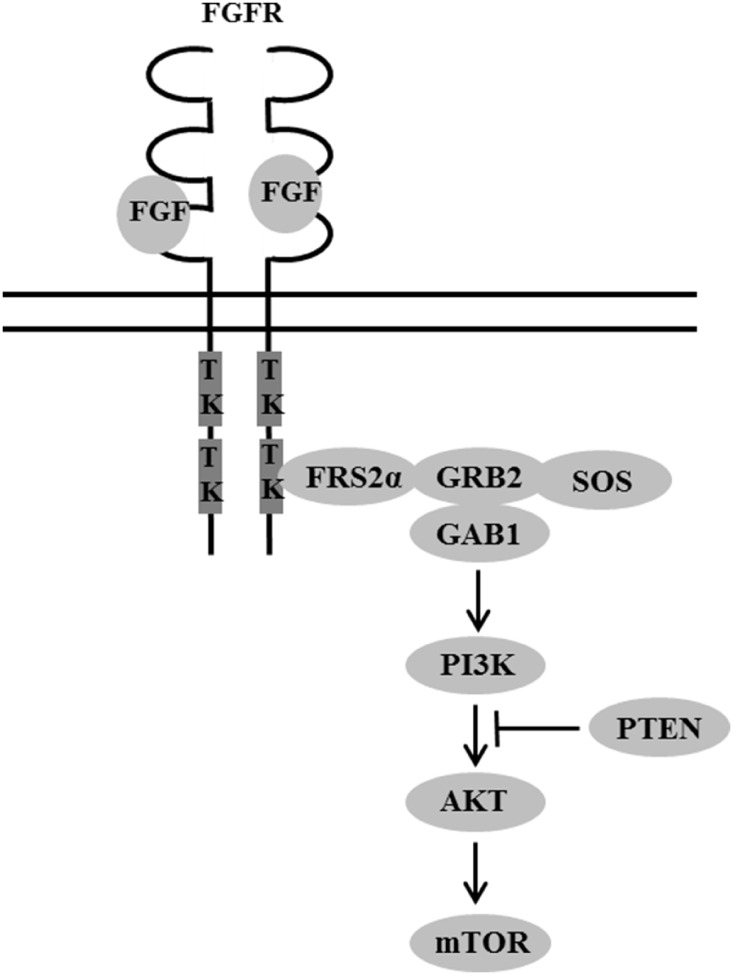
There is limited data on co-expression of FGFR/FGR amplifications and PI3K/ AKT/mTOR alterations in breast cancer. Tumors from patients with metastatic breast cancer referred to our Phase I Program were analyzed by next generation sequencing (NGS). Genomic libraries were selected for all exons of 236 (or 182) cancer-related genes sequenced to average depth of >500× in a CLIA laboratory (Foundation Medicine, Cambridge, MA, USA) and analyzed for all classes of genomic alterations. We report genomic profiles of 112 patients with metastatic breast cancer, median age 55 years (range, 27-78). Twenty-four patients (21%) had at least one amplified FGFR or FGF. Fifteen of the 24 patients (63%) also had an alteration in the PI3K/ AKT/mTOR pathway. There was no association between alterations in FGFR/FGF and PI3K/AKT/mTOR (P=0.49). Patients with simultaneous amplification in FGFR/FGF signaling and the PI3K/AKT/mTOR pathway had a higher rate of SD≥6 months/PR/ CR when treated with therapies targeting the PI3K/AKT/mTOR pathway than patients with only alterations in the PI3K/AKT/mTOR pathway (73% vs. 34%; P=0.0376) and remained on treatment longer (6.8 vs. 3.7 months; P=0.053). Higher response rates were seen in patients with simultaneous amplification in FGFR/FGF signaling and alterations in the PI3K/AKT/mTOR pathway who were treated with inhibitors of that pathway.
关于乳腺癌中FGFR/FGR扩增与PI3K/AKT/mTOR改变的共表达数据有限。对转诊至我们I期项目的转移性乳腺癌患者的肿瘤进行了二代测序(NGS)分析。在美国马萨诸塞州剑桥市的Foundation Medicine公司的CLIA实验室中,选择了236个(或182个)癌症相关基因的所有外显子构建基因组文库,测序平均深度>500×,并分析所有类型的基因组改变。我们报告了112例转移性乳腺癌患者的基因组图谱,中位年龄55岁(范围27 - 78岁)。24例患者(21%)至少有一个FGFR或FGF扩增。这24例患者中有15例(63%)PI3K/AKT/mTOR通路也有改变。FGFR/FGF改变与PI3K/AKT/mTOR改变之间无关联(P = 0.49)。与仅PI3K/AKT/mTOR通路有改变的患者相比,FGFR/FGF信号与PI3K/AKT/mTOR通路同时扩增的患者接受靶向PI3K/AKT/mTOR通路的治疗时,疾病稳定≥6个月/部分缓解/完全缓解的发生率更高(73%对34%;P = 0.0376),且治疗持续时间更长(6.8个月对3.7个月;P = 0.053)。在FGFR/FGF信号同时扩增且PI3K/AKT/mTOR通路有改变并接受该通路抑制剂治疗的患者中观察到更高的缓解率。