Banke-Thomas Aduragbemi, Wright Kikelomo, Sonoiki Olatunji, Banke-Thomas Oluwasola, Ajayi Babatunde, Ilozumba Onaedo, Akinola Oluwarotimi
Centre for Reproductive Health Research and Innovation, Lagos State University College of Medicine, Ikeja, Lagos, Nigeria;
Centre for Reproductive Health Research and Innovation, Lagos State University College of Medicine, Ikeja, Lagos, Nigeria.
Glob Health Action. 2016 Aug 5;9:31880. doi: 10.3402/gha.v9.31880. eCollection 2016.
Lack of timely and quality emergency obstetric care (EmOC) has contributed significantly to maternal morbidity and mortality, particularly in low- and middle-income countries (LMICs). Since 2009, the global guideline, referred to as the 'handbook', has been used to monitor availability, utilization, and quality of EmOC.
To assess application and explore experiences of researchers in LMICs in assessing EmOC.
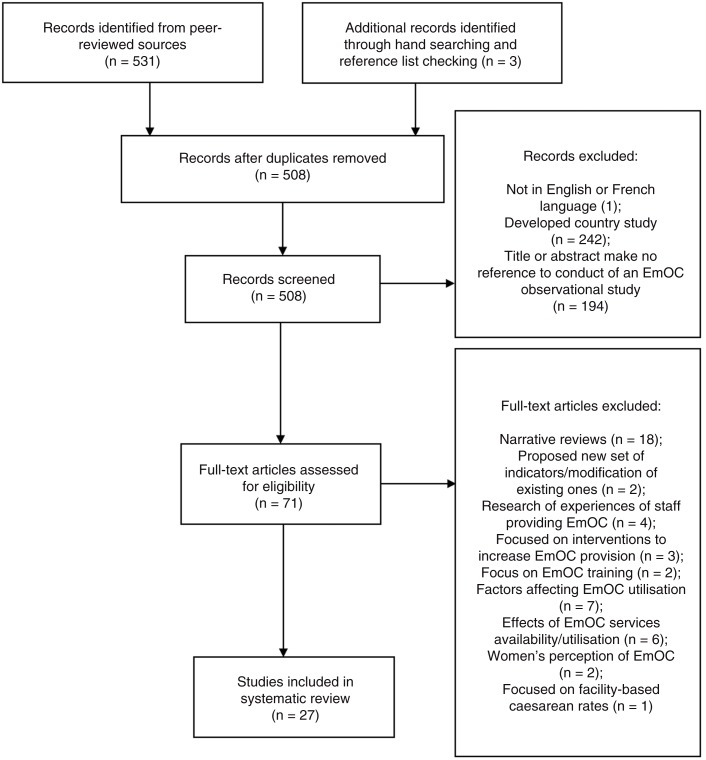
Multiple databases of peer-reviewed literature were systematically reviewed on EmOC assessments in LMICs, since 2009. Following set criteria, we included articles, assessed for quality based on a newly developed checklist, and extracted data using a pre-designed extraction tool. We used thematic summaries to condense our findings and mapped patterns that we observed. To analyze experiences and recommendations for improved EmOC assessments, we took a deductive approach for the framework synthesis.
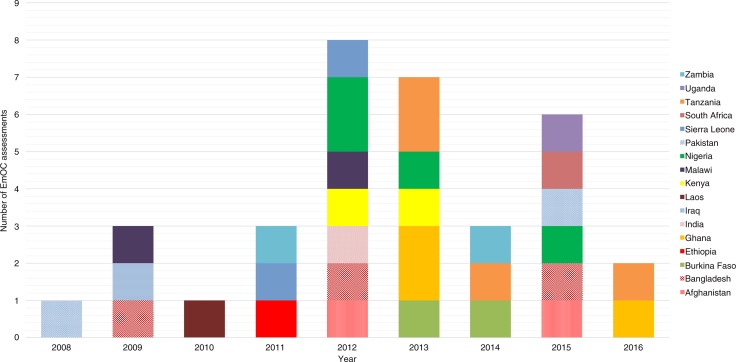
Twenty-seven studies met our inclusion criteria, with 17 judged as high quality. The highest publication frequency was observed in 2015. Most assessments were conducted in Nigeria and Tanzania (four studies each) and Bangladesh and Ghana (three each). Most studies (17) were done at subnational levels with 23 studies using the 'handbook' alone, whereas the others combined the 'handbook' with other frameworks. Seventeen studies conducted facility-based surveys, whereas others used mixed methods. For different reasons, intrapartum and very early neonatal death rate and proportion of deaths due to indirect causes in EmOC facilities were the least reported indicators. Key emerging themes indicate that data quality for EmOC assessments can be improved, indicators should be refined, a holistic approach is required for EmOC assessments, and assessments should be conducted as routine processes.
There is clear justification to review how EmOC assessments are being conducted. Synergy between researchers, EmOC program managers, and other key stakeholders would be critical for improved assessments, which would contribute to increased accountability and ultimately service provision.
缺乏及时且高质量的产科急诊护理(EmOC)是导致孕产妇发病和死亡的重要原因,在低收入和中等收入国家(LMICs)尤为如此。自2009年以来,全球指南(即“手册”)一直用于监测EmOC的可及性、利用率和质量。
评估低收入和中等收入国家研究人员在评估EmOC方面的应用情况并探索其经验。
自2009年以来,对多个同行评审文献数据库进行了系统回顾,以了解低收入和中等收入国家的EmOC评估情况。按照既定标准,我们纳入了文章,根据新制定的清单评估质量,并使用预先设计的提取工具提取数据。我们使用主题摘要来浓缩研究结果,并梳理观察到的模式。为了分析改善EmOC评估的经验和建议,我们采用演绎法进行框架综合分析。
27项研究符合我们的纳入标准,其中17项被判定为高质量。2015年的发表频率最高。大多数评估在尼日利亚和坦桑尼亚进行(各有四项研究),以及孟加拉国和加纳(各有三项研究)。大多数研究(17项)在国家以下层面开展,23项研究仅使用“手册”,而其他研究则将“手册”与其他框架相结合。17项研究进行了基于机构的调查,而其他研究采用了混合方法。由于不同原因,EmOC机构中分娩期和极早期新生儿死亡率以及间接原因导致的死亡比例是报告最少的指标。关键的新出现主题表明,EmOC评估的数据质量可以提高,指标应进一步细化,EmOC评估需要采用整体方法,并且评估应作为常规流程进行。
审查EmOC评估的开展方式具有明确的合理性。研究人员、EmOC项目经理和其他关键利益相关者之间的协同作用对于改进评估至关重要,这将有助于提高问责制并最终改善服务提供。