Deng Maoxian, Tufan Turan, Raza Muhammad U, Jones Thomas C, Zhu Meng-Yang
Department of Biomedical Sciences, Quillen College of Medicine, East Tennessee State University, Johnson City, Tennessee, USA.
Department of Veterinary Medicine and Animal Husbandry, Jiangsu Polytechnic College of A&F, Jurong, Jiangsu, China.
J Neurochem. 2016 Oct;139(2):197-207. doi: 10.1111/jnc.13761. Epub 2016 Sep 22.
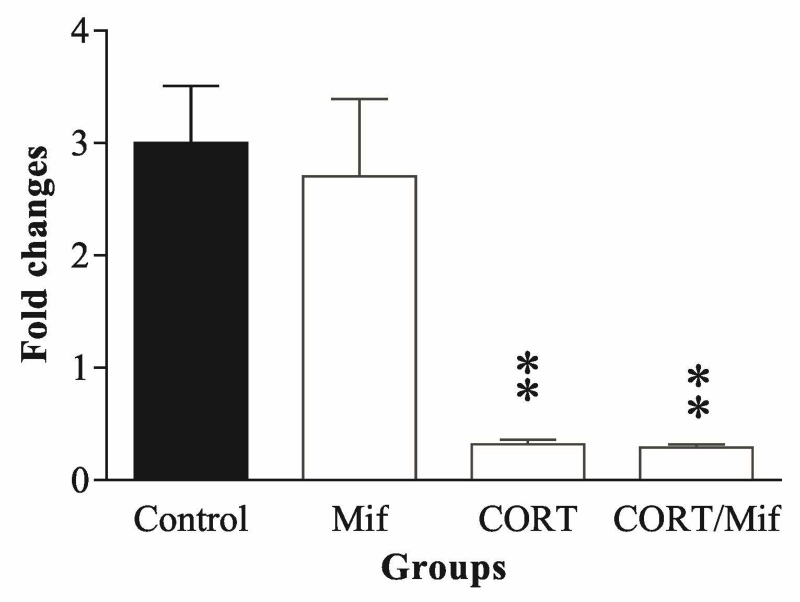
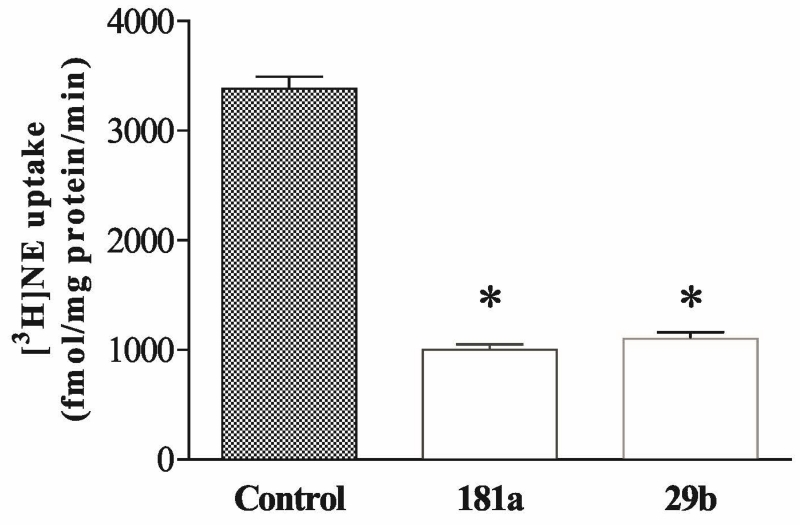
MicroRNAs are short non-coding RNAs that provide global regulation of gene expression at the post-transcriptional level. Such regulation has been found to play a role in stress-induced epigenetic responses in the brain. The norepinephrine transporter (NET) and glucocorticoid receptors are closely related to the homeostatic integration and regulation after stress. Our previous studies demonstrated that NET mRNA and protein levels in rats are regulated by chronic stress and by administration of corticosterone, which is mediated through glucocorticoid receptors. Whether miRNAs are intermediaries in the regulation of these proteins remains to be elucidated. This study was undertaken to determine possible regulatory effects of miRNAs on the expression of NET and glucocorticoid receptors in the noradrenergic neuronal cell line. Using computational target prediction, we identified several candidate miRNAs potentially targeting NET and glucocorticoid receptors. Western blot results showed that over-expression of miR-181a and miR-29b significantly repressed protein levels of NET, which is accompanied by a reduced [ H] norepinephrine uptake, and glucocorticoid receptors in PC12 cells. Luciferase reporter assays verified that both miR-181a and miR-29b bind the 3'UTR of mRNA of NET and glucocorticoid receptors. Furthermore, exposure of PC12 cells to corticosterone markedly reduced the endogenous levels of miR-29b, which was not reversed by the application of glucocorticoid receptor antagonist mifepristone. These observations indicate that miR-181a and miR-29b can function as the negative regulators of NET and glucocorticoid receptor translation in vitro. This regulatory effect may be related to stress-induced up-regulation of the noradrenergic phenotype, a phenomenon observed in stress models and depressive patients. This study demonstrated that miR-29b and miR-181a, two short non-coding RNAs that provide global regulation of gene expression, markedly repressed protein levels of norepinephrine (NE) transporter and glucocorticoid receptor (GR), as well as NE uptake by binding the 3'UTR of their mRNAs in PC12 cells. Also, exposure of cells to corticosterone significantly reduced miR-29b levels through a GR-independent way.
微小RNA是短链非编码RNA,可在转录后水平对基因表达进行全局调控。已发现这种调控在大脑应激诱导的表观遗传反应中发挥作用。去甲肾上腺素转运体(NET)和糖皮质激素受体与应激后的稳态整合和调节密切相关。我们之前的研究表明,大鼠体内的NET mRNA和蛋白水平受慢性应激以及皮质酮给药的调节,这是通过糖皮质激素受体介导的。微小RNA是否为这些蛋白质调节过程中的中介仍有待阐明。本研究旨在确定微小RNA对去甲肾上腺素能神经元细胞系中NET和糖皮质激素受体表达的可能调节作用。通过计算靶标预测,我们鉴定出了几种可能靶向NET和糖皮质激素受体的候选微小RNA。蛋白质印迹结果显示,miR-181a和miR-29b的过表达显著抑制了PC12细胞中NET的蛋白水平,同时伴随着[H]去甲肾上腺素摄取减少以及糖皮质激素受体水平降低。荧光素酶报告基因检测证实,miR-181a和miR-29b均与NET和糖皮质激素受体mRNA的3'非翻译区(3'UTR)结合。此外,将PC12细胞暴露于皮质酮可显著降低内源性miR-29b水平,而应用糖皮质激素受体拮抗剂米非司酮并不能使其逆转。这些观察结果表明,miR-181a和miR-29b在体外可作为NET和糖皮质激素受体翻译的负调节因子。这种调节作用可能与应激诱导的去甲肾上腺素能表型上调有关,这一现象在应激模型和抑郁症患者中均有观察到。本研究表明,miR-29b和miR-181a这两种可对基因表达进行全局调控的短链非编码RNA,通过结合PC12细胞中去甲肾上腺素(NE)转运体和糖皮质激素受体(GR)mRNA的3'UTR,显著抑制了它们的蛋白水平以及NE摄取。此外,细胞暴露于皮质酮通过一种不依赖糖皮质激素受体的方式显著降低了miR-29b水平。