Division of Brain Tumor Translational Research, National Cancer Center Research Institute, 5-1-1 Tsukiji, Chuo-ku, Tokyo, 104-0045, Japan.
Department of Neurosurgery, Osaka University Graduate School of Medicine, Osaka, Japan.
Acta Neuropathol Commun. 2016 Aug 8;4(1):79. doi: 10.1186/s40478-016-0351-2.
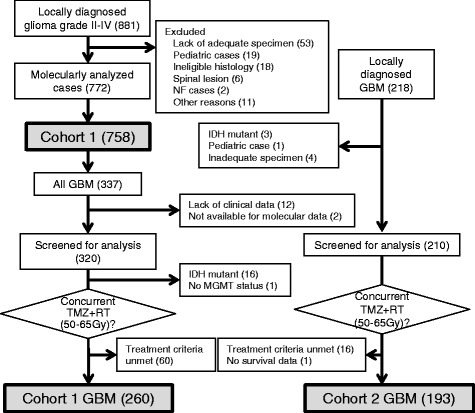
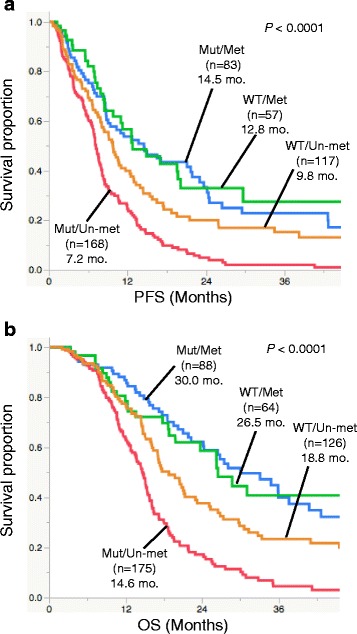
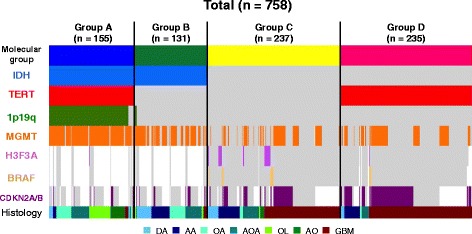
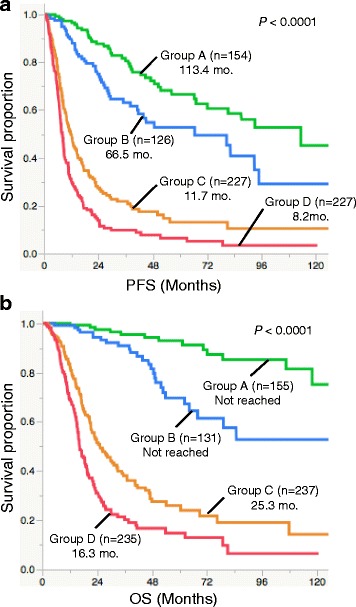
The prognostic impact of TERT mutations has been controversial in IDH-wild tumors, particularly in glioblastomas (GBM). The controversy may be attributable to presence of potential confounding factors such as MGMT methylation status or patients' treatment. This study aimed to evaluate the impact of TERT status on patient outcome in association with various factors in a large series of adult diffuse gliomas. We analyzed a total of 951 adult diffuse gliomas from two cohorts (Cohort 1, n = 758; Cohort 2, n = 193) for IDH1/2, 1p/19q, and TERT promoter status. The combined IDH/TERT classification divided Cohort 1 into four molecular groups with distinct outcomes. The overall survival (OS) was the shortest in IDH wild-type/TERT mutated groups, which mostly consisted of GBMs (P < 0.0001). To investigate the association between TERT mutations and MGMT methylation on survival of patients with GBM, samples from a combined cohort of 453 IDH-wild-type GBM cases treated with radiation and temozolomide were analyzed. A multivariate Cox regression model revealed that the interaction between TERT and MGMT was significant for OS (P = 0.0064). Compared with TERT mutant-MGMT unmethylated GBMs, the hazard ratio (HR) for OS incorporating the interaction was the lowest in the TERT mutant-MGMT methylated GBM (HR, 0.266), followed by the TERT wild-type-MGMT methylated (HR, 0.317) and the TERT wild-type-MGMT unmethylated GBMs (HR, 0.542). Thus, patients with TERT mutant-MGMT unmethylated GBM have the poorest prognosis. Our findings suggest that a combination of IDH, TERT, and MGMT refines the classification of grade II-IV diffuse gliomas.
TERT 突变的预后影响在 IDH 野生型肿瘤中一直存在争议,尤其是在胶质母细胞瘤(GBM)中。这种争议可能归因于存在潜在的混杂因素,如 MGMT 甲基化状态或患者的治疗。本研究旨在评估 TERT 状态在两个队列的大量成人弥漫性神经胶质瘤患者中与各种因素相关的患者预后的影响。我们分析了来自两个队列的总共 951 例成人弥漫性神经胶质瘤,用于 IDH1/2、1p/19q 和 TERT 启动子状态。联合 IDH/TERT 分类将队列 1 分为四个分子组,具有不同的结局。在 IDH 野生型/TERT 突变组中,总生存(OS)最短,主要由 GBM 组成(P<0.0001)。为了研究 TERT 突变与 MGMT 甲基化对 GBM 患者生存的关系,对接受放疗和替莫唑胺治疗的 453 例 IDH 野生型 GBM 病例的联合队列样本进行了分析。多变量 Cox 回归模型显示,TERT 和 MGMT 之间的相互作用对 OS 具有显著意义(P=0.0064)。与 TERT 突变-MGMT 非甲基化 GBM 相比,纳入相互作用的 OS 风险比(HR)在 TERT 突变-MGMT 甲基化 GBM 中最低(HR,0.266),其次是 TERT 野生型-MGMT 甲基化(HR,0.317)和 TERT 野生型-MGMT 非甲基化 GBM(HR,0.542)。因此,TERT 突变-MGMT 非甲基化 GBM 患者的预后最差。我们的研究结果表明,IDH、TERT 和 MGMT 的联合将改善 II-IV 级弥漫性神经胶质瘤的分类。