Kunogi Hiroaki, Wakumoto Yoshiaki, Yamaguchi Nanae, Horie Shigeo, Sasai Keisuke
Department of Radiation Oncology.
Department of Urology, Juntendo University, Hongo, Bunkyo-ku, Tokyo, Japan.
J Contemp Brachytherapy. 2016 Jun;8(3):165-72. doi: 10.5114/jcb.2016.60452. Epub 2016 Jun 13.
To investigate the treatment results for focal partial salvage re-implantation against local recurrence after permanent prostate brachytherapy.
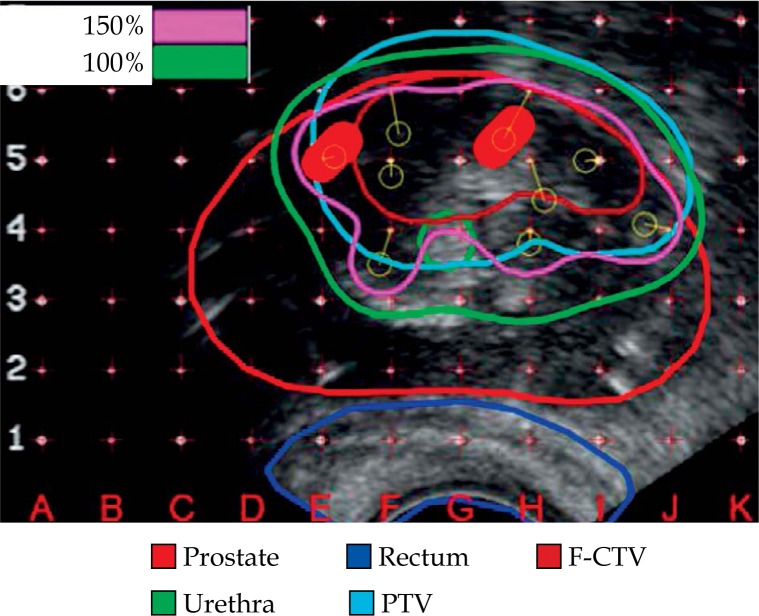
Between January 2010 and September 2015, 12 patients were treated with focal partial salvage re-implantation for local recurrence after low-dose-rate brachytherapy using (125)I seeds. The focal clinical target volume (F-CTV) was delineated on positive biopsy areas in a mapping biopsy, combining the cold spots on the post-implant dosimetry for initial brachytherapy. The F-CTV was expanded by 3 mm to create the planning target volume (PTV) as a margin to compensate for uncertainties in image registration and treatment delivery. The prescribed dose to the PTV was 145 Gy. The characteristics and biochemical disease-free survival (BdFS) rates were analyzed. Genitourinary (GU) and gastrointestinal (GI) toxicities were evaluated using the Common Terminology Criteria for Adverse Events version 4.
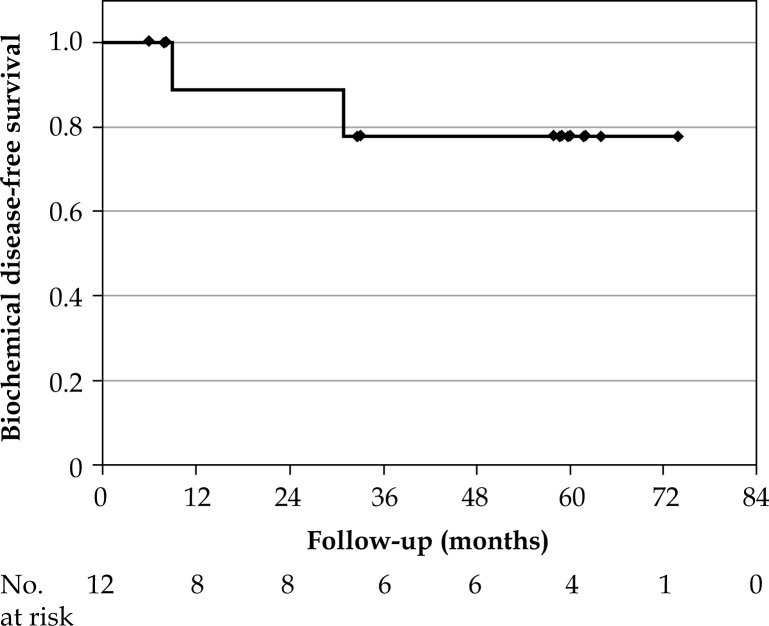
The median prostate-specific antigen (PSA) level at re-implantation was 4.09 ng/ml (range: 2.91-8.24 ng/ml). The median follow-up time was 56 months (range: 6-74 months). The median RD2cc and UD10 were 63 Gy and 159 Gy, respectively. The 4-year BdFS rate was 78%, which included non-responders. Biochemical recurrence occurred in two patients after 7 and 31 months, respectively. The former was treated with hormonal therapy after biochemical failure, and the latter underwent watchful waiting (PSA at the last follow-up of 53 months: 7.3 ng/ml) at the patient's request. No patients had grade 3 GU/GI toxicities or died after salvage re-implantation.
The partial salvage low-dose-rate brachytherapy used to treat local recurrence after permanent prostate brachytherapy is well-tolerated, with high biochemical response rates. This treatment can be not only a method to delay chemical castration but also a curative treatment option in cases of local recurrence of prostate carcinoma after seed implantation.
探讨针对永久性前列腺近距离放射治疗后局部复发的局灶性部分挽救性再植入治疗效果。
2010年1月至2015年9月期间,12例患者接受了针对低剂量率近距离放射治疗(使用¹²⁵I粒子)后局部复发的局灶性部分挽救性再植入治疗。在映射活检的阳性活检区域勾勒出局灶性临床靶区(F-CTV),结合初始近距离放射治疗植入后剂量测定中的冷区。将F-CTV扩大3 mm以创建计划靶区(PTV)作为边缘,以补偿图像配准和治疗实施中的不确定性。PTV的处方剂量为145 Gy。分析了患者特征和生化无病生存率(BdFS)。使用不良事件通用术语标准第4版评估泌尿生殖系统(GU)和胃肠道(GI)毒性。
再植入时前列腺特异性抗原(PSA)水平的中位数为4.09 ng/ml(范围:2.91 - 8.24 ng/ml)。中位随访时间为56个月(范围:6 - 74个月)。中位RD2cc和UD10分别为63 Gy和159 Gy。4年BdFS率为78%,其中包括无反应者。两名患者分别在7个月和31个月后发生生化复发。前者在生化失败后接受了激素治疗,后者应患者要求进行了观察等待(最后一次随访53个月时的PSA为7.3 ng/ml)。没有患者出现3级GU/GI毒性或在挽救性再植入后死亡。
用于治疗永久性前列腺近距离放射治疗后局部复发的部分挽救性低剂量率近距离放射治疗耐受性良好,生化反应率高。这种治疗不仅可以作为延迟化学去势的一种方法,而且对于粒子植入后前列腺癌局部复发的病例也是一种治愈性治疗选择。