Research Center for Child Mental Development, Hamamatsu University School of Medicine, Hamamatsu, Japan; Department of Child Development, United Graduate School of Child Development, Osaka University, Kanazawa University, Hamamatsu University School of Medicine, Chiba University and University of Fukui, Hamamatsu, Japan.
Research Center for Child Mental Development, Hamamatsu University School of Medicine , Hamamatsu , Japan.
Front Public Health. 2016 Jul 25;4:152. doi: 10.3389/fpubh.2016.00152. eCollection 2016.
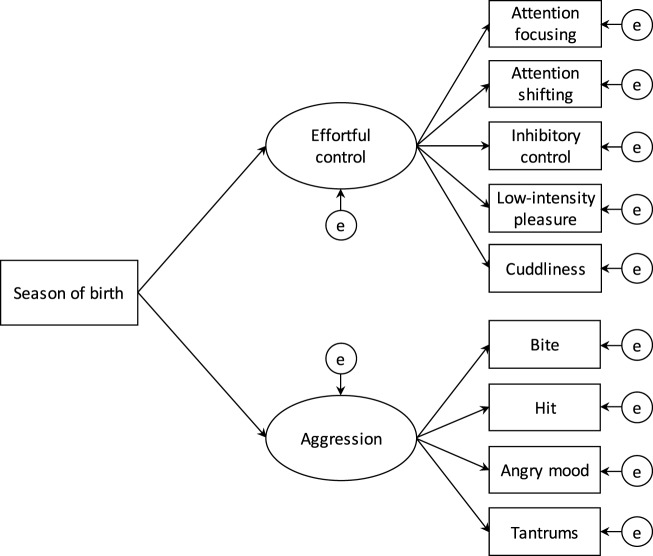
Previous research has demonstrated that the season of birth may predict development of emotional and behavioral regulation during childhood or adolescence. This study examined whether the season of birth predicts effortful control (i.e., the ability to voluntarily choose course of actions during conflict and to plan for the future) and aggression (i.e., the use of physical force and expression of anger toward others) in 18-month-old infants.
Participants included 885 infants who were enrolled in the Hamamatsu Birth Cohort for Mothers and Children in Hamamatsu, Japan. Seasons of birth were categorized into winter (December, January, and February), spring (March, April, and May), summer (June, July, and August), and autumn (September, October, and November). At 18 months of age, effortful control was assessed using the Early Childhood Behavior Questionnaire, and aggression was measured using the Cardiff Infant Contentiousness Scale. Structural equation modeling analysis with measurement and structural equations was conducted to test our prediction.
Effortful control was higher in infants born in spring [B = 0.095, 95% CI (0.014 to 0.175), p = 0.021, β = 0.146] and summer [B = 0.078, 95% CI (0.001 to 0.156), p = 0.049, β = 0.118] than in those born in winter. In addition, aggression was lower in those born in spring [B = -0.286, 95% CI (-0.551 to -0.021), p = 0.035, β = -0.135] than those born in winter, even after controlling for seven covariates.
The findings suggest that season of birth may determine development of emotional and behavioral regulation skills during early infancy. Future research should pay more attention to the underlying mechanisms of the effects of birth season on development of emotional and behavioral regulation during infancy.
先前的研究表明,出生季节可能会影响儿童或青少年时期情绪和行为调节的发展。本研究旨在检验出生季节是否会影响 18 个月大婴儿的努力控制(即自愿选择冲突期间行动过程和规划未来的能力)和攻击行为(即使用武力和对他人表达愤怒)。
参与者包括日本滨松市母婴队列研究中的 885 名婴儿。出生季节分为冬季(12 月、1 月和 2 月)、春季(3 月、4 月和 5 月)、夏季(6 月、7 月和 8 月)和秋季(9 月、10 月和 11 月)。在 18 个月大时,使用幼儿行为问卷评估努力控制,使用加的夫婴儿性情量表评估攻击行为。采用测量和结构方程的结构方程模型分析来检验我们的预测。
与冬季出生的婴儿相比,春季(B=0.095,95%CI(0.014 至 0.175),p=0.021,β=0.146)和夏季(B=0.078,95%CI(0.001 至 0.156),p=0.049,β=0.118)出生的婴儿的努力控制能力更高。此外,春季出生的婴儿的攻击行为(B=-0.286,95%CI(-0.551 至 -0.021),p=0.035,β=-0.135)低于冬季出生的婴儿,即使在控制了 7 个协变量后也是如此。
这些发现表明,出生季节可能会决定婴儿早期情绪和行为调节技能的发展。未来的研究应该更加关注出生季节对婴儿期情绪和行为调节发展影响的潜在机制。