Akhtar Evana, Mily Akhirunnesa, Haq Ahsanul, Al-Mahmud Abdullah, El-Arifeen Shams, Hel Baqui Abdullah, Roth Daniel E, Raqib Rubhana
Immunobiology, Nutrition and Toxicology Laboratory, Infectious Diseases Division, icddr,b, Dhaka, 1212, Bangladesh.
Maternal and Child Health Division, icddr,b, Dhaka, 1212, Bangladesh.
Nutr J. 2016 Aug 9;15(1):75. doi: 10.1186/s12937-016-0194-5.
Antenatal vitamin D3 (vitD3) supplementation significantly increases maternal and neonatal 25-hydroxyvitamin D3 (25(OH)D3) concentration, yet the effect of an improvement in maternal-fetal vitamin D status on the neonatal immune response is unclear.
To assess the effect of prenatal vitD3 supplementation on cord blood T cell function, healthy pregnant Bangladeshi women (n = 160) were randomized to receive either oral 35,000 IU/week vitD3 or placebo from 26 to 29 weeks of gestation to delivery. In a subset of participants (n = 80), cord blood mononuclear cells (CBMC) were cultured, non-adherent lymphocytes were isolated to assess T cell cytokine responses to phytohemagglutinin (PHA) and anti-CD3/anti-CD28 (iCD3/iCD28), measured by multiplex assay. In 12 participants, lymphocyte gene expression profiles were analyzed by PCR array.
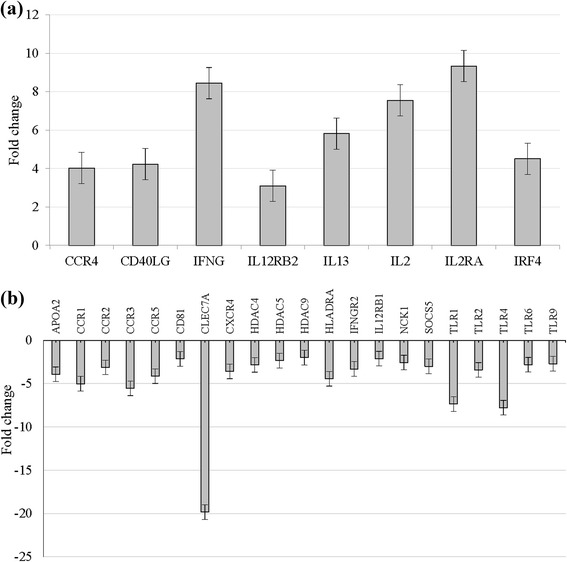
In supplemented group, increased concentrations of IL-10 (P < 0.000) and TNF-α (P = 0.05) with iCD3/iCD28 stimulation and IFN-γ (p = 0.05) with PHA stimulation were obtained compared to placebo group. No differences in the gene expression profile were noted between the two groups. However, PHA stimulation significantly induced the expression of genes encoding Th1 and Th2 cytokines and down-regulated a number of genes involved in T-cell development, proliferation and differentiation of B cells, signal transduction pathway, transcriptional regulation and pattern recognition receptors (PRRs) in the vitamin D group (vitD group).
Third-trimester high-dose vitD3 supplementation in healthy pregnant women had balanced effects on biomarkers of cord blood Th1 and Th2 responses.
ClinicalTrials.gov ( NCT01126528 ).
产前补充维生素D3(vitD3)可显著提高母体和新生儿的25-羟基维生素D3(25(OH)D3)浓度,但母体-胎儿维生素D状态改善对新生儿免疫反应的影响尚不清楚。
为评估产前补充vitD3对脐血T细胞功能的影响,将160名健康的孟加拉国孕妇随机分为两组,在妊娠26至29周直至分娩期间,一组每周口服35,000国际单位vitD3,另一组口服安慰剂。在一部分参与者(n = 80)中,培养脐血单个核细胞(CBMC),分离非贴壁淋巴细胞,通过多重检测评估T细胞对植物血凝素(PHA)和抗CD3/抗CD28(iCD3/iCD28)的细胞因子反应。对12名参与者,通过PCR阵列分析淋巴细胞基因表达谱。
与安慰剂组相比,补充组在iCD3/iCD28刺激下IL-10浓度升高(P < 0.000)和TNF-α浓度升高(P = 0.05),在PHA刺激下IFN-γ浓度升高(p = 0.05)。两组基因表达谱无差异。然而,在维生素D组(vitD组)中,PHA刺激显著诱导了编码Th1和Th2细胞因子的基因表达,并下调了许多参与T细胞发育、B细胞增殖和分化、信号转导途径、转录调控和模式识别受体(PRR)的基因。
健康孕妇在妊娠晚期高剂量补充vitD3对脐血Th1和Th2反应的生物标志物有平衡作用。
ClinicalTrials.gov(NCT01126528)