Cobos April J, Nelson Clinton G, Jehn Megan, Viboud Cécile, Chowell Gerardo
School of Human Evolution and Social Change, Arizona State University, Tempe, AZ, USA.
School of Life Sciences, Arizona State University, Tempe, AZ, USA.
BMC Infect Dis. 2016 Aug 11;16(1):405. doi: 10.1186/s12879-016-1716-7.
While prior studies have quantified the mortality burden of the 1957 H2N2 influenza pandemic at broad geographic regions in the United States, little is known about the pandemic impact at a local level. Here we focus on analyzing the transmissibility and mortality burden of this pandemic in Arizona, a setting where the dry climate was promoted as reducing respiratory illness transmission yet tuberculosis prevalence was high.
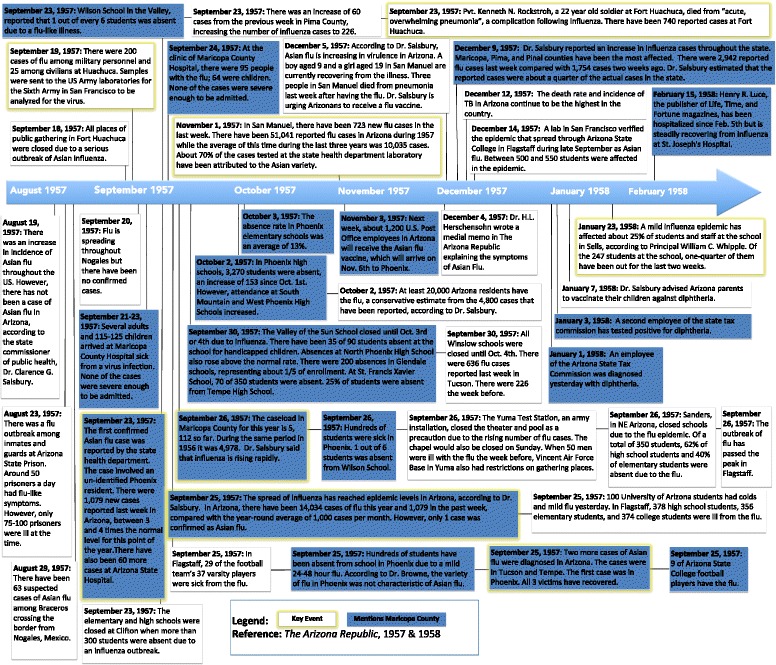
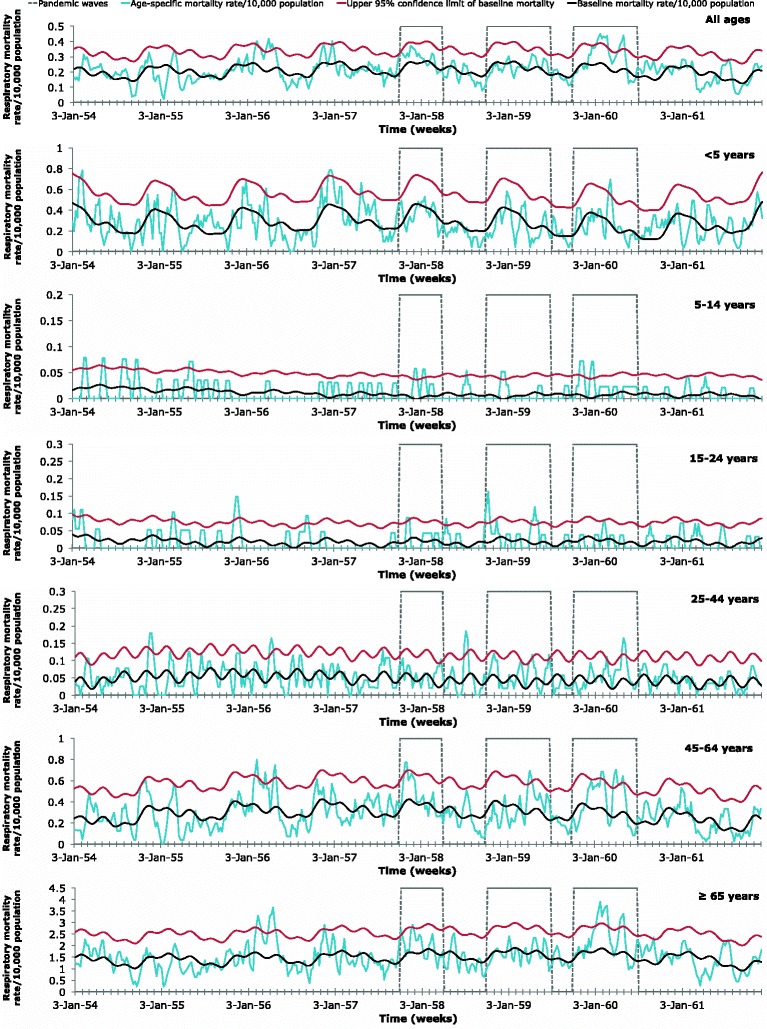
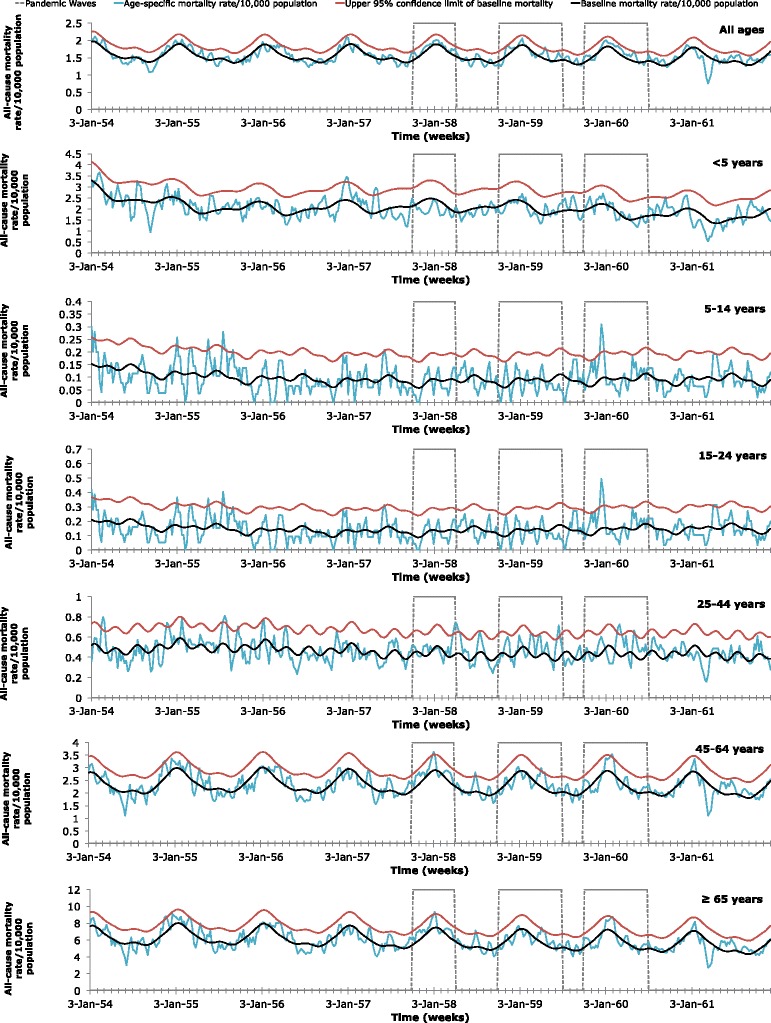
Using archival death certificates from 1954 to 1961, we quantified the age-specific seasonal patterns, excess-mortality rates, and transmissibility patterns of the 1957 H2N2 pandemic in Maricopa County, Arizona. By applying cyclical Serfling linear regression models to weekly mortality rates, the excess-mortality rates due to respiratory and all-causes were estimated for each age group during the pandemic period. The reproduction number was quantified from weekly data using a simple growth rate method and assumed generation intervals of 3 and 4 days. Local newspaper articles published during 1957-1958 were also examined.
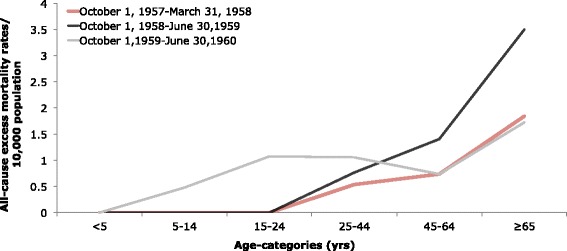
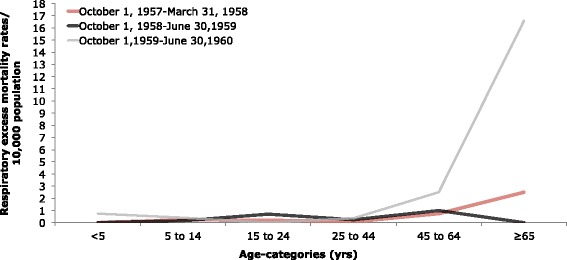
Excess-mortality rates varied between waves, age groups, and causes of death, but overall remained low. From October 1959-June 1960, the most severe wave of the pandemic, the absolute excess-mortality rate based on respiratory deaths per 10,000 population was 16.59 in the elderly (≥65 years). All other age groups exhibit very low excess-mortality and the typical U-shaped age-pattern was absent. However, the standardized mortality ratio was greatest (4.06) among children and young adolescents (5-14 years) from October 1957-March 1958, based on mortality rates of respiratory deaths. Transmissibility was greatest during the same 1957-1958 period, when the mean reproduction number was estimated at 1.08-1.11, assuming 3- or 4-day generation intervals with exponential or fixed distributions.
Maricopa County exhibited very low mortality impact associated with the 1957 influenza pandemic. Understanding the relatively low excess-mortality rates and transmissibility in Maricopa County during this historic pandemic may help public health officials prepare for and mitigate future outbreaks of influenza.
虽然先前的研究已经量化了1957年H2N2流感大流行在美国广大地理区域的死亡负担,但对于其在地方层面的影响却知之甚少。在此,我们聚焦于分析此次大流行在亚利桑那州的传播性和死亡负担,该地区气候干燥,曾被认为有助于减少呼吸道疾病传播,但结核病患病率却很高。
利用1954年至1961年的档案死亡证明,我们量化了1957年H2N2流感大流行在亚利桑那州马里科帕县的特定年龄季节性模式、超额死亡率和传播模式。通过将周期性塞尔弗林线性回归模型应用于每周死亡率,估算了大流行期间各年龄组因呼吸系统疾病和所有原因导致的超额死亡率。使用简单增长率方法并假设代间隔为3天和4天,从每周数据中量化繁殖数。还查阅了1957 - 1958年期间发表的当地报纸文章。
不同波次、年龄组和死因的超额死亡率有所不同,但总体仍较低。在1959年10月至1960年6月大流行最严重的波次中,以每10000人口中呼吸系统疾病死亡计算的绝对超额死亡率,老年人(≥65岁)为16.59。所有其他年龄组的超额死亡率都非常低,且不存在典型的U形年龄模式。然而,基于呼吸系统疾病死亡死亡率,1957年10月至1958年3月期间儿童和青少年(5 - 14岁)的标准化死亡率最高(4.06)。在同一1957 - 1958年期间传播性最强,假设代间隔为3天或4天,呈指数分布或固定分布时,平均繁殖数估计为1.08 - 1.11。
马里科帕县与1957年流感大流行相关的死亡影响非常低。了解此次历史性大流行期间马里科帕县相对较低的超额死亡率和传播性,可能有助于公共卫生官员为未来流感爆发做好准备并加以缓解。