Banzi Rita, Camaioni Paolo, Tettamanti Mauro, Bertele' Vittorio, Lucca Ugo
Laboratorio Politiche Regolatorie del Farmaco, IRCCS Istituto di Ricerche Farmacologiche Mario Negri, Via La Masa 19, Milan, 20156, Italy.
Laboratorio di Neuropsichiatria Geriatrica, IRCCS Istituto di Ricerche Farmacologiche Mario Negri, Via La Masa 19, Milan, 20156, Italy.
Alzheimers Res Ther. 2016 Aug 12;8:32. doi: 10.1186/s13195-016-0201-2.
The age gap between participants in trials and patients who could benefit from the drugs studied has been widely documented across different clinical areas. Patients with dementia included in clinical research are systematically younger than those in the general population. We examined the age gap between participants in recent clinical trials testing interventions for Alzheimer's disease and epidemiological data.
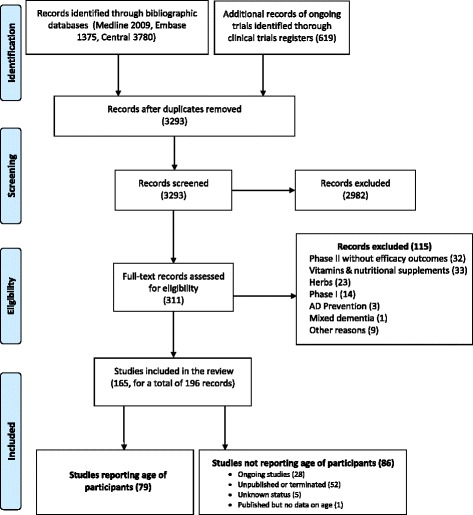
We systematically searched literature databases (MedLine, EMBASE, the Cochrane Library) and ClinicalTrials.gov from 2000 to July 2015 to retrieve clinical trials testing pharmacologic treatments for Alzheimer's disease, other than cholinesterase inhibitors and memantine. We included ongoing and completed phase II/III randomized clinical trials, irrespective of their publication status. From each study reporting the participants' ages, we extracted size of sample, mean age, and standard deviation, and estimated the proportions of participants in different age classes. The number of patients with Alzheimer's disease by age class in the USA population was used for comparison.
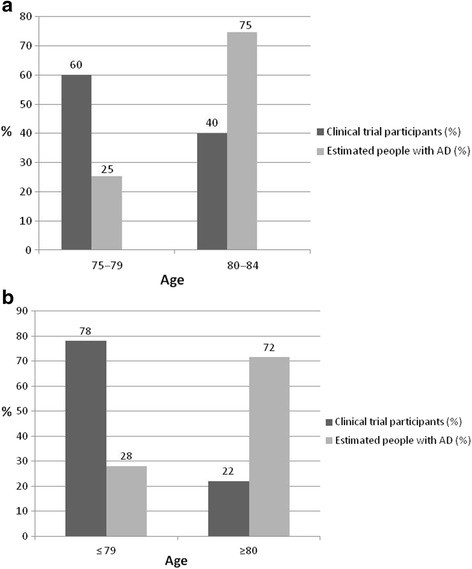
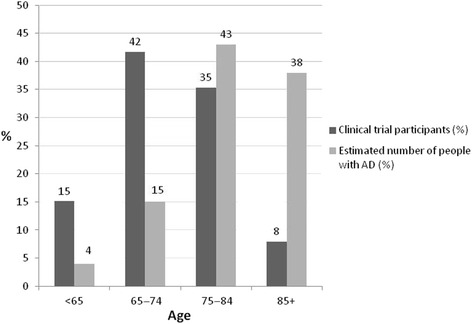
We included 165 clinical trials testing almost 100 different compounds, which enrolled or planned to enroll about 74,300 participants. Seventy-nine of these trials, accounting for about 26,800 participants, reported the age of the participants. The weighted mean age was 73.6 years (standard deviation, 8.2). People younger than 80 years were highly represented in clinical trials (78 %), despite the fact that those aged 80 and older form the majority (72 %) of patients with Alzheimer's disease. Only 8 % of clinical trial participants were 85 years or older.
Patients enrolled in clinical trials on Alzheimer's disease are far from being representative of actual distribution of the patients in the general population. Clinical research should not be designed and conducted overlooking the fact that the majority of individuals with Alzheimer's disease are likely to be 80 or older.
在不同临床领域,试验参与者与能从所研究药物中获益的患者之间的年龄差距已有广泛记录。纳入临床研究的痴呆症患者在系统上比一般人群中的患者年轻。我们研究了近期针对阿尔茨海默病进行干预测试的临床试验参与者与流行病学数据之间的年龄差距。
我们系统检索了2000年至2015年7月的文献数据库(MedLine、EMBASE、Cochrane图书馆)和ClinicalTrials.gov,以检索除胆碱酯酶抑制剂和美金刚之外针对阿尔茨海默病进行药物治疗测试的临床试验。我们纳入了正在进行和已完成的II/III期随机临床试验,无论其发表状态如何。从每项报告参与者年龄的研究中,我们提取了样本量、平均年龄和标准差,并估计了不同年龄组参与者的比例。美国人群中按年龄组划分的阿尔茨海默病患者数量用于比较。
我们纳入了165项测试近100种不同化合物的临床试验,这些试验已招募或计划招募约74300名参与者。其中79项试验,涉及约26800名参与者,报告了参与者的年龄。加权平均年龄为73.6岁(标准差8.2)。尽管80岁及以上的人占阿尔茨海默病患者的大多数(72%),但80岁以下的人在临床试验中占比很高(78%)。只有8%的临床试验参与者年龄在85岁及以上。
参与阿尔茨海默病临床试验的患者远不能代表一般人群中患者的实际分布情况。临床研究的设计和开展不应忽视这样一个事实,即大多数阿尔茨海默病患者可能年龄在80岁及以上。