Lee Jae-Hong, Yeom Sang Yoon, Hwang Ho Young, Choi Jae-Woong, Cho Hyun-Jai, Lee Hae-Young, Huh Jae-Hak, Kim Ki-Bong
Department of Thoracic and Cardiovascular Surgery, Seoul National University Hospital.
Department of Internal Medicine and Cardiovascular Center, Seoul National University Hospital.
Korean J Thorac Cardiovasc Surg. 2016 Aug;49(4):242-9. doi: 10.5090/kjtcs.2016.49.4.242. Epub 2016 Aug 5.
We evaluated early and long-term results after heart transplantation (HTPL).
One hundred five consecutive patients (male:female=80:25) who underwent HTPL between 1994 and 2013 were enrolled. Based on the changes in immunosuppressive regimen, the study patients were divided into two groups. Early and long-term clinical outcomes were evaluated and compared between the patients who underwent HTPL before (group E, n=41) and after July 2009 (group L, n=64). The group L patients were older (p<0.001), had higher incidence of hypertension (p=0.001) and chronic kidney disease (p<0.001), and more frequently needed preoperative mechanical ventilation (p=0.027) and mechanical circulatory support (p=0.014) than the group E patients.
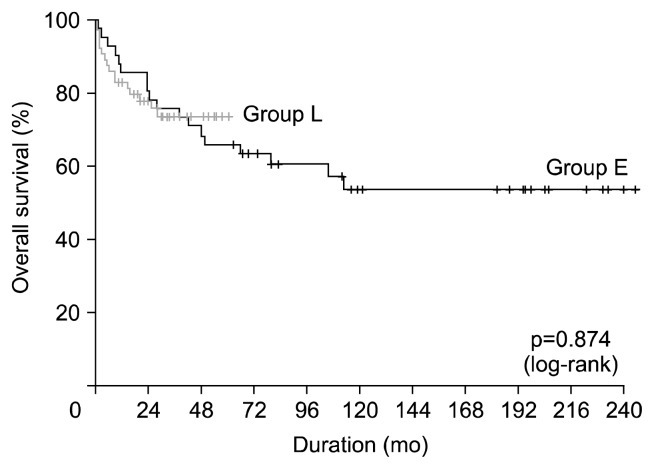
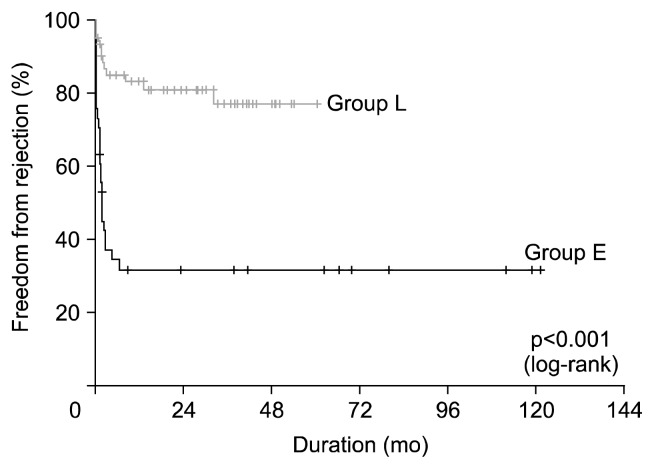
Overall operative mortality was 3.8%, and postoperative morbidities included acute kidney injury (n=31), respiratory complications (n=16), reoperation for bleeding (n=15) and wound complications (n=10). There were no significant differences in early results except acute kidney injury between group E and group L patients. Overall survival rates at 1, 5, and 10 years were 83.8%, 67.7%, and 54.9%, respectively, with no significant difference between the two patient groups. Rejection-free rates at 1 and 5 years were 63.0% and 59.7%, respectively; rates were significantly higher in group L than in group E (p<0.001).
Despite increased preoperative comorbidities, group L patients showed similar early and long-term outcomes and significantly higher rejection-free rates when compared with group E patients.
我们评估了心脏移植术后的早期和长期结果。
纳入了1994年至2013年间连续接受心脏移植的105例患者(男性:女性 = 80:25)。根据免疫抑制方案的变化,将研究患者分为两组。对2009年7月之前(E组,n = 41)和之后(L组,n = 64)接受心脏移植的患者的早期和长期临床结果进行了评估和比较。L组患者比E组患者年龄更大(p < 0.001),高血压发病率更高(p = 0.001),慢性肾病发病率更高(p < 0.001),术前更频繁地需要机械通气(p = 0.027)和机械循环支持(p = 0.014)。
总体手术死亡率为3.8%,术后并发症包括急性肾损伤(n = 31)、呼吸并发症(n = 16)、出血再次手术(n = 15)和伤口并发症(n = 10)。除急性肾损伤外,E组和L组患者的早期结果无显著差异。1年、5年和10年的总体生存率分别为83.8%、67.7%和54.9%,两组患者之间无显著差异。1年和5年的无排斥率分别为63.0%和59.7%;L组的无排斥率显著高于E组(p < 0.001)。
尽管术前合并症增加,但与E组患者相比,L组患者的早期和长期结果相似,且无排斥率显著更高。