Crawford Rebecca J, Volken Thomas, Valentin Stephanie, Melloh Markus, Elliott James M
Institute for Health Sciences, School of Health Professions, ZHAW, Zurich University of Applied Sciences, Technikumstrasse 81, CH-8401 Winterthur, Switzerland ; Faculty of Health Sciences, Curtin University, Perth, Australia.
Institute for Health Sciences, School of Health Professions, ZHAW, Zurich University of Applied Sciences, Technikumstrasse 81, CH-8401 Winterthur, Switzerland.
Scoliosis Spinal Disord. 2016 Aug 5;11:21. doi: 10.1186/s13013-016-0080-0. eCollection 2016.
The spinal column including its vertebrae and disks has been well examined and extensively reported in relation to age-aggregated degeneration. In contrast, paravertebral muscles are poorly represented in describing normative degeneration. Increasing evidence points to the importance of paravertebral muscle quality in low back health, and their potential as a modifiable factor in low back pain (LBP). Studies examining normative decline of paravertebral muscles are needed to advance the field's etiological understanding. With a novel approach and based on published data, we establish and compare decline rates of imaging features for degeneration of lumbar vertebrae and disks, versus fatty infiltration in paravertebral muscles in asymptomatic adults.
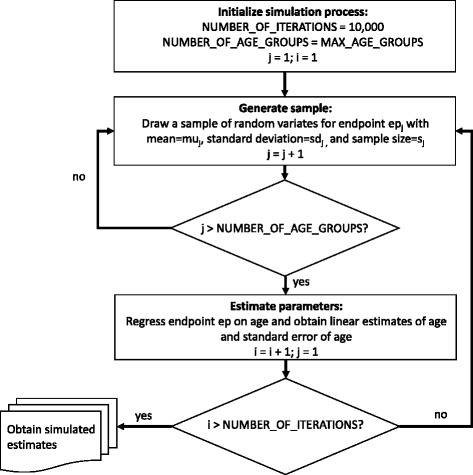
Our cross-sectional simulation study examined age-aggregated data from three published studies who reported on asymptomatic adults spanning 18-60 years. Prevalence rates of imaging degenerative features of the spinal column were examined via logistic regression and compared with percentage fatty infiltration in erector spinae, multifidus and psoas using synthetic data and Monte Carlo simulation with 10,000 endpoint-specific regression iterations. General linear regression models were employed to estimate marginal effects of age reported as a one-year change rate (with 95 % confidence intervals) for comparisons between all reported spinal features.
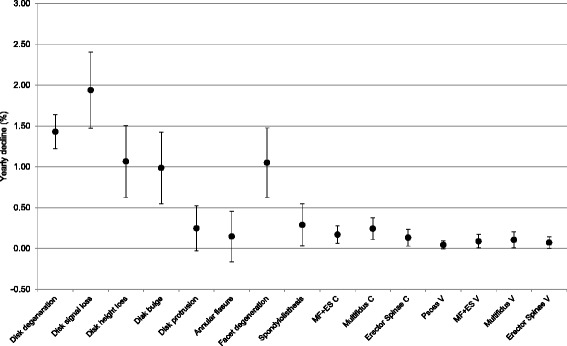
Declines in multifidus (0.24 & 0.11 %/year), erector spinae (0.13 & 0.07 %/year), and psoas (0.04 %/year) occur at similarly slow rates to disk protrusion (0.25 %/year), annular fissure (0.15 %/year), and spondylolisthesis (0.29 %/year). Multifidus showed a trend for faster decline than erector spinae, particularly in men. Of the features examined, disk signal loss declined fastest, and psoas muscle the slowest.
Degeneration of lumbar paravertebral muscles occurs slowly in asymptomatic adults, with a tendency to be most pronounced in multifidus. Rate of decline of spinal structures represents a novel variable that warrants inclusion as a known feature of the expected degenerative cascade, and to provide a basis for comparison to diseases of the spine in research and clinical practice. Concurrent examination of spinal features using advanced imaging to improve muscle analysis would be a strong addition to the field.
包括椎体和椎间盘在内的脊柱已得到充分研究,并就年龄相关的退变进行了广泛报道。相比之下,在描述正常退变时,椎旁肌的研究较少。越来越多的证据表明椎旁肌质量对下背部健康的重要性,以及它们作为下背痛(LBP)中一个可调节因素的潜力。需要开展研究来探讨椎旁肌的正常退变情况,以推进该领域对病因的理解。我们采用一种新方法并基于已发表的数据,建立并比较了无症状成年人腰椎和椎间盘退变的影像学特征与椎旁肌脂肪浸润的退变率。
我们的横断面模拟研究分析了三项已发表研究中的年龄汇总数据,这些研究报道了年龄在18至60岁之间的无症状成年人。通过逻辑回归分析脊柱影像学退变特征的患病率,并使用合成数据和蒙特卡罗模拟(进行10,000次特定终点回归迭代),将其与竖脊肌、多裂肌和腰大肌的脂肪浸润百分比进行比较。采用一般线性回归模型估计年龄的边际效应(以每年变化率表示,并给出95%置信区间),用于比较所有报告的脊柱特征。
多裂肌(每年0.24%和0.11%)、竖脊肌(每年0.13%和0.07%)和腰大肌(每年0.04%)的退变速度与椎间盘突出(每年0.25%)、环状裂隙(每年0.15%)和椎体滑脱(每年0.29%)相似,都很缓慢。多裂肌的退变趋势比竖脊肌更快,尤其是在男性中。在所研究的特征中,椎间盘信号丢失退变最快,腰大肌最慢。
无症状成年人的腰椎椎旁肌退变缓慢,多裂肌的退变倾向最为明显。脊柱结构的退变率是一个新的变量,应作为预期退变级联反应的已知特征纳入研究,并为研究和临床实践中与脊柱疾病的比较提供基础。使用先进影像学技术同时检查脊柱特征以改进肌肉分析,将是该领域的有力补充。