Skrdlant Lindsey, Stark Jeremy M, Lin Ren-Jang
Department of Molecular and Cellular Biology, Irell & Manella Graduate School of Biological Sciences, Beckman Research Institute of the City of Hope, Duarte, CA, 91010, USA.
Department of Cancer Genetics and Epigenetics, Irell & Manella Graduate School of Biological Sciences, Beckman Research Institute of the City of Hope, Duarte, CA, 91010, USA.
BMC Mol Biol. 2016 Aug 23;17(1):18. doi: 10.1186/s12867-016-0071-y.
Serine-arginine rich splicing factor 2 (SRSF2) is a protein known for its role in RNA splicing and genome stability. It has been recently discovered that SRSF2, along with other splicing regulators, is frequently mutated in patients with myelodysplastic syndrome (MDS). The most common MDS mutations in SRSF2 occur at proline 95; the mutant proteins are shown to have different RNA binding preferences, which may contribute to splicing changes detected in mutant cells. However, the influence of these SRSF2 MDS-associated mutations on specific splicing events remains poorly understood.
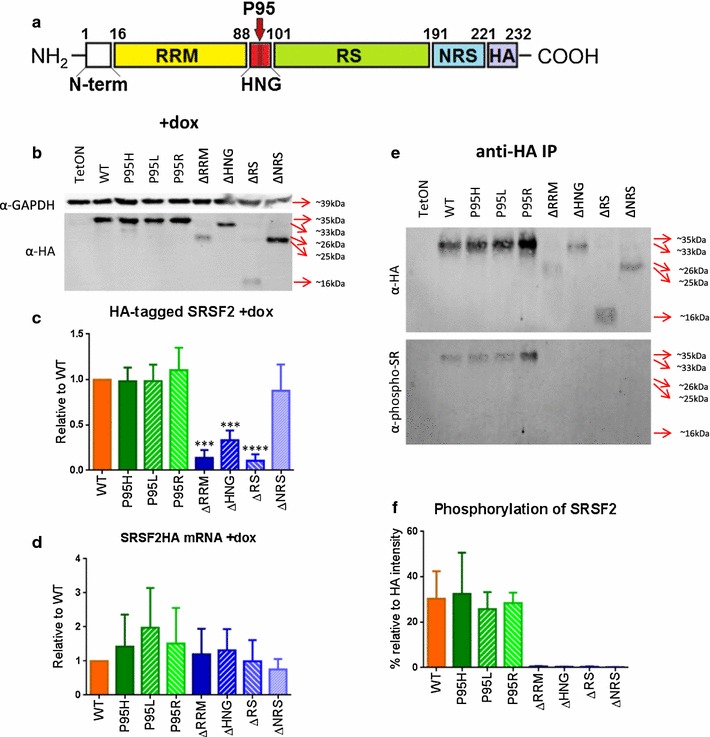
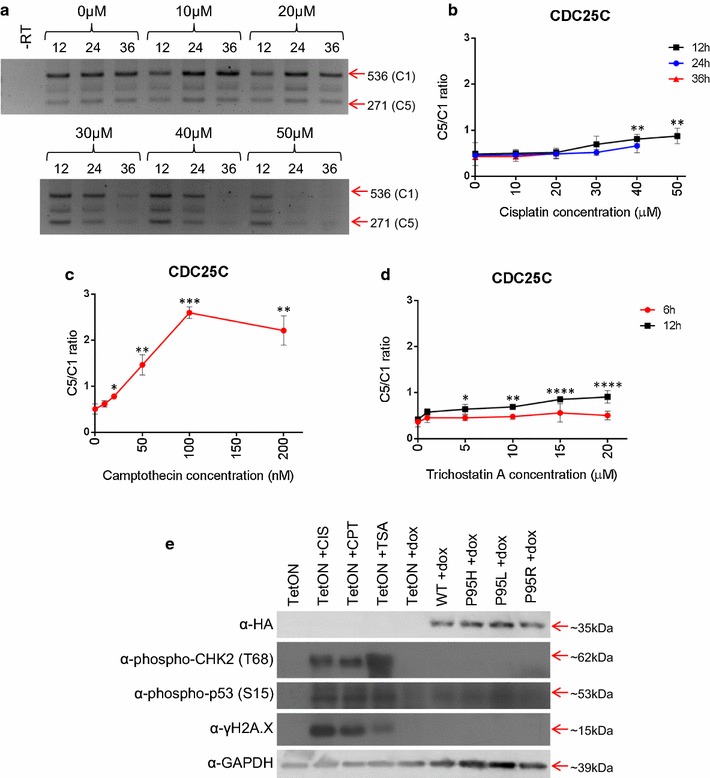
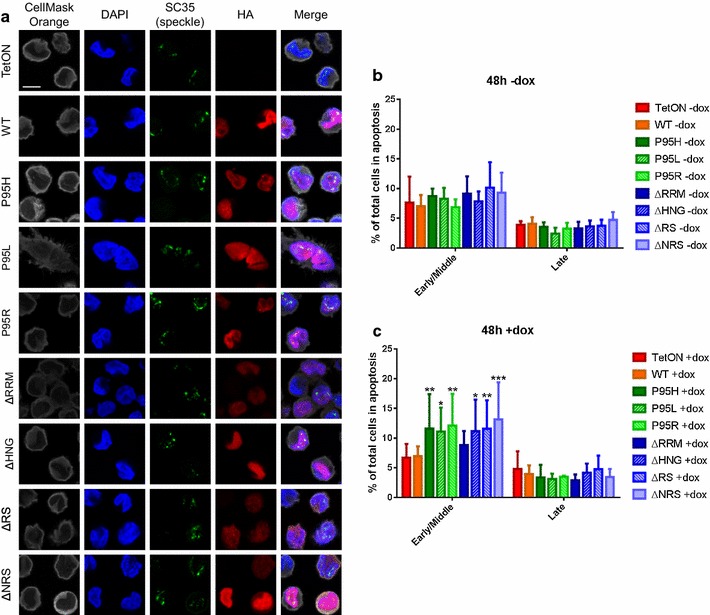
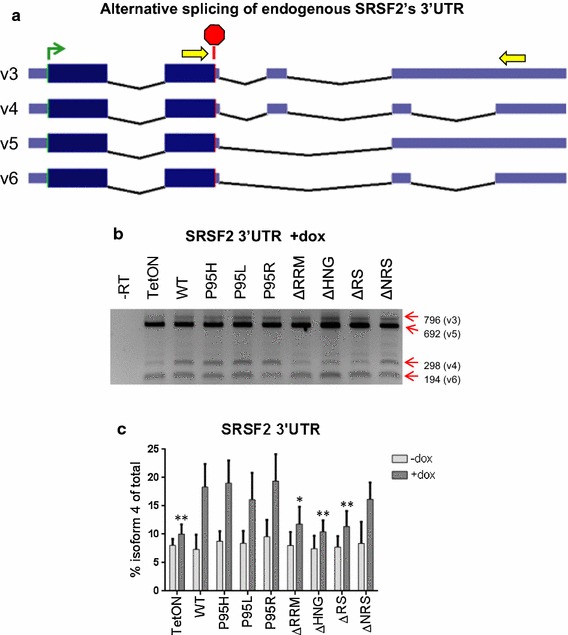
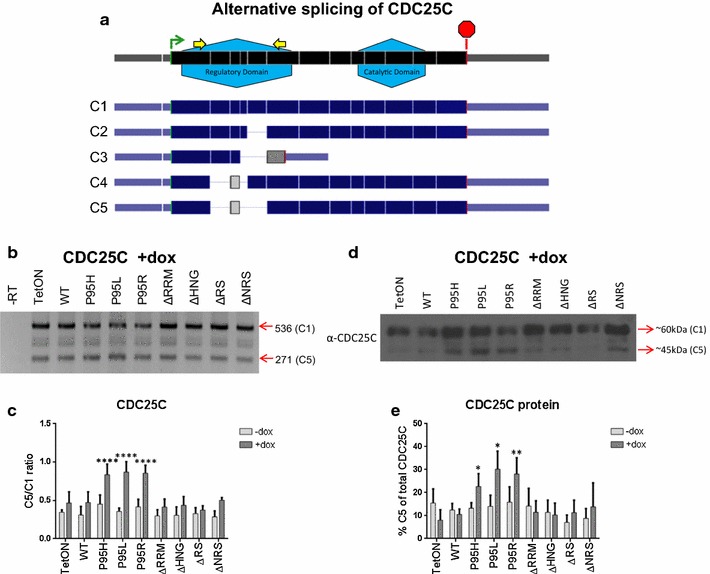
A tetracycline-inducible TF-1 erythroleukemia cell line was transduced with retroviruses to create cell lines expressing HA-tagged wildtype SRSF2, SRSF2 with proline 95 point mutations found in MDS, or SRSF2 with a deletion of one of the four major domains of the protein. Effects of these mutants on apoptosis and specific alternative splicing events were evaluated. Cells were also treated with DNA damaging drugs for comparison. MDS-related P95 point mutants of SRSF2 were expressed and phosphorylated at similar levels as wildtype SRSF2. However, cells expressing mutant SRSF2 exhibited higher levels of apoptosis than cells expressing wildtype SRSF2. Regarding alternative splicing events, in nearly all examined cases, SRSF2 P95 mutants acted in a similar fashion as the wildtype SRSF2. However, cells expressing SRSF2 P95 mutants had a percent increase in the C5 spliced isoform of cell division cycle 25C (CDC25C). The same alternative splicing of CDC25C was detected by treating cells with DNA damaging drugs, such as cisplatin, camptothecin, and trichostatin A at appropriate dosage. However, unlike DNA damaging drugs, SRSF2 P95 mutants did not activate the Ataxia telangiectasia mutated (ATM) pathway.
SRSF2 P95 mutants lead to alternative splicing of CDC25C in a manner that is not dependent on the DNA damage response.
富含丝氨酸 - 精氨酸的剪接因子2(SRSF2)是一种因其在RNA剪接和基因组稳定性中的作用而闻名的蛋白质。最近发现,SRSF2与其他剪接调节因子一起,在骨髓增生异常综合征(MDS)患者中经常发生突变。SRSF2中最常见的MDS突变发生在脯氨酸95处;已显示突变蛋白具有不同的RNA结合偏好,这可能导致在突变细胞中检测到的剪接变化。然而,这些与SRSF2 MDS相关的突变对特定剪接事件的影响仍知之甚少。
用逆转录病毒转导四环素诱导的TF - 1红白血病细胞系,以创建表达带有HA标签的野生型SRSF2、在MDS中发现的具有脯氨酸95点突变的SRSF2或缺失该蛋白四个主要结构域之一的SRSF2的细胞系。评估了这些突变体对细胞凋亡和特定可变剪接事件的影响。还对细胞用DNA损伤药物进行处理以作比较。SRSF2的MDS相关P95点突变体的表达和磷酸化水平与野生型SRSF2相似。然而,表达突变型SRSF2的细胞比表达野生型SRSF2的细胞表现出更高水平的细胞凋亡。关于可变剪接事件,在几乎所有检测的情况下,SRSF2 P95突变体的作用方式与野生型SRSF2相似。然而,表达SRSF2 P95突变体的细胞中细胞分裂周期25C(CDC25C)的C5剪接异构体百分比增加。在用顺铂、喜树碱和曲古抑菌素A等DNA损伤药物以适当剂量处理细胞时,也检测到了相同的CDC25C可变剪接。然而,与DNA损伤药物不同,SRSF2 P95突变体未激活共济失调毛细血管扩张突变(ATM)途径。
SRSF2 P95突变体以不依赖于DNA损伤反应的方式导致CDC25C的可变剪接。