Mager Rene, Daneshmand Siamak, Evans Christopher P, Palou Joan, Martínez-Salamanca Juan I, Master Viraj A, McKiernan James M, Libertino John A, Haferkamp Axel, Haferkamp Axel, Capitanio Umberto, Carballido Joaquín A, Chantada Venancio, Chromecki Thomas, Ciancio Gaetano, Daneshmand Siamak, Evans Christopher P, Gontero Paolo, González Javier, Hohenfellner Markus, Huang William C, Koppie Theresa M, Libertino John A, Espinós Estefanía Linares, Lorentz Adam, Martínez-Salamanca Juan I, Master Viraj A, McKiernan James M, Montorsi Francesco, Novara Giacomo, O'Malley Padraic, Pahernik Sascha, Palou Joan, Moreno José Luis Pontones, Pruthi Raj S, Faba Oscar Rodriguez, Russo Paul, Scherr Douglas S, Shariat Shahrokh F, Spahn Martin, Terrone Carlo, Tilki Derya, Vázquez-Martul Dario, Donoso Cesar Vera, Vergho Daniel, Wallen Eric M, Zigeuner Richard
Department of Urology and Pediatric Urology, University Medical Center Mainz, Mainz, Germany.
USC/Norris Comprehensive Cancer Center, Los Angeles, California.
J Surg Oncol. 2016 Nov;114(6):764-768. doi: 10.1002/jso.24395. Epub 2016 Aug 26.
Renal cell carcinoma forming a venous tumor thrombus (VTT) in the inferior vena cava (IVC) has a poor prognosis. Recent investigations have been focused on prognostic markers of survival. Thrombus consistency (TC) has been proposed to be of significant value but yet there are conflicting data. The aim of this study is to test the effect of IVC VTT consistency on cancer specific survival (CSS) in a multi-institutional cohort.
The records of 413 patients collected by the International Renal Cell Carcinoma-Venous Thrombus Consortium were retrospectively analyzed. All patients underwent radical nephrectomy and tumor thrombectomy. Kaplan-Meier estimate and Cox regression analyses investigated the impact of TC on CSS in addition to established clinicopathological predictors.
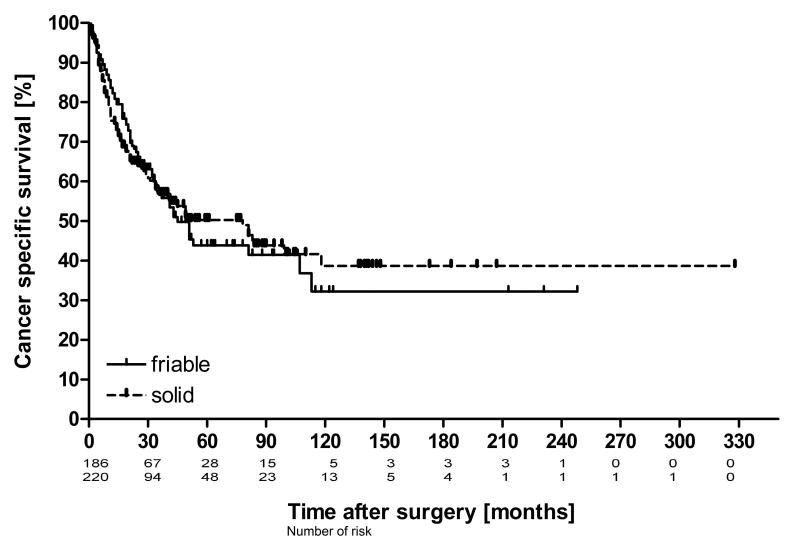
VTT was solid in 225 patients and friable in 188 patients. Median CSS was 50 months in solid and 45 months in friable VTT. TC showed no significant association with metastatic spread, pT stage, perinephric fat invasion, and higher Fuhrman grade. Survival analysis and Cox regression rejected TC as prognostic marker for CSS.
In the largest cohort published so far, TC seems not to be independently associated with survival in RCC patients and should therefore not be included in risk stratification models. J. Surg. Oncol. 2016;114:764-768. © 2016 Wiley Periodicals, Inc.
在下腔静脉(IVC)中形成静脉瘤栓(VTT)的肾细胞癌预后较差。最近的研究集中在生存预后标志物上。血栓质地(TC)已被认为具有重要价值,但数据存在冲突。本研究的目的是在一个多机构队列中测试IVC VTT质地对癌症特异性生存(CSS)的影响。
对国际肾细胞癌-静脉瘤栓联盟收集的413例患者的记录进行回顾性分析。所有患者均接受了根治性肾切除术和肿瘤栓子切除术。除了既定的临床病理预测因素外,采用Kaplan-Meier估计法和Cox回归分析来研究TC对CSS的影响。
225例患者的VTT为实性,188例患者的VTT为易碎性。实性VTT患者的CSS中位数为50个月,易碎性VTT患者为45个月。TC与转移扩散、pT分期、肾周脂肪浸润及更高的Fuhrman分级均无显著相关性。生存分析和Cox回归排除了TC作为CSS的预后标志物。
在迄今为止发表的最大队列研究中,TC似乎与肾细胞癌患者的生存无独立相关性,因此不应纳入风险分层模型。《外科肿瘤学杂志》2016年;114:764 - 768。©2016威利期刊公司