Morgan Richard D, Luyten Yvette A, Johnson Samuel A, Clough Emily M, Clark Tyson A, Roberts Richard J
New England Biolabs, 240 County Road, Ipswich, MA 01938, USA
New England Biolabs, 240 County Road, Ipswich, MA 01938, USA.
Nucleic Acids Res. 2016 Nov 2;44(19):9413-9425. doi: 10.1093/nar/gkw743. Epub 2016 Aug 31.
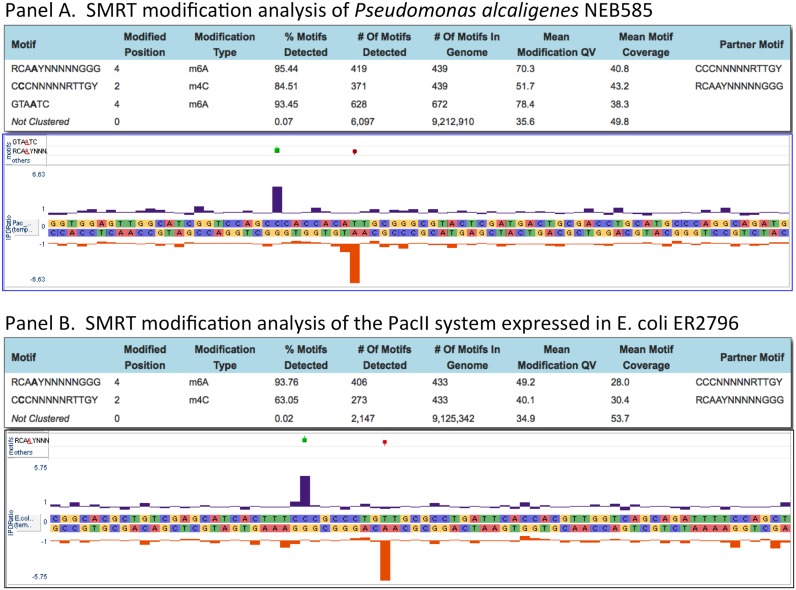
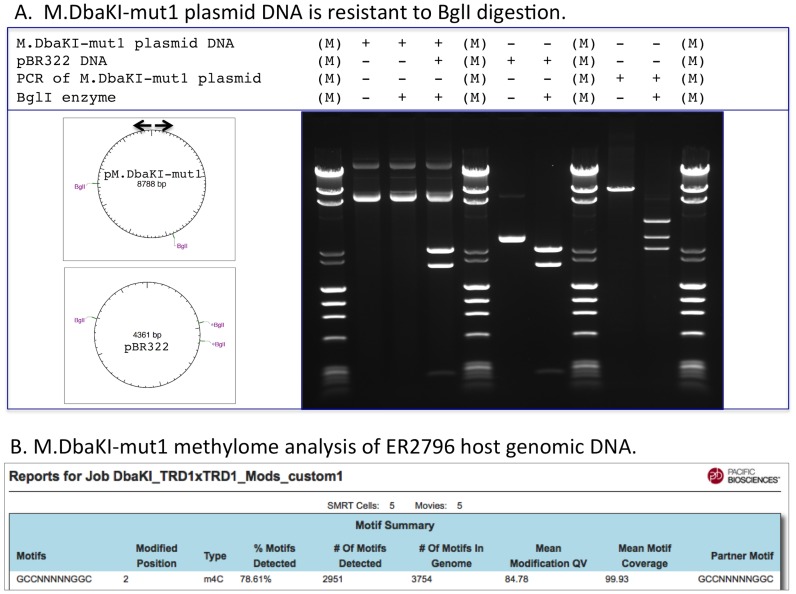
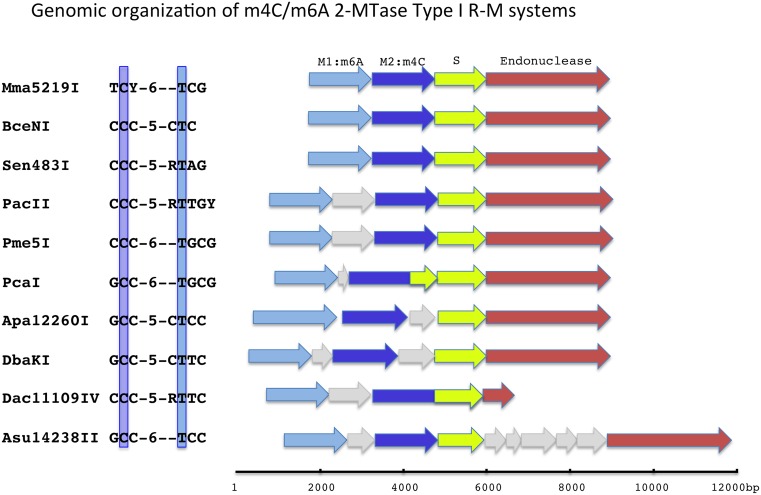
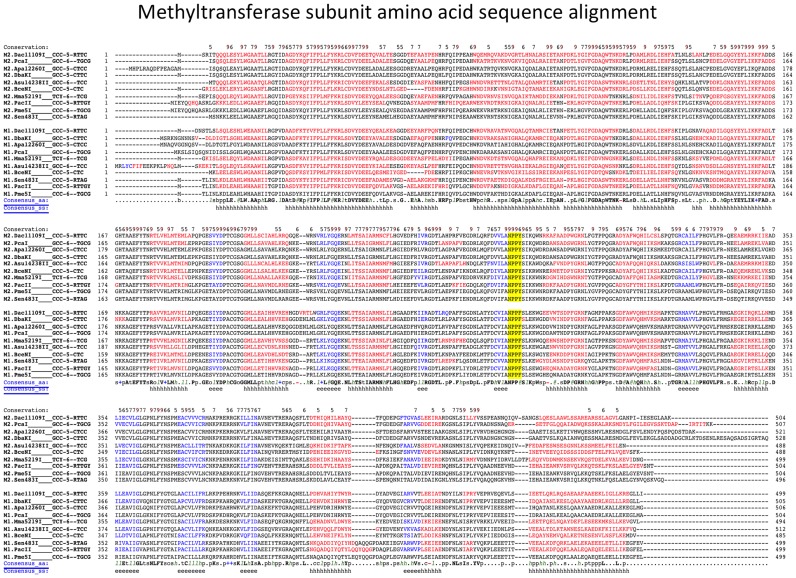
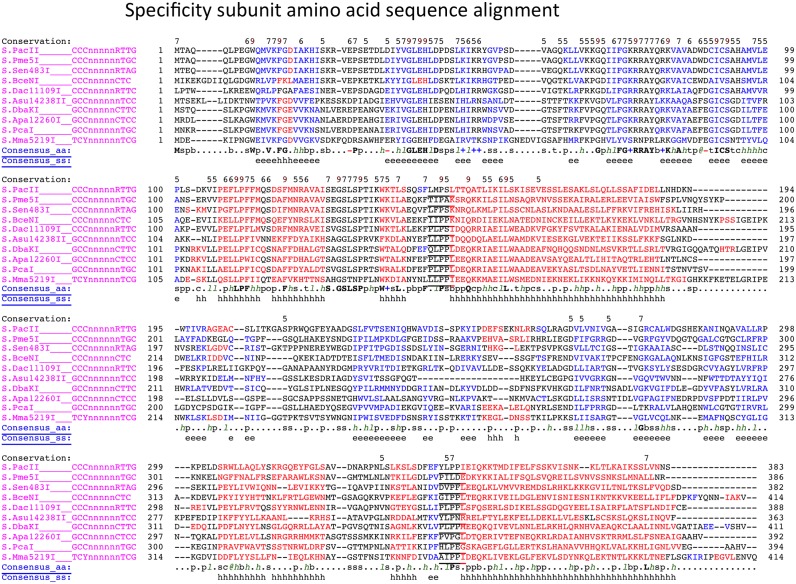
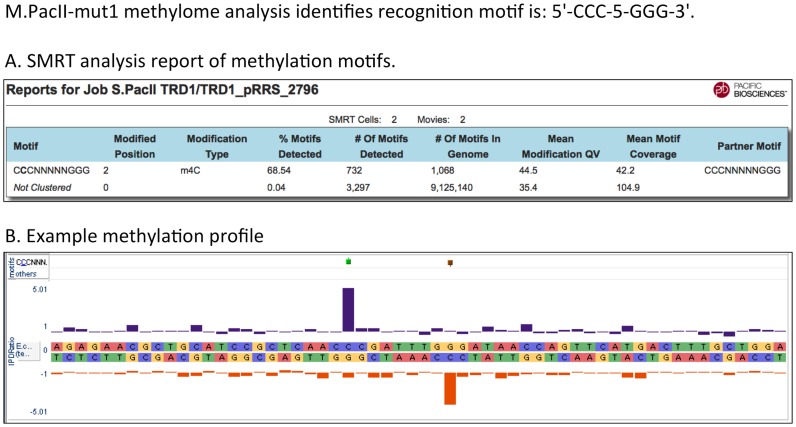
We identify a new subgroup of Type I Restriction-Modification enzymes that modify cytosine in one DNA strand and adenine in the opposite strand for host protection. Recognition specificity has been determined for ten systems using SMRT sequencing and each recognizes a novel DNA sequence motif. Previously characterized Type I systems use two identical copies of a single methyltransferase (MTase) subunit, with one bound at each half site of the specificity (S) subunit to form the MTase. The new m4C-producing Type I systems we describe have two separate yet highly similar MTase subunits that form a heterodimeric M1M2S MTase. The MTase subunits from these systems group into two families, one of which has NPPF in the highly conserved catalytic motif IV and modifies adenine to m6A, and one having an NPPY catalytic motif IV and modifying cytosine to m4C. The high degree of similarity among their cytosine-recognizing components (MTase and S) suggest they have recently evolved, most likely from the far more common m6A Type I systems. Type I enzymes that modify cytosine exclusively were formed by replacing the adenine target recognition domain (TRD) with a cytosine-recognizing TRD. These are the first examples of m4C modification in Type I RM systems.
我们鉴定出了一类新型的I型限制-修饰酶亚群,这类酶通过修饰一条DNA链上的胞嘧啶和互补链上的腺嘌呤来保护宿主。利用单分子实时测序(SMRT测序)确定了十个系统的识别特异性,每个系统都识别一种新的DNA序列基序。先前表征的I型系统使用单个甲基转移酶(MTase)亚基的两个相同拷贝,其中一个结合在特异性(S)亚基的每个半位点上以形成MTase。我们描述的新型产生m4C的I型系统具有两个独立但高度相似的MTase亚基,它们形成异源二聚体M1M2S MTase。这些系统的MTase亚基分为两个家族,其中一个家族在高度保守的催化基序IV中有NPPF,并将腺嘌呤修饰为m6A,另一个家族具有NPPY催化基序IV,并将胞嘧啶修饰为m4C。它们的胞嘧啶识别成分(MTase和S)之间的高度相似性表明它们是最近进化而来的,很可能是从更为常见的m6A I型系统进化而来。专门修饰胞嘧啶的I型酶是通过用胞嘧啶识别靶标识别结构域(TRD)取代腺嘌呤靶标识别结构域而形成的。这些是I型限制-修饰系统中m4C修饰的首个实例。