Ha Eun Ju, Moon Won-Jin, Na Dong Gyu, Lee Young Hen, Choi Nami, Kim Soo Jin, Kim Jae Kyun
Department of Radiology, Ajou University School of Medicine, Suwon 16499, Korea.
Department of Radiology, Konkuk University Medical Center, Konkuk University School of Medicine, Seoul 05030, Korea.
Korean J Radiol. 2016 Sep-Oct;17(5):811-21. doi: 10.3348/kjr.2016.17.5.811. Epub 2016 Aug 23.
To validate a new risk stratification system for thyroid nodules, the Korean Thyroid Imaging Reporting and Data System (K-TIRADS), using a prospective design.
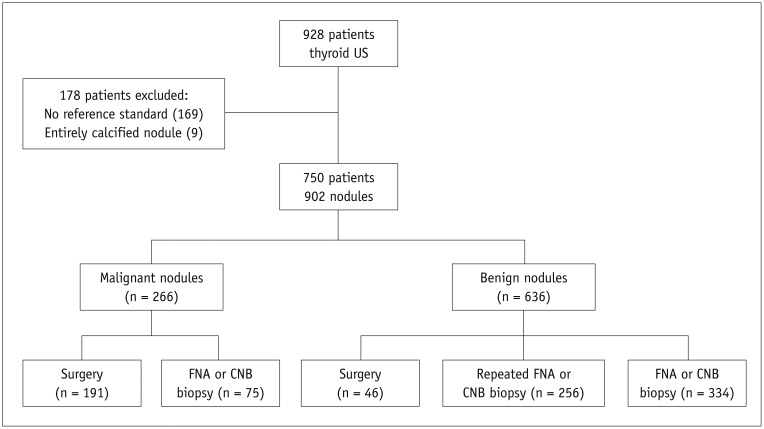
From June 2013 to May 2015, 902 thyroid nodules were enrolled from four institutions. The type and predictive value of ultrasonography (US) predictors were analyzed according to the combination of the solidity and echogenicity of nodules; in addition, we determined malignancy risk and diagnostic performance for each category of K-TIRADS, and compared the efficacy of fine-needle aspiration (FNA) with a three-tier risk categorization system published in 2011.
The malignancy risk was significantly higher in solid hypoechoic nodules, as compared to partially cystic or isohyperechoic nodules (each p < 0.001). The presence of any suspicious US features had a significantly higher malignancy risk (73.4%) in solid hypoechoic nodules than in partially cystic or isohyperechoic nodules (4.3-38.5%; p < 0.001). The calculated malignancy risk in K-TIRADS categories 5, 4, 3, and 2 nodules were 73.4, 19.0, 3.5, and 0.0%, respectively; and the sensitivity, specificity, positive predictive value, negative predictive value, and accuracy for malignancy were 95.5, 58.6, 44.5, 96.9, and 69.5%, respectively, in K-TIRADS categories 4 and 5. The efficacy of FNA for detecting malignancy based on K-TIRADS was increased from 18.6% (101/544) to 22.5% (101/449), as compared with the three-tier risk categorization system (p < 0.001).
The proposed new risk stratification system based on solidity and echogenicity was useful for risk stratification of thyroid nodules and the decision for FNA. The malignancy risk of K-TIRADS was in agreement with the findings of a previous retrospective study.
采用前瞻性设计验证一种新的甲状腺结节风险分层系统——韩国甲状腺影像报告和数据系统(K-TIRADS)。
2013年6月至2015年5月,从四家机构纳入902个甲状腺结节。根据结节的实性和回声性组合分析超声(US)预测指标的类型和预测价值;此外,我们确定了K-TIRADS各分类的恶性风险和诊断性能,并将细针穿刺活检(FNA)的有效性与2011年发布的三级风险分类系统进行比较。
与部分囊性或等/高回声结节相比,实性低回声结节的恶性风险显著更高(各p<0.001)。实性低回声结节中存在任何可疑US特征的恶性风险(73.4%)显著高于部分囊性或等/高回声结节(4.3%-38.5%;p<0.001)。K-TIRADS分类为5、4、3和2类结节的计算恶性风险分别为73.4%、19.0%、3.5%和0.0%;K-TIRADS分类为4和5类时,恶性肿瘤的敏感性、特异性、阳性预测值、阴性预测值和准确性分别为95.5%、58.6%、44.5%、96.9%和69.5%。与三级风险分类系统相比,基于K-TIRADS检测恶性肿瘤的FNA有效性从18.6%(101/544)提高到22.5%(101/449)(p<0.001)。
基于实性和回声性提出的新风险分层系统有助于甲状腺结节的风险分层和FNA决策。K-TIRADS的恶性风险与先前一项回顾性研究的结果一致。