Clark Ian A, Vissel Bryce
Biomedical Sciences and Biochemistry, Research School of Biology, Australian National University, Acton, Canberra, Australian Capital Territory, 0200, Australia.
Neurodegeneration Research Group, Garvan Institute, 384 Victoria Street, Sydney, New South Wales, 2010, Australia.
J Neuroinflammation. 2016 Sep 5;13(1):236. doi: 10.1186/s12974-016-0708-2.
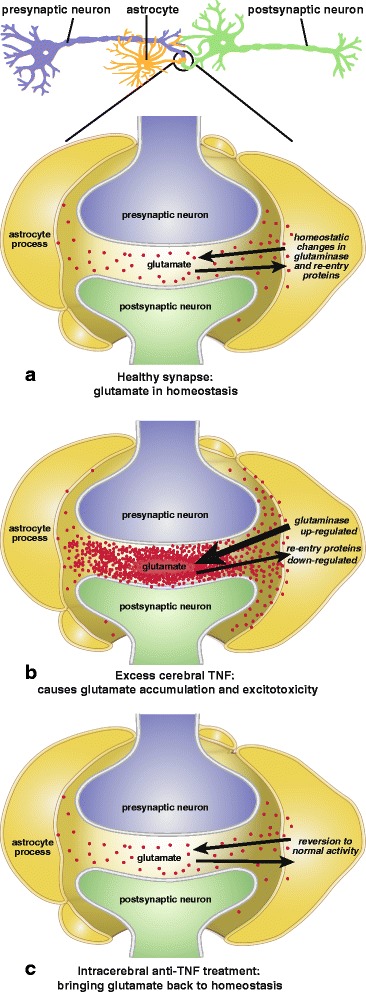
The basic mechanism of the major neurodegenerative diseases, including neurogenic pain, needs to be agreed upon before rational treatments can be determined, but this knowledge is still in a state of flux. Most have agreed for decades that these disease states, both infectious and non-infectious, share arguments incriminating excitotoxicity induced by excessive extracellular cerebral glutamate. Excess cerebral levels of tumor necrosis factor (TNF) are also documented in the same group of disease states. However, no agreement exists on overarching mechanism for the harmful effects of excess TNF, nor, indeed how extracellular cerebral glutamate reaches toxic levels in these conditions. Here, we link the two, collecting and arguing the evidence that, across the range of neurodegenerative diseases, excessive TNF harms the central nervous system largely through causing extracellular glutamate to accumulate to levels high enough to inhibit synaptic activity or kill neurons and therefore their associated synapses as well. TNF can be predicted from the broader literature to cause this glutamate accumulation not only by increasing glutamate production by enhancing glutaminase, but in addition simultaneously reducing glutamate clearance by inhibiting re-uptake proteins. We also discuss the effects of a TNF receptor biological fusion protein (etanercept) and the indirect anti-TNF agents dithio-thalidomides, nilotinab, and cannabinoids on these neurological conditions. The therapeutic effects of 6-diazo-5-oxo-norleucine, ceptriaxone, and riluzole, agents unrelated to TNF but which either inhibit glutaminase or enhance re-uptake proteins, but do not do both, as would anti-TNF agents, are also discussed in this context. By pointing to excess extracellular glutamate as the target, these arguments greatly strengthen the case, put now for many years, to test appropriately delivered ant-TNF agents to treat neurodegenerative diseases in randomly controlled trials.
在确定合理的治疗方法之前,需要就包括神经源性疼痛在内的主要神经退行性疾病的基本机制达成共识,但这方面的知识仍在不断变化。几十年来,大多数人都认为,这些感染性和非感染性疾病状态都存在因细胞外脑谷氨酸过量引发的兴奋性毒性问题。在同一组疾病状态中,也有文献记载脑肿瘤坏死因子(TNF)水平过高。然而,对于过量TNF产生有害影响的总体机制,以及在这些情况下细胞外脑谷氨酸如何达到毒性水平,目前尚无定论。在此,我们将两者联系起来,收集并论证证据表明,在一系列神经退行性疾病中,过量的TNF主要通过使细胞外谷氨酸积累到足以抑制突触活动或杀死神经元及其相关突触的水平,从而损害中枢神经系统。从更广泛的文献中可以预测,TNF导致这种谷氨酸积累,不仅是通过增强谷氨酰胺酶来增加谷氨酸的产生,还同时通过抑制再摄取蛋白来减少谷氨酸的清除。我们还讨论了TNF受体生物融合蛋白(依那西普)以及间接抗TNF药物二硫代沙利度胺、尼洛替尼和大麻素对这些神经疾病的影响。在这一背景下,我们还讨论了6 - 重氮 - 5 - 氧代 - 正亮氨酸、头孢曲松和利鲁唑的治疗效果,这些药物与TNF无关,但它们要么抑制谷氨酰胺酶,要么增强再摄取蛋白,但不像抗TNF药物那样同时具备这两种作用。通过将过量的细胞外谷氨酸作为靶点,这些观点极大地强化了多年来提出的观点,即在随机对照试验中测试适当给药的抗TNF药物以治疗神经退行性疾病。