De Bruyn Alexandre, Harimalala Mireille, Zinga Innocent, Mabvakure Batsirai M, Hoareau Murielle, Ravigné Virginie, Walters Matthew, Reynaud Bernard, Varsani Arvind, Harkins Gordon W, Martin Darren P, Lett Jean-Michel, Lefeuvre Pierre
CIRAD, UMR PVBMT, Pôle de Protection des Plantes, 7 chemin de l'IRAT, Saint-Pierre, Ile de la Réunion, 97410, France.
Université de la Réunion, UMR PVBMT, Pôle de Protection des Plantes, 7 chemin de l'IRAT, Saint-Pierre, Ile de la Réunion, 97410, France.
BMC Evol Biol. 2016 Sep 6;16(1):182. doi: 10.1186/s12862-016-0749-2.
Cassava mosaic disease (CMD) in Madagascar is caused by a complex of at least six African cassava mosaic geminivirus (CMG) species. This provides a rare opportunity for a comparative study of the evolutionary and epidemiological dynamics of distinct pathogenic crop-infecting viral species that coexist within the same environment. The genetic and spatial structure of CMG populations in Madagascar was studied and Bayesian phylogeographic modelling was applied to infer the origins of Madagascan CMG populations within the epidemiological context of related populations situated on mainland Africa and other south western Indian Ocean (SWIO) islands.
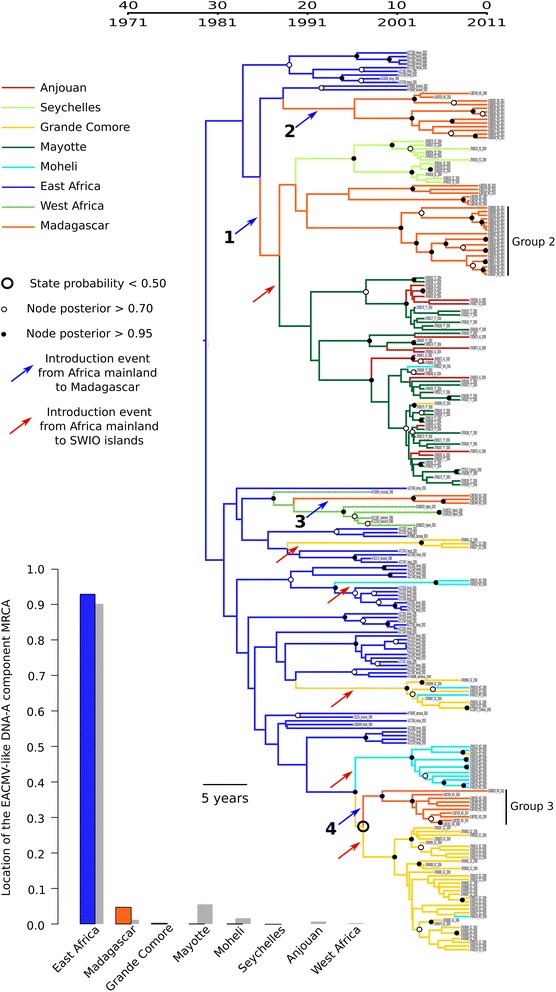
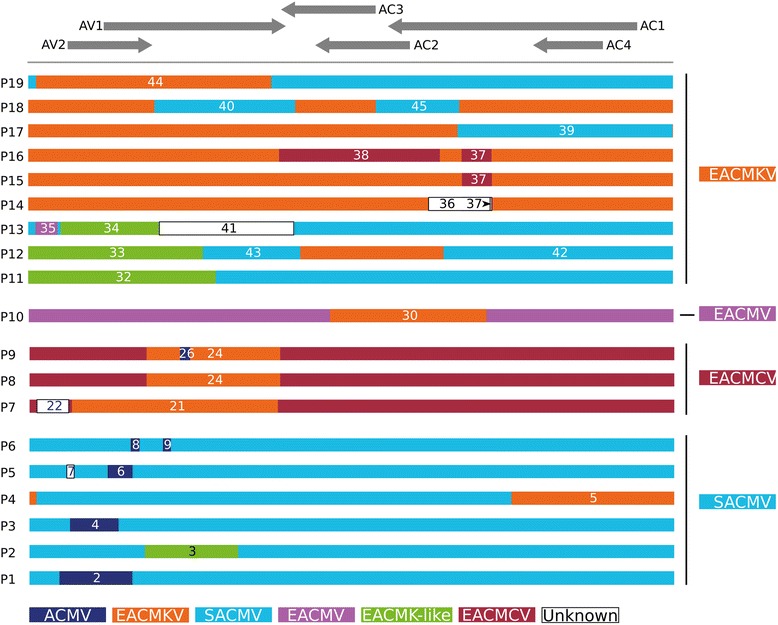
The isolation and analysis of 279 DNA-A and 117 DNA-B sequences revealed the presence in Madagascar of four prevalent CMG species (South African cassava mosaic virus, SACMV; African cassava mosaic virus, ACMV; East African cassava mosaic Kenya virus, EACMKV; and East African cassava mosaic Cameroon virus, EACMCV), and of numerous CMG recombinants that have, to date, only ever been detected on this island. SACMV and ACMV, the two most prevalent viruses, displayed low degrees of genetic diversity and have most likely been introduced to the island only once. By contrast, EACMV-like CMG populations (consisting of East African cassava mosaic virus, EAMCKV, EACMCV and complex recombinants of these) were more diverse, more spatially structured, and displayed evidence of at least three independent introductions from mainland Africa. Although there were no statistically supported virus movement events between Madagascar and the other SWIO islands, at least one mainland African ACMV variant likely originated in Madagascar.
Our study highlights both the complexity of CMD in Madagascar, and the distinct evolutionary and spatial dynamics of the different viral species that collectively are associated with this disease. Given that more distinct CMG species and recombinants have been found in Madagascar than any other similarly sized region of the world, the risks of recombinant CMG variants emerging on this island are likely to be higher than elsewhere. Evidence of an epidemiological link between Madagascan and mainland African CMGs suggests that the consequences of such emergence events could reach far beyond the shores of this island.
马达加斯加的木薯花叶病(CMD)由至少六种非洲木薯花叶双生病毒(CMG)组成的复合病毒引起。这为在同一环境中共存的不同致病作物感染病毒物种的进化和流行病学动态的比较研究提供了难得的机会。对马达加斯加CMG种群的遗传和空间结构进行了研究,并应用贝叶斯系统地理学模型在非洲大陆和其他西南印度洋(SWIO)岛屿相关种群的流行病学背景下推断马达加斯加CMG种群的起源。
对279个DNA-A和117个DNA-B序列的分离和分析表明,马达加斯加存在四种流行的CMG物种(南非木薯花叶病毒,SACMV;非洲木薯花叶病毒,ACMV;东非木薯花叶肯尼亚病毒,EACMKV;以及东非木薯花叶喀麦隆病毒,EACMCV),以及许多迄今仅在该岛检测到的CMG重组体。两种最流行的病毒SACMV和ACMV显示出低水平的遗传多样性,很可能仅被引入该岛一次。相比之下,类东非木薯花叶病毒CMG种群(由东非木薯花叶病毒,EAMCKV,EACMCV以及它们的复杂重组体组成)更加多样化,空间结构更复杂,并且显示出至少有三次从非洲大陆独立引入的证据。尽管在马达加斯加和其他SWIO岛屿之间没有统计学支持的病毒传播事件,但至少有一个非洲大陆ACMV变体可能起源于马达加斯加。
我们的研究突出了马达加斯加CMD的复杂性,以及共同导致该疾病的不同病毒物种独特的进化和空间动态。鉴于在马达加斯加发现的独特CMG物种和重组体比世界上任何其他类似规模的地区都多,该岛上出现重组CMG变体的风险可能高于其他地方。马达加斯加和非洲大陆CMG之间存在流行病学联系的证据表明,此类出现事件的后果可能远远超出该岛的范围。