
CDH1或CTNNB1表达降低影响食管癌患者的不良预后。
Decreased expression of CDH1 or CTNNB1 affects poor prognosis of patients with esophageal cancer.
作者信息
Ishiguro Hideyuki, Wakasugi Takehiro, Terashita Yukio, Sakamoto Nobuhiro, Tanaka Tatsuya, Mizoguchi Koji, Sagawa Hiroyuki, Okubo Tomotaka, Takeyama Hiromitsu
机构信息
Gastroenterological Surgery, Nagoya City University Graduate School of Medical Science, 1 Kawasumi, Mizuho-cho, Mizuho-ku, Nagoya, 467-8601, Japan.
出版信息
World J Surg Oncol. 2016 Sep 6;14(1):240. doi: 10.1186/s12957-016-0956-8.
BACKGROUND
E-cadherin/CDH1 is one of the proteins involved in cell adhesion, and it is known that decreased expression of E-cadherin induces lymph node metastasis in esophageal cancer. Beta catenin/CTNNB1, which is an important component of the Wnt signaling pathway, binds to E-cadherin at the cell membrane, where the complex of these two proteins functions in the stabilization of cell adhesion. However, its role in the pathogenesis of esophageal cancer is still unknown.
METHODS
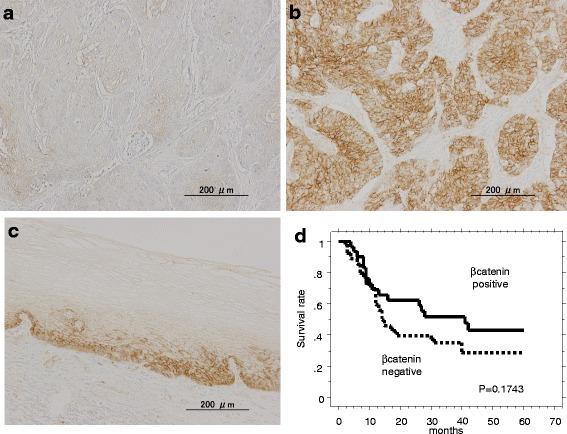
This study included 86 patients with esophageal cancer who underwent surgery between 1998 and 2007. The expression of the E-cadherin/CDH1 gene product (E-cadherin/CDH1) and that of the beta catenin/CTNNB1 protein in the cell membrane were analyzed by immunohistochemistry. We examined the correlations among CDH1 or CTNNB1 expression, clinicopathological factors, and the prognosis of patients with ESCC.
RESULTS
CDH1 and CTNNB1 were expressed in 52.3 % (45/86) and 36.0 % (31/86) of tumor samples, respectively. Both CDH1 and CTNNB1 were co-expressed in 22.1 % (19/86) of esophageal cancer tissues. CDH1 expression correlated with the p-stage (stages I-II vs stages III-IV, p = 0.032), T factor (T1-2 vs T3-4, p = 0.0088), and lymphatic invasion (p = 0.019). However, CDH1 expression did not correlate with the N factor or the blood vessel invasion. CTNNB1 expression correlated with the T factor (T1-2 vs T3-4, p = 0.0015), p-stage (stages I-II vs stages III-IV, p = 0.030), and lymphatic invasion (p = 0.007). The CDH1(+)/CTNNB1(+) phenotype was inversely correlated with the T factor, N factor, p-stage, lymphatic invasion, and blood vessel invasion. Furthermore, patients whose tumors were double-positive for CDH1 and CTNNB1 had a significantly higher survival rate than those whose tumors were negative for CDH1 or CTNNB1 (log-rank test, p = 0.0192). The T factor and N factor had a strong negative correlation with double-positive tumors. These were both independent prognostic factors, as was the double-positive phenotype. A univariate analysis indicated that the T factor, the N factor, and CDH1 and CTNNB1 co-expression were significant variables that predicted survival (hazard ratio, 2.387; 95 % confidence interval, 1.115-5.102; p = 0.025).
CONCLUSIONS
Decreased expression of CDH1 or CTNNB1 in the cell membranes of cancer cells is associated with poor survival of patients with esophageal cancer.
背景
E-钙黏蛋白/CDH1是参与细胞黏附的蛋白质之一,已知E-钙黏蛋白表达降低会诱导食管癌发生淋巴结转移。β-连环蛋白/CTNNB1是Wnt信号通路的重要组成部分,在细胞膜上与E-钙黏蛋白结合,这两种蛋白的复合物在稳定细胞黏附中发挥作用。然而,其在食管癌发病机制中的作用尚不清楚。
方法
本研究纳入了1998年至2007年间接受手术的86例食管癌患者。通过免疫组织化学分析细胞膜中E-钙黏蛋白/CDH1基因产物(E-钙黏蛋白/CDH1)和β-连环蛋白/CTNNB1蛋白的表达。我们研究了CDH1或CTNNB1表达、临床病理因素与食管鳞状细胞癌患者预后之间的相关性。
结果
肿瘤样本中CDH1和CTNNB1的表达率分别为52.3%(45/86)和36.0%(31/86)。CDH1和CTNNB1在22.1%(19/86)的食管癌组织中共同表达。CDH1表达与p分期(I-II期与III-IV期,p = 0.032)、T因子(T1-2与T3-4,p = 0.0088)和淋巴浸润(p = 0.019)相关。然而,CDH1表达与N因子或血管浸润无关。CTNNB1表达与T因子(T1-2与T3-4,p = 0.0015)、p分期(I-II期与III-IV期,p = 0.030)和淋巴浸润(p = 0.007)相关。CDH1(+)/CTNNB1(+)表型与T因子、N因子、p分期、淋巴浸润和血管浸润呈负相关。此外,肿瘤CDH1和CTNNB1均为阳性的患者生存率显著高于肿瘤CDH1或CTNNB1为阴性的患者(对数秩检验,p = 0.0192)。T因子和N因子与双阳性肿瘤呈强烈负相关。这些都是独立的预后因素,双阳性表型也是如此。单因素分析表明,T因子、N因子以及CDH1和CTNNB1的共同表达是预测生存的显著变量(风险比,2.387;95%置信区间,1.115 - 5.102;p = 0.025)。
结论
癌细胞膜中CDH1或CTNNB1表达降低与食管癌患者的不良生存相关。


 Zotero 插件