Karim Habib Md Reazaul, Yunus Md, Bhattacharyya Prithwis
Department of Anaesthesiology, Critical Care and Pain Medicine, North Eastern Indira Gandhi Regional Institute of Health and Medical Sciences, Shillong, Meghalaya, India.
Indian J Anaesth. 2016 Aug;60(8):552-9. doi: 10.4103/0019-5049.187783.
Pre-operative investigations are often required to supplement information for risk stratification and assessing reserve for undergoing surgery. Although there are evidence-based recommendations for which investigations should be done, clinical practice varies. The present study aimed to assess the pre-operative investigations and referral practices and compare it with the standard guidelines.
The present observational study was carried out during 2014-appen2015 in a teaching institute after the approval from Institute Ethical Committee. A designated anaesthesiologist collected data from the completed pre-anaesthetic check-up (PAC) sheets. Investigations already done, asked by anaesthesiologists as well as referral services sought were noted and compared with an adapted master table prepared from standard recommendations and guidelines. Data were expressed in frequencies, percentage and statistically analysed using INSTAT software (GraphPad Prism software Inc., La Zolla, USA).
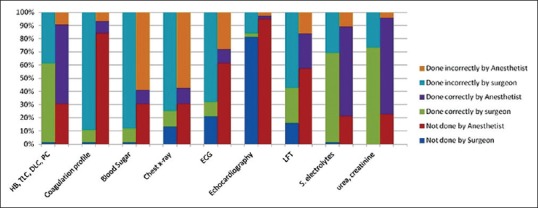
Seventy-five out of 352 patients (42.67% male, 57.33% female; American Society of Anesthesiologists physical status I to III) were included in this study. Nearly, all patients attended PAC with at least 5 investigations done. Of them, 89.33% were subjected to at least one unnecessary investigation and 91.67% of the referral services were not required which lead to 3.5 ( SD ±1.64) days loss. Anaesthesiologist-ordered testing was more focused than surgeons.
More than two-third of pre-operative investigations and referral services are unnecessary. Anaesthesiologists are relatively more rational in ordering pre-operative tests yet; a lot can be done to rationalise the practice as well as reducing healthcare cost.
术前检查通常用于补充信息,以进行风险分层并评估手术耐受性。尽管对于应进行哪些检查有循证医学建议,但临床实践仍存在差异。本研究旨在评估术前检查及转诊情况,并与标准指南进行比较。
本观察性研究于2014年至2015年在一所教学机构进行,经机构伦理委员会批准。由指定的麻醉医师从完成的麻醉前检查表(PAC)中收集数据。记录已完成的检查、麻醉医师要求进行的检查以及寻求的转诊服务,并与根据标准建议和指南编制的适配主表进行比较。数据以频率、百分比表示,并使用INSTAT软件(美国拉霍亚GraphPad Prism软件公司)进行统计分析。
352例患者中的75例(男性占42.67%,女性占57.33%;美国麻醉医师协会身体状况分级为I至III级)纳入本研究。几乎所有患者都至少进行了5项检查。其中,89.33%的患者接受了至少一项不必要的检查,91.67%的转诊服务并不必要,这导致了3.5(标准差±1.64)天的时间损失。麻醉医师要求的检查比外科医师更具针对性。
超过三分之二的术前检查和转诊服务是不必要的。麻醉医师在开具术前检查单方面相对更为合理;然而,在使实践合理化以及降低医疗成本方面仍有很多工作要做。