Jim On Shelbi C, Knudsen Kim Mark, Skov Torsten, Lebwohl Mark
Department of Dermatology, Mount Sinai School of Medicine, New York, NY, USA.
LEO Pharma A/S, Biostatistics, Ballerup, Denmark.
Clin Cosmet Investig Dermatol. 2016 Aug 24;9:211-6. doi: 10.2147/CCID.S113044. eCollection 2016.
Ingenol mebutate gel is a topical field treatment for actinic keratosis (AK). The treatment elicits application-site reactions in most patients. This analysis evaluated the relationship between the severity of reactions and the speed of their resolution.
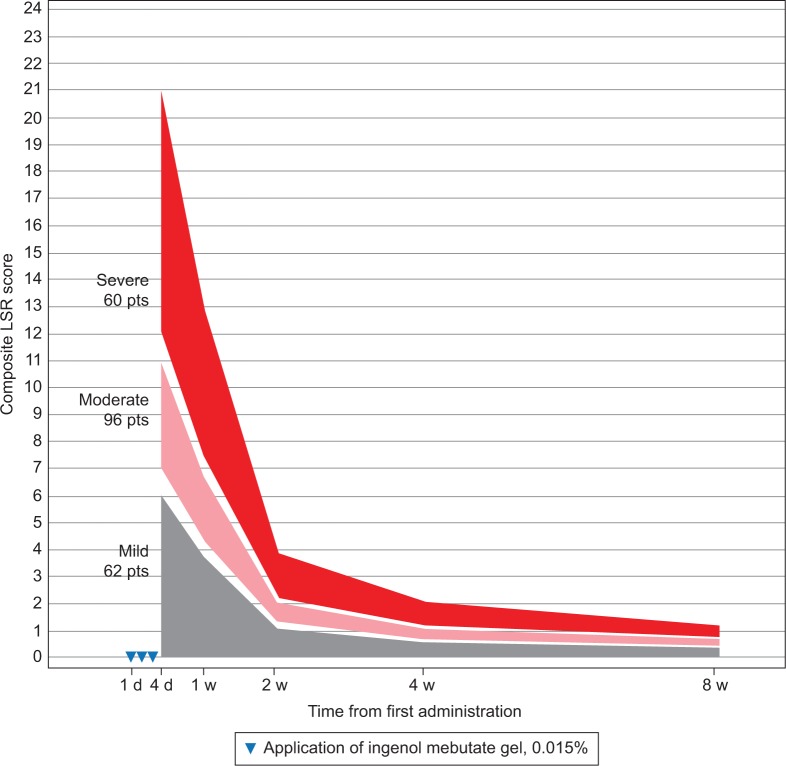
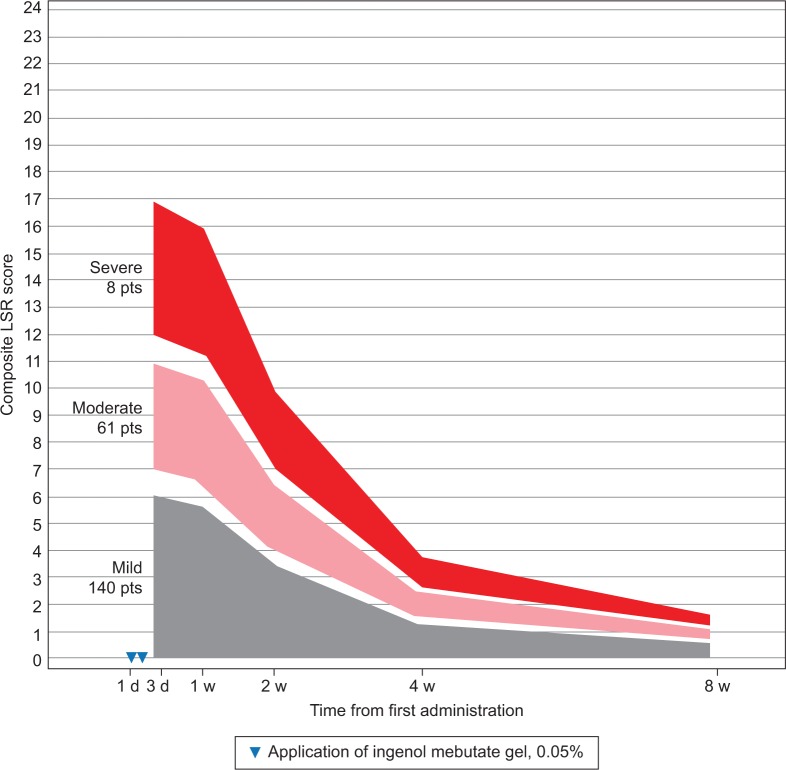
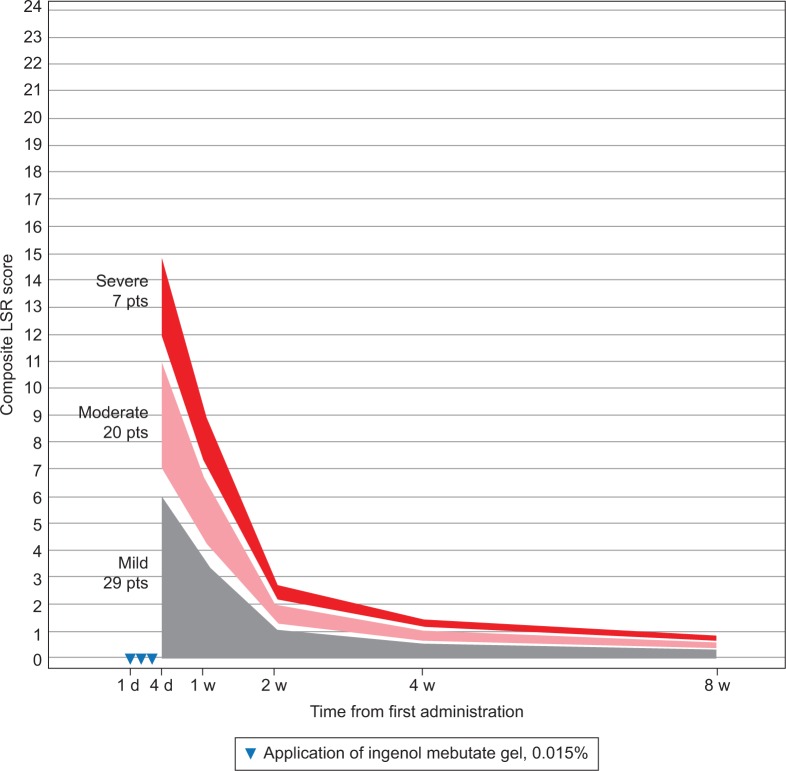
Patients in Phase III studies were treated for AKs on the face (n=218), scalp (n=56), and trunk and extremities (n=209). All of the patients were treated with either ingenol mebutate gel 0.015% once daily for three consecutive days (face/scalp) or ingenol mebutate gel 0.05% once daily for two consecutive days (trunk/extremities). Local skin reactions (LSRs) were assessed on a 5-point scale from 0 to 4 in six categories, yielding composite scores in the range of 0 to 24.
The composite LSR score on the day after the last application of ingenol mebutate gel was an important predictor of the speed of resolution of LSRs. The rate of resolution was greatest for AKs treated on the face, followed by the scalp, and then the trunk and extremities. All patients were expected to have minimal LSR scores for the face and scalp at 2 weeks, and for the trunk and extremities at 4 weeks.
The absolute reduction in LSR scores was proportional to the composite LSR score on the day after the last application of ingenol mebutate gel treatment. The rate of resolution for LSRs was dependent on the anatomic site treated as well as the day 4 composite score.
咪喹莫特凝胶是一种用于光化性角化病(AK)的局部外用治疗药物。该治疗在大多数患者中会引发用药部位反应。本分析评估了反应严重程度与其消退速度之间的关系。
III期研究中的患者接受面部(n = 218)、头皮(n = 56)以及躯干和四肢(n = 209)的AK治疗。所有患者均接受以下治疗:面部/头皮使用0.015%咪喹莫特凝胶,每日一次,连续三天;或躯干/四肢使用0.05%咪喹莫特凝胶,每日一次,连续两天。局部皮肤反应(LSR)按0至4分的5级量表在六个类别中进行评估,得出的综合评分范围为0至24分。
最后一次使用咪喹莫特凝胶后次日的LSR综合评分是LSR消退速度的重要预测指标。面部治疗的AK的消退速度最快,其次是头皮,然后是躯干和四肢。预计所有患者在2周时面部和头皮的LSR评分最低,在4周时躯干和四肢的LSR评分最低。
LSR评分的绝对降低与最后一次使用咪喹莫特凝胶治疗后次日的LSR综合评分成正比。LSR的消退速度取决于治疗的解剖部位以及第4天的综合评分。