Taylor Sabrina R, Smith Colin M, Keeley Kristen L, McGuone Declan, Dodge Carter P, Duhaime Ann-Christine, Costine Beth A
Department of Physical Medicine and Rehabilitation, Spaulding Rehabilitation Hospital Charlestown, MA, USA.
Brain Trauma Lab, Department of Neurosurgery, Massachusetts General Hospital Boston, MA, USA.
Front Neurosci. 2016 Aug 23;10:387. doi: 10.3389/fnins.2016.00387. eCollection 2016.
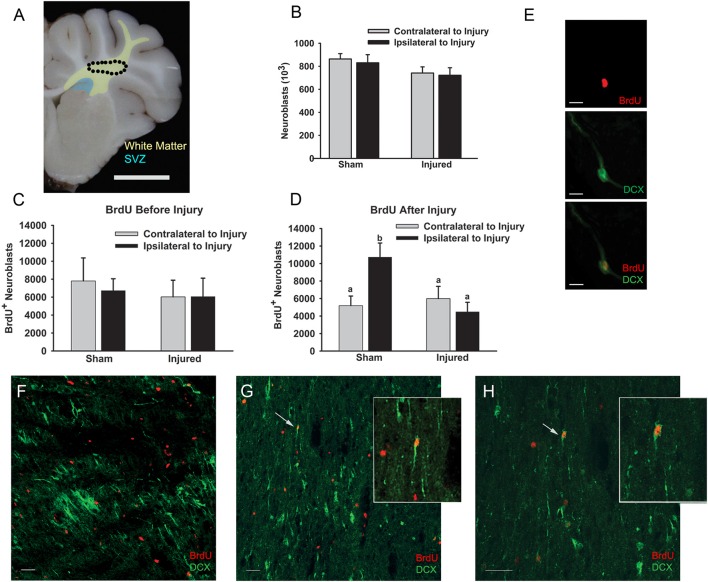
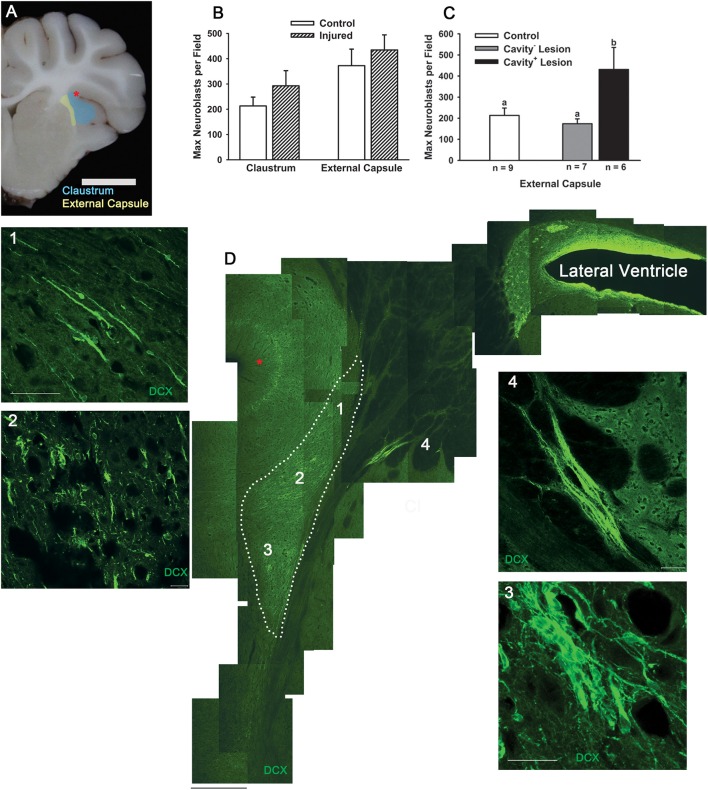
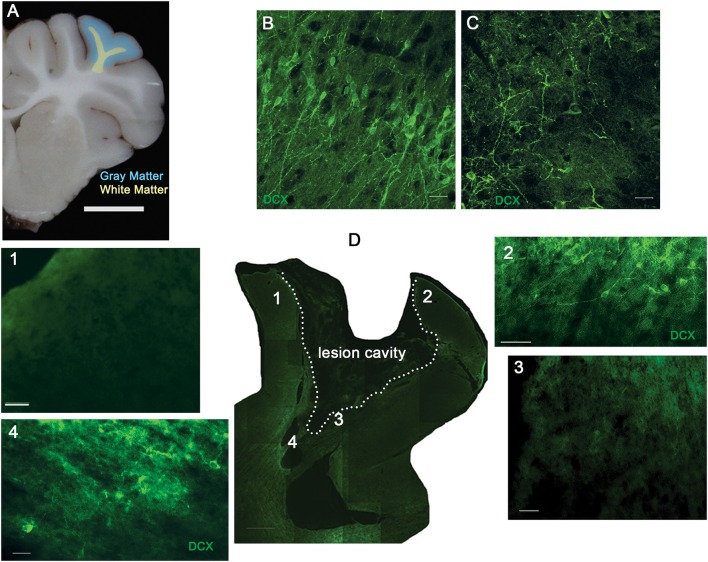
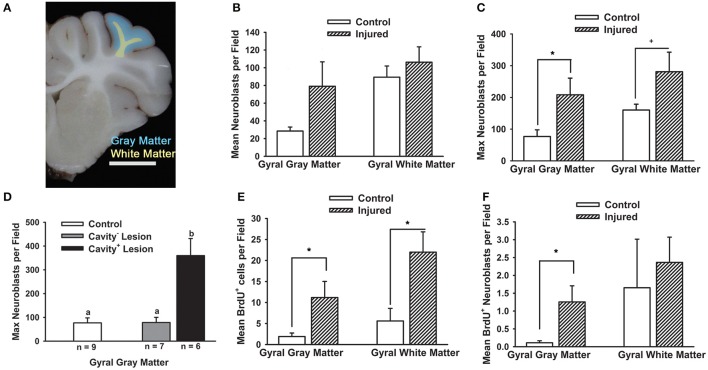
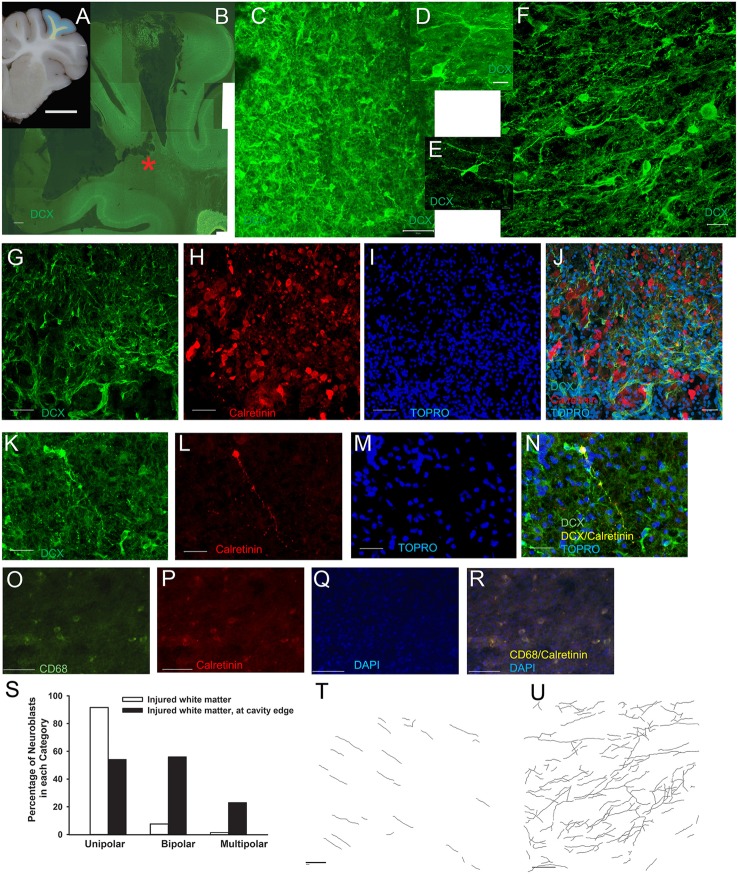
Cortical contusions are a common type of traumatic brain injury (TBI) in children. Current knowledge of neuroblast response to cortical injury arises primarily from studies utilizing aspiration or cryoinjury in rodents. In infants and children, cortical impact affects both gray and white matter and any neurogenic response may be complicated by the large expanse of white matter between the subventricular zone (SVZ) and the cortex, and the large number of neuroblasts in transit along the major white matter tracts to populate brain regions. Previously, we described an age-dependent increase of neuroblasts in the SVZ in response to cortical impact in the immature gyrencephalic brain. Here, we investigate if neuroblasts target the injury, if white matter injury influences repair efforts, and if postnatal population of brain regions are disrupted. Piglets received a cortical impact to the rostral gyrus cortex or sham surgery at postnatal day (PND) 7, BrdU 2 days prior to (PND 5 and 6) or after injury (PND 7 and 8), and brains were collected at PND 14. Injury did not alter the number of neuroblasts in the white matter between the SVZ and the rostral gyrus. In the gray matter of the injury site, neuroblast density was increased in cavitated lesions, and the number of BrdU(+) neuroblasts was increased, but comprised less than 1% of all neuroblasts. In the white matter of the injury site, neuroblasts with differentiating morphology were densely arranged along the cavity edge. In a ventral migratory stream, neuroblast density was greater in subjects with a cavitated lesion, indicating that TBI may alter postnatal development of regions supplied by that stream. Cortical impact in the immature gyrencephalic brain produced complicated and variable lesions, increased neuroblast density in cavitated gray matter, resulted in potentially differentiating neuroblasts in the white matter, and may alter the postnatal population of brain regions utilizing a population of neuroblasts that were born prior to PND 5. This platform may be useful to continue to study potential complications of white matter injury and alterations of postnatal population of brain regions, which may contribute to the chronic effects of TBI in children.
皮质挫伤是儿童常见的创伤性脑损伤(TBI)类型。目前关于神经母细胞对皮质损伤反应的认识主要来自于利用啮齿动物进行抽吸或冷冻损伤的研究。在婴儿和儿童中,皮质撞击会影响灰质和白质,并且任何神经源性反应可能会因脑室下区(SVZ)和皮质之间大片的白质以及沿主要白质束迁移以填充脑区的大量神经母细胞而变得复杂。此前,我们描述了未成熟脑回脑皮质撞击后SVZ中神经母细胞数量随年龄的增加。在此,我们研究神经母细胞是否靶向损伤部位、白质损伤是否影响修复过程以及出生后脑区的细胞群是否受到破坏。仔猪在出生后第7天接受对额回皮质的撞击或假手术,在损伤前2天(出生后第5天和第6天)或损伤后(出生后第7天和第8天)注射溴脱氧尿苷(BrdU),并在出生后第14天收集大脑。损伤并未改变SVZ和额回之间白质中神经母细胞的数量。在损伤部位的灰质中,空洞性病变处神经母细胞密度增加,BrdU(+)神经母细胞数量增加,但占所有神经母细胞的比例不到1%。在损伤部位的白质中,具有分化形态的神经母细胞沿空洞边缘密集排列。在腹侧迁移流中,有空洞性病变的受试者神经母细胞密度更高,表明TBI可能会改变该迁移流所供应区域的出生后发育。未成熟脑回脑的皮质撞击产生了复杂多变的病变,空洞性灰质中神经母细胞密度增加,白质中出现了可能正在分化的神经母细胞,并且可能会改变利用出生后第5天之前出生的神经母细胞群的脑区出生后细胞群。该平台可能有助于继续研究白质损伤的潜在并发症以及脑区出生后细胞群的改变,这可能有助于解释TBI对儿童的慢性影响。