
初始内镜止血后影响慢性肾脏病患者消化性溃疡出血结局的危险因素:一项全国性队列研究。
Risk factors influencing the outcome of peptic ulcer bleeding in chronic kidney disease after initial endoscopic hemostasis: A nationwide cohort study.
作者信息
Liang Chih-Ming, Hsu Chien-Ning, Tai Wei-Chen, Yang Shih-Cheng, Wu Cheng-Kun, Shih Chih-Wei, Ku Ming-Kun, Yuan Lan-Ting, Wang Jiunn-Wei, Tseng Kuo-Lun, Sun Wei-Chih, Hung Tsung-Hsing, Nguang Seng-Howe, Hsu Pin-I, Wu Deng-Chyang, Chuah Seng-Kee
机构信息
Division of Hepatogastroenterology, Department of Internal Medicine Department of Pharmacy, Kaohsiung Gang Gung Memorial Hospital, Kaohsiung School of Pharmacy, Kaohsiung Medical University, Kaohsiung Chang Gung University, College of Medicine, Kaohsiung Division of Hepatogastroenterology, Department of Internal Medicine, Chiayi Chang Gung Memorial Hospital, Chiayi Division of Gastroenterology, Fu-Ying University Hospital, Pin-Tung Divisions of Gastroenterology, Yuan General Hospital, Kaohsiung Division of Gastroenterology, Department of Internal Medicine, Kaohsiung Medical University Hospital, and Kaohsiung Municipal Ta-Tung Hospital, Kaohsiung Division of Gastroenterology, Department of Internal Medicine, Kaohsiung Veterans General Hospital, National Yang-Ming University, Kaohsiung Division of Gastroenterology; Department of Medicine, Dalin Tzu Chi Hospital, Buddhist Tzu Chi Medical Foundation, Chiayi Division of Gastroenterology; Pin-Tung Christian Hospital, Pin-Tung, Taiwan.
出版信息
Medicine (Baltimore). 2016 Sep;95(36):e4795. doi: 10.1097/MD.0000000000004795.
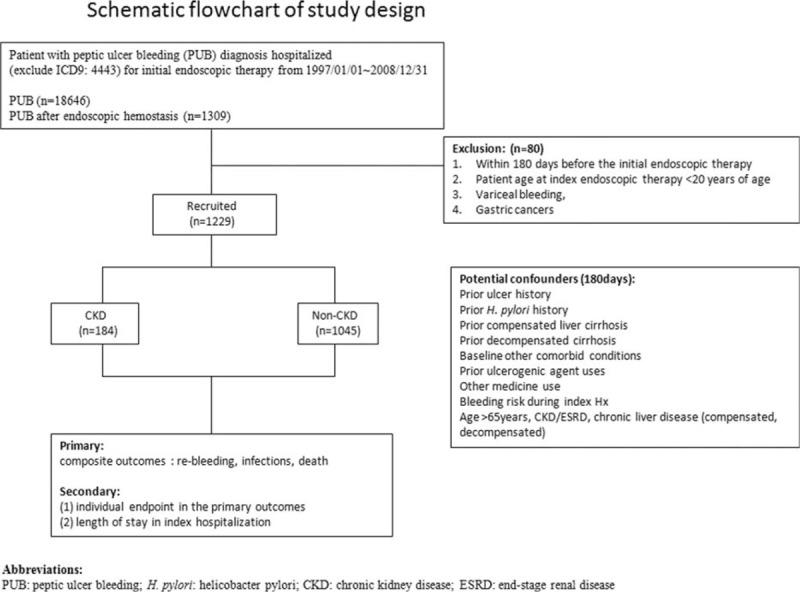
Patients with chronic kidney disease (CKD) who had peptic ulcer bleeding (PUB) may have more adverse outcomes. This population-based cohort study aimed to identify risk factors that may influence the outcomes of patients with CKD and PUB after initial endoscopic hemostasis. Data from 1997 to 2008 were extracted from the National Health Insurance Research Database in Taiwan. We included a cohort dataset of 1 million randomly selected individuals and a dataset of patients with CKD who were alive in 2008. A total of 18,646 patients with PUB were screened, and 1229 patients admitted for PUB after endoscopic hemostasis were recruited. The subjects were divided into non-CKD (n = 1045) and CKD groups (n = 184). We analyzed the risks of peptic ulcer rebleeding, sepsis events, and mortality among in-hospital patients, and after discharge. Results showed that the rebleeding rates associated with repeat endoscopic therapy (11.96% vs 6.32%, P = 0.0062), death rates (8.7%, vs 2.3%, P < 0.0001), hospitalization cost (US$ 5595±7200 vs US$2408 ± 4703, P < 0.0001), and length of hospital stay (19.6 ± 18.3 vs 11.2 ± 13.1, P < 0.0001) in the CKD group were higher than those in the non-CKD group. The death rate in the CKD group was also higher than that in the non-CKD group after discharge. The independent risk factor for rebleeding during hospitalization was age (odds ratio [OR], 1.02; P = 0.0063), whereas risk factors for death were CKD (OR, 2.37; P = 0.0222), shock (OR, 2.99; P = 0.0098), and endotracheal intubation (OR, 5.31; P < 0.0001). The hazard ratio of rebleeding risk for aspirin users after discharge over a 10-year follow-up period was 0.68 (95% confidence interval [CI]: 0.45-0.95, P = 0.0223). On the other hand, old age (P < 0.0001), CKD (P = 0.0090), diabetes (P = 0.0470), and congestive heart failure (P = 0.0013) were the independent risk factors for death after discharge. In-hospital patients with CKD and PUB after endoscopic therapy had higher recurrent bleeding, infection, and mortality rates, and the need for second endoscopic therapy. Age was the independent risk factor for recurrent bleeding during hospitalization. After being discharged with a 10-year follow-up period, nonaspirin user was a significant factor for recurrent bleeding.
患有消化性溃疡出血(PUB)的慢性肾脏病(CKD)患者可能会有更多不良结局。这项基于人群的队列研究旨在确定在初次内镜止血后可能影响CKD和PUB患者结局的危险因素。1997年至2008年的数据取自台湾国民健康保险研究数据库。我们纳入了一个由100万随机选择个体组成的队列数据集以及2008年仍存活的CKD患者数据集。总共筛查出18646例PUB患者,招募了1229例在内镜止血后因PUB入院的患者。将受试者分为非CKD组(n = 1045)和CKD组(n = 184)。我们分析了住院患者及出院后消化性溃疡再出血、脓毒症事件和死亡的风险。结果显示,CKD组与重复内镜治疗相关的再出血率(11.96%对6.32%,P = 0.0062)、死亡率(8.7%对2.3%,P<0.0001)、住院费用(5595±7200美元对2408±4703美元,P<0.0001)以及住院时间(19.6±18.3对11.2±13.1,P<0.0001)均高于非CKD组。CKD组出院后的死亡率也高于非CKD组。住院期间再出血的独立危险因素是年龄(比值比[OR],1.02;P = 0.0063),而死亡的危险因素是CKD(OR,2.37;P = 0.0222)、休克(OR,2.99;P = 0.0098)和气管插管(OR,5.31;P<0.0001)。在10年随访期内,出院后阿司匹林使用者再出血风险的风险比为0.68(95%置信区间[CI]:0.45 - 0.95,P = 0.0223)。另一方面,高龄(P<0.0001)、CKD(P = 0.0090)、糖尿病(P = 0.0470)和充血性心力衰竭(P = 0.0013)是出院后死亡的独立危险因素。内镜治疗后住院的CKD和PUB患者有更高的再出血、感染和死亡率,以及二次内镜治疗的需求。年龄是住院期间再出血的独立危险因素。在出院并经过10年随访期后,非阿司匹林使用者是再出血的一个重要因素。


 Zotero 插件